
From Startups to Enterprises: How Kona HR Scales HR Solutions Without the Complexity 2026
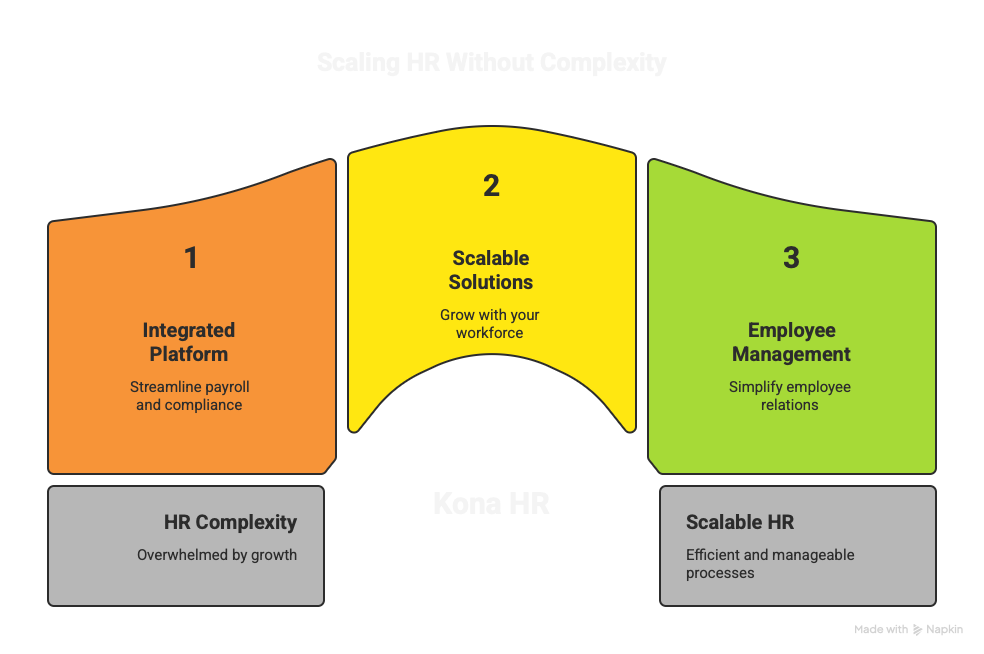
Your business is growing fast. One day you’re a tight-knit team of fifteen people, and the next thing you know, you’re managing a hundred-plus workforce spread across multiple locations. But here’s the catch: as your company scales, your HR processes shouldn’t become a nightmare.
This is where most businesses stumble. Founders who thrived managing everything in spreadsheets suddenly find themselves drowning in compliance paperwork, payroll complications, and employee management headaches. They try to piece together different tools, hire hastily, and often end up with systems that fall apart the moment they need them most.
The real challenge? Finding HR solutions that actually grow with you—without adding complexity at every step.
The Startup Paradox: Speed Versus Systems
When you’re launching a startup, speed is oxygen. You move fast, make decisions quickly, and adapt on the fly. Your founding team wears a thousand hats. The person handling customer relationships on Monday is managing payroll on Tuesday and recruiting on Wednesday.
This scrappy approach works brilliantly in the early days. Your team is small enough that everyone knows everything. Communication is direct. Culture happens naturally because you’re literally sitting together. But there’s a hidden cost to this flexibility—it’s unsustainable.
According to recent research, startups moving fast also scale their teams just as quickly. And when that happens, the lack of formal HR systems becomes painfully apparent. Onboarding that used to take one conversation now requires juggling five departments and two time zones. That spreadsheet tracking employee information? It’s now a patchwork of conflicting versions across different devices. And compliance? That’s the whispered worry nobody talks about until something goes wrong.
One founder reported spending over 30% of their weekly hours just on HR paperwork—time that could have gone into product development, fundraising, or actually running the business.
The startup paradox is this: the very flexibility that makes startups nimble becomes their greatest liability as they scale.
The Middle Ground Problem: When Generic Solutions Break Down
Now imagine you’ve survived the startup phase. You’ve hit 50 employees. You’ve raised funding. You have actual departments with titles and reporting structures. You think you’ve made it past the chaos.
Then you realize your one-size-fits-all HR software doesn’t work for you anymore.
This is the middle ground where most businesses struggle. You’re too complex for generic solutions, but not large enough to justify hiring a dedicated 15-person HR department. You have multiple office locations, each with different compliance requirements. You have part-time contractors, full-time employees, and seasonal workers all competing for the same benefits. Your sales team needs different performance metrics than your engineering team.
Small and mid-sized businesses report that retaining key talent (60%) and hiring qualified employees (56%) are their two biggest concerns. Yet more than one-third of these companies are using virtually no HR technology or are operating at the foundational level with just payroll and basic record-keeping.
The gap between where they are and where they need to be is massive—but it’s not because they don’t want better HR solutions. It’s because generic HR software treats their unique challenges as edge cases, not the core business.
Enterprise Complexity: The Opposite Problem
Skip forward five more years. Now you’re an enterprise with 500+ employees across multiple countries. You might think you’ve “solved” the HR problem by having a dedicated HR department and sophisticated systems.
But enterprise HR has its own set of brutal complexities. Managing compliance across different jurisdictions means staying current with labor laws that change constantly. Benefits administration becomes a nightmare when you’re negotiating with insurance providers across different regions. Performance management systems that seemed reasonable at 100 people become bureaucratic nightmares at 1,000.
Large organizations struggle with a different problem: speed. Implementing even small changes to HR programs can take months or even years to execute. The very systems that prevent chaos also create bottlenecks. Flexibility dies in the name of standardization. But this uniformity often ignores legitimate business differences—between departments, between roles, between regions.
What Truly Matters: The Three Core HR Challenges Across All Company Sizes
Whether you’re a startup of 10, a mid-market company of 200, or an enterprise of 2,000, three core HR challenges persist:
Challenge #1: Talent Acquisition and Retention at Scale
Every company fights the same battle: finding great people and keeping them. But the specifics change dramatically by company size.
Startups struggle with limited employer branding and competing against remote-first global firms. They can’t afford long recruitment cycles or bad hires that drain runway. Small and mid-sized businesses compete with larger companies for the same talent pool while offering less structured career paths. Enterprises face the opposite problem—they have the resources to hire, but maintaining engagement and preventing burnout across a massive workforce requires sophisticated approaches.
The key insight here is that talent challenges aren’t just HR problems—they’re business problems. They affect your fundraising (investors want to see professional HR infrastructure as a sign of operational readiness), your growth, and ultimately your ability to execute your business strategy.
Challenge #2: Compliance Without Overwhelming Your Team
Labor laws are getting more complicated, not simpler. Whether it’s payroll taxes, benefits regulations, employment classifications, or regional mandates, staying compliant requires constant attention.
For startups, a single compliance mistake can mean penalties that derail growth plans. For mid-market companies, the sheer volume of compliance requirements across multiple jurisdictions creates constant stress. For enterprises, maintaining compliance while innovating in HR practices feels like pushing water uphill.
What compounds this challenge is that compliance keeps evolving. Remote work changed everything about compliance and tax jurisdictions. ESG mandates are adding new requirements. And every company, regardless of size, is operating with limited time and expertise to stay on top of it all.
Challenge #3: Systems That Actually Communicate With Each Other
Here’s the painful truth: most companies run HR on spreadsheets and disconnected software systems. Your payroll system doesn’t talk to your benefits system. Your performance management system is separate from your recruiting system. Onboarding happens in one tool, and then the data needs to be manually entered into another.
This fragmentation creates errors, wastes time, and makes it impossible to get a clear picture of your workforce. Startups lose productivity. Mid-market companies waste HR team bandwidth on data entry and reconciliation. Enterprises maintain costly workarounds to make systems communicate.
Why Generic HR Solutions Fail
Standard HR software is built for the typical company—which means it doesn’t work well for the atypical ones. But here’s the thing: most companies are atypical in ways that matter to them.
Your sales organization has different needs than your operations team. Your customer-facing roles need different development than your backend engineering roles. If you’re global, your Tokyo office doesn’t have the same compliance requirements as your Austin office.
Generic HR solutions treat these differences as outliers. They offer limited customization. When you need something specific, you’re stuck either doing workarounds (manual spreadsheets, external tools) or moving to an overly complex enterprise system that requires hiring specialists just to manage it.
The result? Companies get stuck in a system that’s almost right—which is infinitely worse than a system that’s clearly wrong, because almost-right systems fail in unpredictable ways.
The Kona HR Approach: Scaling Without Complexity
This is where Kona HR’s philosophy stands apart. Instead of forcing you into a template, Kona HR builds solutions that actually fit your business.
Understanding Your Actual Business
Kona HR starts with a fundamental premise: every business is unique. What works for a tech startup won’t work for a financial services firm. What works for a 50-person company won’t work for a 500-person company. And what works for one department within your company might not work for another.
This isn’t abstract thinking—it’s built on decades of experience working with clients of all sizes. That experience means Kona HR understands not just HR theory, but the reality of how different industries, different company stages, and different business models actually operate.
Combining Technology With Human Expertise
Here’s where most HR solutions get it wrong: they’re either pure technology (great automation, terrible understanding of your business) or pure consulting (great expertise, terrible scalability).
Kona HR combines both. The technology automates repetitive tasks, ensures consistency, and creates visibility. But that technology is overlaid with actual HR expertise that understands your specific situation.
This matters because the best HR decisions require both elements. You need systems that can handle payroll for 500 people across multiple countries automatically. But you also need someone who understands your company’s culture, your competitive dynamics, and your strategic goals to help you design compensation structures, benefits packages, and retention strategies that actually work.
Customization That Doesn’t Break Scalability
The trap of customization is that every custom solution becomes a snowflake—unique, beautiful, and impossible to scale or modify when your business changes.
Kona HR avoids this by building customization within a framework. They provide modular solutions that can be configured for your specific needs without requiring a complete overhaul every time your business evolves.
This matters at every growth stage. For startups, it means you can start lean (maybe just payroll and onboarding) and add features as you grow. For mid-market companies, it means you can have different configurations for different departments or regions, while maintaining a unified system. For enterprises, it means you can standardize core processes while allowing for necessary flexibility.
Real-World Scaling: The Three Growth Stages
To make this concrete, let’s walk through what scaling HR actually looks like in practice.
Stage 1: Startup (1-50 People)
The Challenge: Your founder is handling recruitment in coffee meetings. You have a spreadsheet for employee records. You’re not sure if you’re compliant with labor laws. Onboarding is inconsistent. You’re hiring so fast you’re not sure who reports to whom.
What You Need: A system that removes manual overhead without being overkill. You need basic payroll, onboarding workflows, and employee records management. You need compliance tracking so you don’t accidentally violate regulations. You need just enough structure to maintain your culture while establishing clear processes.
The Kona Approach: Kona HR helps you establish foundational systems without bureaucracy. They implement payroll that handles your specific compensation structure (maybe you have contractor, full-time, and part-time employees). They build onboarding workflows that reflect your culture and your role requirements. They help you understand compliance requirements for your industry and location. The result: you have professional HR infrastructure that investors recognize as a sign you’re ready to scale.
Stage 2: Growth (50-300 People)
The Challenge: You now have multiple departments, multiple office locations, and maybe your first international hire. Your generic HR software is starting to break. You’re adding complexity faster than your current systems can handle. Your founders can no longer handle HR alongside their regular jobs. You need a dedicated HR person, but you’re not big enough for a full HR department.
What You Need: Systems that handle complexity without overwhelming you. You need benefits administration that works for your varied workforce. You need performance management that’s fair across departments. You need compliance tracking across multiple jurisdictions. You need visibility into your workforce that helps you make strategic decisions (not just operational decisions).
The Kona Approach: Kona HR customizes solutions for your specific structure. If you have a unique benefits need (maybe you want to offer different benefits for part-time vs. full-time employees), they build that. If you’re operating in multiple countries, they handle the compliance complexity. If you need different performance management approaches for different departments, they set that up. The key is that they do this without creating custom workarounds—everything fits within a unified system that actually works.
Stage 3: Enterprise (300+ People)
The Challenge: You have sophisticated HR processes, but they’re also bureaucratic and slow. Change takes months to implement. You’re operating in multiple countries with different regulations. Your HR team has grown, but they spend more time managing systems than supporting the business. You need flexibility to innovate in HR practice while maintaining consistency and compliance.
What You Need: Systems that balance standardization with flexibility. You need global compliance across multiple jurisdictions. You need performance management that’s rigorous but not soul-crushing. You need benefits administration that works across different employment models. You need to be able to experiment and innovate with HR programs without derailing your entire system.
The Kona Approach: Kona HR helps enterprises break through the rigidity that comes with scale. They can design core standardized processes that apply everywhere, while allowing for necessary customization in specific markets or departments. They help you implement new HR initiatives without requiring a full system overhaul. They provide the combination of technology efficiency and human expertise that allows enterprises to innovate rather than just maintain.
The Business Impact: Why This Matters
Treating HR as a strategic investment rather than a compliance burden changes business outcomes.
Companies that implement customized HR solutions see measurable improvements. In one case study, a mid-sized tech firm that implemented tailored training programs, flexible work arrangements, and personalized recognition saw employee turnover drop by 25% and engagement scores increase by 40%. A global retail chain that customized its HR systems achieved a 20% reduction in scheduling conflicts, a 30% increase in workforce satisfaction, and significant cost savings in seasonal worker retention.
These aren’t marginal improvements. These are transformational business outcomes.
Why does this happen? Because HR is the most direct way you control your most valuable asset—your people. Generic HR solutions treat people management as a standard process. Customized HR solutions recognize that your people are your competitive advantage, and the way you attract, develop, and retain them should reflect that strategic importance.
The Kona HR Difference: Decades of Experience Meets Cutting-Edge Solutions
What sets Kona HR apart is that they combine two things that are surprisingly rare in HR services:
First, deep expertise across company sizes and industries. They’ve worked with everyone from startups to enterprises, from tech companies to manufacturing firms. That’s not just resume padding—it means they’ve actually solved the problems your company is facing. They understand what works and what doesn’t, not from theory but from experience.
Second, a commitment to customization without overcomplication. They don’t force you into templates. They don’t sell you features you don’t need. They build solutions that scale with you, not solutions that break under their own weight.
Moving Forward: The First Steps
If you’re reading this and thinking, “Yes, this is exactly the problem we’re facing,” the starting point isn’t complicated.
The first step is an honest assessment of where your current H R systems are working and where they’re breaking down. Are you losing people to bigger companies? Are compliance issues keeping you up at night? Are your systems creating more work than they’re solving? Is your founder spending hours on H R tasks that should be automated?
From there, the next step is talking to someone who understands your specific situation. Not a generic H R software salesperson selling the same product to every company. Someone who will ask questions about your industry, your structure, your goals, and your challenges.
The companies that thrive aren’t the ones with the most sophisticated H R systems. They’re the ones with H R systems that fit. Systems that remove the friction of growing. Systems that let you focus on building your business instead of managing H R chaos.
That’s the Kona H R philosophy: combine customized solutions with decades of experience to help companies scale without complexity.
Because growth shouldn’t require chaos. And scaling shouldn’t mean compromising on the way you treat your people.
Ready to explore how Kona H R can customize H R solutions for your specific growth stage? Reach out to discuss how decades of experience combined with cutting-edge customization can help your company scale intelligently.


One Comment