
From Vision to Impact: WoeBot Health’s Journey to Becoming the World’s Most Innovative Digital Health Company 2026
Introduction
The global mental health crisis has reached unprecedented levels. The World Health Organization estimates that over 280 million people suffer from depression worldwide, yet access to quality mental health care remains profoundly inequitable. In many regions, patients face years-long waiting lists to see a therapist, while others lack any meaningful access to professional mental health support. Against this backdrop of systemic failure, one company has emerged as a transformative force: WoeBot Health. Founded in 2017 by clinical research psychologist Dr. Alison Darcy, WoeBot Health represents a paradigm shift in how artificial intelligence and psychological science converge to address one of the world’s most pressing health challenges.
Today, WoeBot Health stands as a beacon of innovation in digital therapeutics, recognized by Newsweek as one of the world’s best digital health companies and powered by over $123 million in venture funding. More than 1.5 million people across 120 countries have engaged with Woebot, the company’s proprietary AI-powered relational agent, which has delivered 74 million minutes of evidence-based mental health support. This is not merely a success story of technological advancement; it is a transformative narrative about how vision, scientific rigor, and human-centered design can fundamentally reshape healthcare delivery. This comprehensive exploration traces WoeBot Health’s remarkable journey from concept to global impact, illuminating the strategic decisions, clinical innovations, and forward-thinking vision that have positioned the company as a leader in the digital health revolution.
The Genesis: A Bold Vision for Accessible Mental Health
Dr. Alison Darcy’s journey to founding WoeBot Health reflects a unique convergence of psychology, technology, and unwavering purpose. A clinical research psychologist trained at the University College Dublin and Stanford School of Medicine, Darcy spent years studying the intersection of human psychology and technology before recognizing a profound gap in mental health care delivery. Her vision was deceptively simple yet radically ambitious: if AI could be designed with psychological principles at its core, it could democratize access to evidence-based mental health interventions that had previously been confined to the exclusive domain of licensed clinicians.
In 2017, Darcy launched WoeBot Health with a team of psychologists and AI experts at Stanford, including collaboration with pioneering AI researcher Andrew Ng. The founding principle was clear—mental health support should be radically accessible, available 24/7, and designed to meet people where they were: on their phones, in moments of crisis, or between therapy appointments. This was not about replacing human therapists; rather, it was about creating a complementary tool that could bridge the massive gap between demand for mental health support and the finite supply of trained clinicians.
The timing was crucial. As digital health adoption accelerated and smartphones became ubiquitous, the company recognized that technology could transcend traditional barriers to care: geography, cost, stigma, and time constraints. WoeBot Health positioned itself not as a technology company accidentally entering healthcare, but as a clinical organization that embedded artificial intelligence as a means to an end—better mental health outcomes at scale.
The Technology: Relational AI at the Heart of Innovation
At the core of WoeBot Health’s innovation lies Woebot, a sophisticated relational agent powered by natural language processing (NLP) and machine learning. What distinguishes Woebot from generic AI chatbots is its foundation in clinical psychology and therapeutic alliance—a concept long thought to be achievable only through human-to-human interaction.
The Therapeutic Bond: In 2021, WoeBot Health published landmark peer-reviewed research demonstrating that Woebot could establish a genuine therapeutic bond with users, comparable to those formed between patients and human therapists. This finding challenged a core assumption in mental health care and opened new possibilities for scalable interventions. Users reported that Woebot was relatable, empathetic, and genuinely responsive to their emotional states—not because of sophisticated language generation alone, but because the platform was meticulously designed by clinical experts who understood the nuances of therapeutic relationships.
Evidence-Based Clinical Design: Every interaction within Woebot is grounded in decades of peer-reviewed clinical research. The platform incorporates principles from cognitive behavioral therapy (CBT), interpersonal therapy (IPT), dialectical behavior therapy (DBT), and motivational interviewing. When a user shares their thoughts and feelings, Woebot’s NLP algorithms interpret intent and recommend the most appropriate therapeutic technique for that precise moment. Conversations are crafted by clinical experts and conversational writers working collaboratively, ensuring that every response feels natural while maintaining clinical integrity.
Safety and Responsible AI: WoeBot Health has established itself as a leader in responsible AI deployment within healthcare. The platform includes sophisticated language detection systems that identify potentially concerning language—including signs of crisis or self-harm—and immediately offer users pathways to external crisis resources. All clinical studies undergo independent review board (IRB) approval, and the company maintains rigorous safety protocols. Importantly, WoeBot is designed to respect user agency; it never presumes to know what users should do next but instead offers choices and encourages human connection when appropriate.
Technical Architecture: Woebot operates using a proprietary prompt architecture designed to prevent injection attacks and hallucinations—common vulnerabilities in AI systems. The platform implements guardrails including off-topic identification, maximum turn enforcement, and output validation to keep interactions focused and clinically appropriate. Unlike some AI systems that generate novel responses, Woebot strategically combines human-written content with AI-driven understanding, ensuring that users receive validated therapeutic content rather than algorithmically generated advice.
Clinical Evidence and Real-World Impact
WoeBot Health’s credibility rests not on marketing claims but on rigorous scientific evidence. The company has conducted 18 randomized controlled trials (RCTs) with over 1,800 participants, establishing it as the single most-mentioned digital therapeutics company in peer-reviewed scientific literature.
Postpartum Depression: WB001
Perhaps the company’s most significant clinical achievement is WB001, the first AI-powered digital therapeutic specifically designed to treat postpartum depression. In May 2021, the FDA granted WB001 Breakthrough Device Designation—an honor reserved for technologies with the potential to treat life-threatening or severely debilitating conditions more effectively than existing alternatives. This designation accelerated the regulatory pathway and signaled the FDA’s recognition of WoeBot Health’s clinical rigor.
WB001 combines CBT and interpersonal psychotherapy delivered over eight weeks through a smartphone application. The intervention addresses the specific barriers that prevent women from seeking postpartum depression treatment: lack of time, childcare challenges, stigma, and fear of losing parental rights. Clinical trial data demonstrate that participants using WB001 experienced significant reductions in depression symptoms within two weeks of starting the program, with improvements sustained at six weeks. Over 70% of users achieved clinically significant improvement on validated depression scales, compared to only 30% in control groups. Mean Edinburgh Postnatal Depression Scale (EPDS) scores dropped by more than five points in the treatment group versus just one point in controls.
Depression and Anxiety Across Diverse Populations
WoeBot Health’s evidence base extends far beyond postpartum depression. Peer-reviewed studies have demonstrated significant reductions in depression and anxiety symptoms across diverse populations. In one large-scale study, participants with clinically elevated depression or anxiety symptoms experienced significant declines in self-reported symptoms. Notably, improvements were observed even among participants without baseline clinical depression or anxiety, suggesting WoeBot’s value as a preventive tool and wellness enhancer.
Substance Use Disorder: W-SUD
In collaboration with Stanford University School of Medicine, WoeBot Health developed W-SUD (Woebot for Substance Use Disorders), adapted with content informed by motivational interviewing and dialectical behavior therapy. A randomized controlled trial published in 2021 demonstrated that during an eight-week intervention, substance use occasions decreased by 30%, cravings fell by 50%, and participants’ confidence in resisting urges to use substances increased by 36%. Additionally, participants reported a 21% reduction in depression symptoms and a 23% reduction in anxiety symptoms.
Real-World Engagement and Satisfaction
Beyond clinical outcomes, WoeBot Health’s data reveal exceptional user engagement and satisfaction. Users average nearly five interactions per week with Woebot, and over 82% report they would recommend the platform to others. The platform has documented high enactment scores—meaning users successfully apply learnings in their daily lives—and strong therapeutic alliance metrics, both predictors of sustained mental health improvement.
Growth, Funding, and Market Recognition
WoeBot Health’s financial trajectory reflects investor confidence in both the company’s mission and its business model. The company has raised $123.5 million across multiple funding rounds, including a landmark $90 million Series B in July 2021 co-led by JAZZ Venture Partners and Temasek, with participation from BlackRock Private Equity Partners and Owl Ventures. In 2022, the company raised an additional $9.5 million from Leaps by Bayer, a strategic investment signaling Bayer’s commitment to supporting mental health innovation.
This funding has enabled rapid scaling, team expansion, and acceleration of the regulatory pathway for digital therapeutics. More importantly, it has provided the capital necessary to conduct the rigorous clinical trials that differentiate WoeBot Health from competitors claiming to address mental health through technology.
Market Recognition and Awards
Industry recognition has consistently affirmed WoeBot Health’s leadership position. In 2021, CB Insights named the company to its prestigious Digital Health 150 list of the most innovative digital health startups. In 2023, WoeBot Health earned the “Best Overall Mental Health Solution” award in the MedTech Breakthrough Awards, an international recognition program receiving over 4,000 nominations from 17 countries. The company was subsequently included in Newsweek’s inaugural list of the World’s Best Digital Health Companies, highlighting organizations with truly beneficial products that address significant health challenges.
Perhaps most notably, Dr. Alison Darcy was named to TIME Magazine’s 2023 TIME100 AI list, recognizing her as one of the 100 most influential individuals advancing artificial intelligence globally. This recognition reflects the broader impact of her vision in legitimizing AI’s role in healthcare and mental health specifically.
Strategic Partnerships and Healthcare Integration
A critical dimension of WoeBot Health’s growth strategy has been strategic partnerships that integrate Woebot into existing healthcare ecosystems rather than positioning it as a standalone consumer app. This clinical integration model represents a sophisticated evolution in digital health deployment.
PayrollPlans, Curai Health, and Employer Benefits
In September 2023, WoeBot Health announced a groundbreaking partnership with PayrollPlans and Curai Health to deliver mental health and primary care services to small- and medium-sized businesses employing over 70 million underserved American workers. Through this collaboration, Woebot for Adults is offered as part of a comprehensive virtual benefits platform, significantly expanding access to populations traditionally underserved by digital health solutions. This partnership exemplifies WoeBot Health’s strategy of embedding its platform within care pathways rather than relying solely on direct-to-consumer channels.
Health System Partnerships
WoeBot Health has forged partnerships with major health systems including Virtua Health, a comprehensive healthcare organization in New Jersey. Through these collaborations, Woebot becomes an adjunctive tool within clinician workflows, allowing primary care providers and mental health specialists to recommend Woebot as part of comprehensive treatment plans. Virtua Health implemented a shared resource center with WoeBot Health to provide training, deployment, and reporting, ensuring seamless integration into clinical care pathways. The partnership includes assessment of patient-reported outcomes, healthcare resource utilization, and health economics metrics, contributing to the growing evidence base demonstrating return on investment in digital mental health.
Pediatric and Adolescent Care
WoeBot Health signed a three-year agreement with Akron Children’s Hospital in Ohio, a pediatric healthcare system serving rural communities. Through this partnership, clinicians recommend Woebot to adolescents ages 13-17 screening positive for depression and anxiety during annual well visits. The platform operates as an adjunct to in-person therapy, providing 24/7 support and complementing traditional clinical care. This partnership demonstrates WoeBot Health’s commitment to addressing mental health disparities in underserved rural communities where access to specialist mental health care is particularly limited.
The Visionary Leadership: Dr. Alison Darcy and Michael Evers
The success of WoeBot Health reflects exceptional visionary leadership. Dr. Alison Darcy’s unique background—combining clinical psychology training, experience as a software developer, and collaboration with AI pioneer Andrew Ng at Stanford—positioned her ideally to bridge the chasm between clinical science and technological innovation. Her commitment to rigorous clinical validation distinguishes WoeBot Health from competitors who deploy AI without the same level of scientific evidence.
Michael Evers, who serves as CEO, brings complementary expertise in business development and scaling. His leadership has guided the company through funding rounds, regulatory navigation, and strategic partnerships while maintaining unwavering commitment to clinical rigor and responsible AI deployment. Evers articulates a compelling vision: “We’re at a moment when mental health issues are front and center in a global conversation, and there’s incredible momentum to apply cutting-edge approaches to help solve real human problems.”
Responsible AI: A Commitment to Safe Innovation
As AI adoption in healthcare accelerates, WoeBot Health has established itself as an industry leader in responsible AI principles. The company has articulated explicit commitments to safety, rigor, and transparency that guide all product development and deployment.
Guiding Principles
WoeBot Health’s AI core principles include prioritizing user agency—ensuring users retain control over conversations and next steps—and avoiding presumptive assumptions about user needs. The platform is designed to enhance human connections rather than replace them, actively encouraging users to engage with human clinicians when appropriate.
All use of AI, including emerging large language model (LLM) technology, is subject to rigorous clinical oversight. Rather than deploying LLMs for response generation, WoeBot Health strategically uses them to improve understanding of user intent, ensuring that users receive validated human-authored therapeutic content rather than algorithmically generated responses. The company currently explores generative capabilities only in IRB-regulated study settings, demonstrating its commitment to evidence-based innovation.
Continuous Monitoring and Evolution
WoeBot Health maintains continuous evaluation of AI model performance and drift, with retraining protocols ensuring reliability. The company prioritizes transparency regarding where AI is used, what outcomes are driven by its output, and what fail-safes are in place. This commitment to transparency and continuous learning positions WoeBot Health as a responsible actor in an industry where many competitors operate with less oversight.
Current Challenges and Evolution
Despite its remarkable achievements, WoeBot Health has navigated significant challenges that have shaped its strategic evolution. In June 2025, the company announced it would retire its consumer-focused app, concentrating instead on clinically-mediated delivery pathways through health systems, employers, and payers. This strategic pivot reflects the company’s learning about the most effective channels for mental health support delivery and the importance of clinical oversight in ensuring quality and sustained engagement.
This evolution demonstrates organizational maturity—the willingness to prioritize sustainable, clinically-integrated delivery models over rapid consumer adoption metrics. Rather than pursuing growth at the expense of clinical standards, WoeBot Health has chosen to focus on partnerships that embed Woebot within existing care ecosystems where its effectiveness can be maximized and outcomes rigorously measured.
Future Vision and Strategic Direction
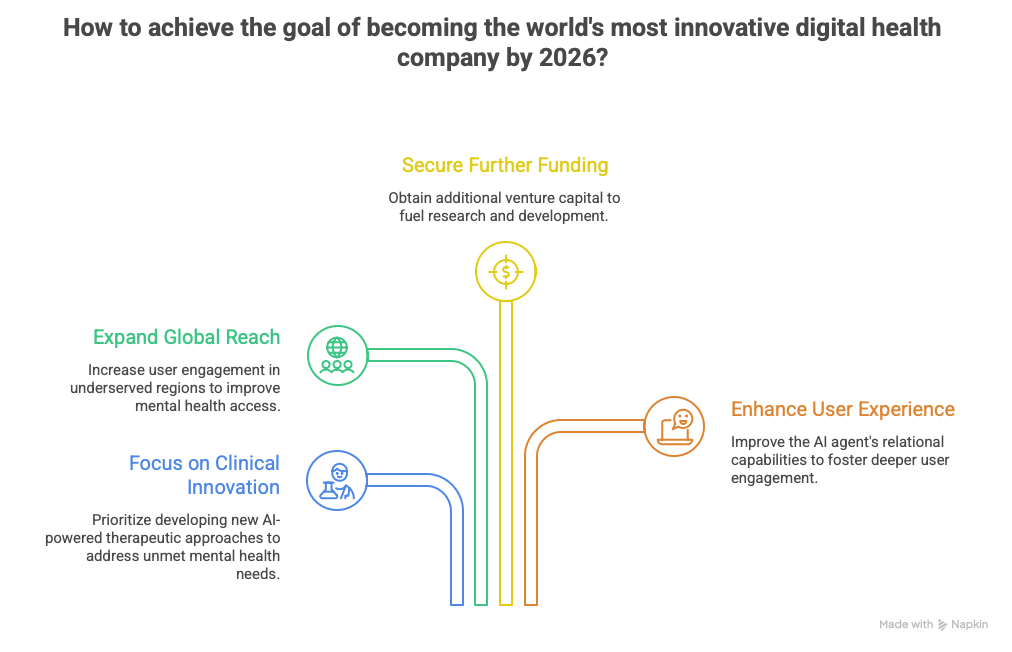
Looking toward 2026 and beyond, WoeBot Health’s strategic priorities center on three interconnected objectives: expanding clinical evidence, deepening healthcare integration, and scaling access through strategic partnerships.
Clinical Expansion: WoeBot Health continues to develop solutions for underaddressed mental health conditions. Beyond postpartum depression, the company is advancing digital therapeutics for depression and anxiety across diverse populations, adolescent mental health, and substance use disorders. The ongoing clinical trial exploring large language model integration promises to inform the next generation of safer, more engaging interventions.
Healthcare Integration at Scale: The PayrollPlans partnership and health system collaborations represent proof of concept for embedded mental health delivery. WoeBot Health anticipates expanding these integration models across additional sectors including hospitality, staffing, and medical services industries. By focusing on clinically-mediated delivery pathways rather than direct-to-consumer channels, the company aims to reach tens of millions of underserved individuals.
Responsible AI Leadership: As AI’s role in healthcare expands, WoeBot Health is positioned to lead industry conversations about responsible deployment. The company’s commitment to safety, transparency, and clinical oversight provides a template for other organizations integrating AI into sensitive health applications.
Regulatory Innovation: With WB001 approaching FDA consideration for digital therapeutic clearance, WoeBot Health aims to establish precedent for how AI-powered mental health interventions can navigate regulatory frameworks. Success here would create pathways for other digital therapeutics and potentially accelerate innovation across the digital health landscape.
Conclusion: A Transformation Underway
WoeBot Health’s journey from concept to global impact embodies the transformative potential of human-centered AI applied to urgent human needs. By grounding artificial intelligence in clinical psychology, maintaining rigorous scientific standards, and prioritizing responsible deployment, Dr. Alison Darcy and her team have created not merely a successful company, but a model for responsible health innovation.
The 1.5 million people who have engaged with Woebot across 120 countries represent more than a user base; they represent evidence that the barriers to mental health care can be systematically dismantled through thoughtful technology, clinical rigor, and unwavering commitment to accessibility. As mental health crises intensify globally and healthcare systems strain under mounting demand, WoeBot Health demonstrates that innovation rooted in evidence, guided by clinical expertise, and committed to safety and transparency can meaningfully expand access to transformative care.
The company’s strategic evolution—from consumer app to clinically-integrated platform, from standalone solution to ecosystem partner—reflects sophisticated understanding of how health innovation actually changes lives. By embedding within existing care pathways rather than attempting to replace human clinicians, WoeBot Health is achieving what many digital health companies aspire to but few accomplish: sustained, scalable impact on real mental health outcomes.
As the company advances into 2026, its vision of making mental health support radically accessible is transitioning from aspiration to tangible reality. Through strategic partnerships, rigorous clinical evidence, and responsible AI leadership, WoeBot Health is writing a new chapter in how humanity addresses one of its most pressing health challenges—one conversation, one therapeutic bond, one life transformed at a time.






One Comment