
What High-Performing People Teams Get Right About Engagement – Backed by Culture Amp Benchmarks 2026
In 2026, “engagement” has become one of the most overused words in HR – and one of the least understood.
Every organization claims to care about it. Most run an annual survey. Many publish internal decks with colorful charts and well-intentioned action plans. And yet, when you look under the surface, you still find:
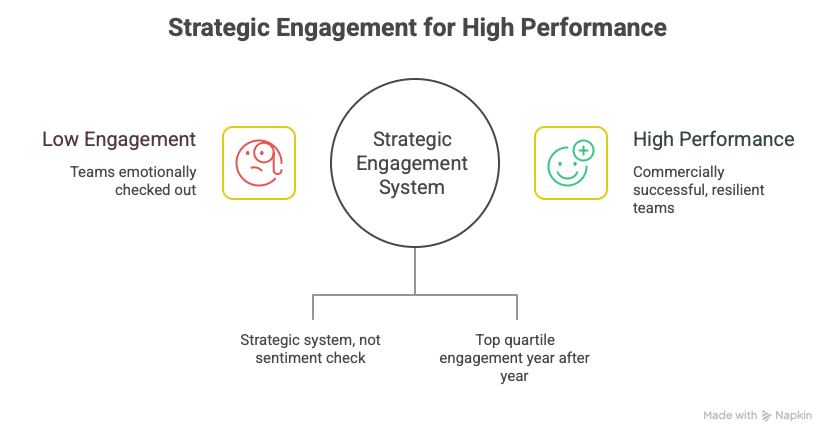
- Teams that are mechanically hitting goals but emotionally checked out
- High performers quietly browsing job boards
- Leaders who say they want feedback, but get defensive when they receive it
Against this backdrop, Culture Amp’s latest benchmarks reveal something important: while overall engagement is under pressure globally, there is a consistent pattern of companies that sit in the top quartile of engagement year after year. These organizations aren’t just “nice places to work.” They are commercially successful, resilient, and capable of sustaining high performance over time – even in volatile conditions.
The difference is not that these companies love surveys more. It is that their People teams understand engagement as a strategic system, not a periodic sentiment check.
This article unpacks what those high-performing People teams are getting right, through the lens of Culture Amp–style benchmarks and people science, and what it means for HR leaders designing engagement strategies in 2026.
From “How Do People Feel?” to “How Does Work Actually Work Here?”
The first shift high-performing People teams make is subtle but fundamental: they stop treating engagement as an emotional weather report and start treating it as evidence of how work is designed and led.
In many organizations, engagement is still framed as a general “How are you feeling?” question. The risk with that approach is that it pushes HR into a vague role: responsible for making people feel better, without real leverage over how decisions are made, how leaders behave, or how performance is managed.
High-performing People teams do something very different:
- They adopt a clear definition of engagement: a combination of pride in the organization, motivation to invest discretionary effort, and intent to stay and grow.
- They use benchmarked survey designs (like those in Culture Amp) so results are comparable against peers, industries, and high-performing cohorts.
- They treat each survey as a diagnostic of the work system – leadership, clarity, growth, recognition, inclusion, psychological safety – rather than as a poll about happiness.
This mindset change sounds theoretical, but it has a very practical effect: it pulls HR into conversations about how the business is run, not just how it is perceived.
Reading the 2026 Landscape: Engagement Under Pressure, Trust in Question
The last few years have left a clear mark on employee sentiment.
Across large benchmark datasets (including Culture Amp’s), several patterns keep appearing:
- Overall engagement has softened
Scores for pride, willingness to recommend the organization, and intention to stay have slipped compared to pre-2023 levels. Employees might still respect the brand, but they are less emotionally attached to it. - Motivation is more fragile
Many employees say they’re doing what’s required, but are less likely to say they are energized by their work or eager to go above and beyond. - Leadership trust is uneven
In some organizations, confidence in leadership’s decisions, transparency, and long-term direction is notably weaker than it was a few years ago. - Employees have stronger boundaries
Paradoxically, there are positive shifts too: in many benchmark sets, more employees report being able to disconnect from work and manage work–life balance more effectively.
In short, the dominant 2026 picture is clearer structures, but weaker emotional connection.
People know what they’re supposed to do. They’re just less convinced it’s worth deeply investing themselves.
High-performing People teams take this seriously. They don’t try to “motivate” people with slogans; they rebuild the underlying conditions that make deep engagement rational again.
The Leadership Effect: Why Confidence at the Top Is Non‑Negotiable
If you analyze Culture Amp–style driver analysis across industries and regions, one theme refuses to go away: leadership is a core driver of engagement.
The questions that correlate most strongly with engagement often sound like:
- “I have confidence in the leaders of this company.”
- “Leaders demonstrate that people are important to the success of the company.”
- “The future direction of the company is clear to me.”
Top‑quartile organizations do not score perfectly on these items – but they are consistently and meaningfully above the global average.
High-performing People teams lean into this in three ways:
- They make leadership data impossible to ignore
Engagement results around leadership are not buried in 80‑page slide decks. They are front and center in executive discussions. People leaders come into those rooms not with opinions, but with patterns: by level, region, and function. - They treat leadership behavior as a design problem
Instead of assuming “some leaders just have it and some don’t,” they define explicit expectations: how leaders should communicate, how they should close feedback loops, how they should role‑model values during change. Leadership programs are then built to practice those behaviors, not just teach theory. - They connect leadership scores to real outcomes
Where benchmarks show that teams with stronger leadership confidence have lower regrettable turnover or higher performance ratings, People teams make that linkage visible to the C‑suite. Engagement stops looking soft when it’s clearly attached to retention of critical roles or sales productivity.
In organizations where leadership is trusted, employees will forgive mistakes, tolerate ambiguity, and stay open to change. Where trust is absent, engagement work becomes cosmetic.
Growth as an Engagement Engine, Not a Perk
If there is one topic that repeatedly emerges as a top driver of engagement across benchmark reports, it is growth and development.
Employees do not just want training budgets. They want to believe that:
- Their skills are becoming more valuable.
- The company is willing to invest in them.
- There is a coherent story about how they can progress.
High-performing People teams move development from the margins of HR into the center of the employee value proposition:
- Career architecture is visible and honest
Roles, levels, and expectations are documented. Employees can see what is realistically required to move from one level or band to another. Promotions may still be competitive, but they’re not mysterious. - Development conversations are structured, not improvised
Managers are trained (and expected) to hold at least one dedicated development conversation per year – separate from the performance review – and to revisit that plan regularly. - Opportunities exist beyond formal courses
L&D is not equated with e‑learning libraries. High-performing People teams curate a blend of:- Stretch assignments
- Cross‑functional projects
- Mentorship and sponsorship
- Shadowing and short‑term rotations
- Development is monitored in the data
Engagement items around growth (“I believe I have good opportunities for professional growth here”, “This company contributes to my development”) are treated as lead indicators. When those indicators decline, People teams respond proactively, not six months later when attrition spikes.
In tight talent markets, employees will leave for even a marginal improvement in perceived growth trajectory. High-performing organizations know this and guard the growth experience carefully.
Recognition, Fairness, and the Hidden Cost of Getting It Wrong
Motivation and recognition data in recent benchmarks tell a cautionary story: a significant share of employees do not believe that the right people are recognized and rewarded.
You see it in comments:
- “The people who shout the loudest get the credit.”
- “We say we value collaboration, but the rewards go to solo heroes.”
- “Some teams always get visibility; others feel invisible.”
From an engagement perspective, this is lethal. Once employees believe the system is fundamentally unfair, no number of engagement workshops or wellness days will restore their energy.
High-performing People teams attack this in three layers:
- Clarity of performance standards
They define performance in behavioral terms, not only numeric targets: how work is done, not just what gets done. This makes it easier to recognize and reward the right things. - Rhythms of recognition
Recognition is built into the operating system: end‑of‑quarter reviews, team rituals, cross‑functional showcases, internal comms. Managers are nudged to recognize specifically and publicly, not generically and privately. - Audit through data
Where performance ratings, pay decisions, or promotions diverge sharply by team or demographic group, high-performing People teams don’t look away. They analyze patterns, surface them with leaders, and intervene where needed.
When recognition feels fair and timely, engagement becomes self‑reinforcing. High performers stay because they can see a future. Solid contributors stay because they feel their work matters. And even those who eventually leave are more likely to do so as advocates, not critics.
Continuous Listening: Less Noise, More Signal
The days of “one big annual engagement survey and nothing else” are fading. But more surveys do not automatically mean better listening. In fact, poorly designed pulses can create survey fatigue and cynicism.
High-performing People teams build continuous listening strategies with discipline:
- They choose a sustainable cadence
For example: a deep engagement survey annually or biannually, one or two short pulses on specific topics, plus always‑on lifecycle surveys for onboarding and exit. Enough to see patterns, not so much that people tune out. - They architect the experience end‑to‑end
Each survey has:- A clear purpose
- An agreed owner for analysis
- A defined decision or action it will inform
- A communication plan for “what we heard and what we’re doing”
- They prioritize depth over breadth in follow‑up
Instead of launching 12 micro‑initiatives, they pick two or three big, visible commitments and execute them well. The message to employees becomes: “We heard you on these issues, and here is what has changed because of your feedback.” - They invest in manager‑level sense‑making
Managers are supported to review their team’s results, discuss them openly, and co‑create actions. This is where most of the real engagement work happens.
The result is a culture where feedback is not an event, but a conversation – and where employees can point to tangible examples of their input shaping decisions.
Using Benchmarks as a Mirror, Not a Trophy
One of the strengths of platforms like Culture Amp is the availability of rich benchmark data: global, regional, industry, size‑based, and even special cohorts such as fast‑growing companies with high engagement.
High-performing People teams use these benchmarks thoughtfully:
- To frame reality
If engagement is dropping everywhere in your industry, it’s important context – but not an excuse. If others facing similar headwinds are still in the top quartile, that’s evidence it can be done differently. - To set ambition
Being “slightly above average” is not enough if your market is highly competitive. High-performing People teams look at how far they are from the top performers on key drivers and treat that gap as their strategic horizon. - To locate outliers
Internally, they compare business units, locations, or populations to find bright spots and pain points. Externally, they study high‑performing cohorts: what are they consistently better at? Leadership communication? Development? Empowerment? Those insights inform the next iteration of their engagement strategy.
Benchmarks, in other words, are used to ask better questions, not to generate bragging rights.
The Manager as the Real Engagement Platform
No matter how good your survey design, leadership messaging, or HR programs are, the day‑to‑day engagement experience lives with one person: the manager.
The difference between a manager who sees engagement as part of their role and one who sees it as “HR’s job” is night and day.
High-performing People teams:
- Make it explicit that engagement is a managerial responsibility, not an optional nice‑to‑have.
- Provide managers with simple, interpretable dashboards and concrete guidance: what the scores mean, how their team compares, which items to focus on.
- Train managers in practical conversational skills: how to run a team discussion on survey results without becoming defensive, how to handle critical feedback, how to co‑create actions.
- Recognize and promote managers who consistently create engaged, high‑performing teams, not just those with strong individual output.
Over time, this builds a managerial culture where engagement conversations feel normal, not awkward – and where teams know their input leads to real changes in how they work together.
Bringing It All Together: A 2026 Playbook for High‑Performing People Teams
If you’re leading People & Culture and want to move closer to this high‑performing pattern, a pragmatic 2026 playbook might look like this:
- Reset your definition of engagement
Anchor it in pride, discretionary effort, and intent to stay. Make sure your survey design reflects that, not just generic satisfaction. - Rebuild the leadership contract
Use your data to tell a clear story about leadership trust. Work with your executive team to define, practice, and measure the behaviors that build confidence, especially during change. - Put growth at the center of your EVP
Treat career development and internal mobility as the heart of your promise to employees. Align learning investments, manager conversations, and talent moves around that. - Repair recognition and performance where needed
Audit where your performance and reward systems are undermining engagement. Clarify standards, support managers in fair assessment, and make recognition more visible and specific. - Design a deliberate listening strategy
Choose a cadence you can sustain. For every survey, know in advance who will act on it and how you will communicate back. - Use benchmarks to sharpen your aim
Compare yourself not only to the average, but to the best‑performing organizations most similar to you. Let that shape the scale of your ambition. - Invest in managers as your engagement channel
Give them data, tools, and skills – and hold them accountable for the experience they create.
High-performing People teams understand something many organizations are still missing: engagement is not a campaign, it is a consequence.
It is the cumulative result of how leaders show up, how work is designed, how growth is enabled, how fairly people are treated, and how honestly the organization listens and responds.
In 2026, with pressure on talent, budgets, and performance, the organizations that will stand out are not those with the loudest culture slogans, but those whose People teams quietly and consistently get these fundamentals right.






One Comment