
How AI Integration Transforms Software Development: Effy’s 5-Step Efficiency Framework 2026
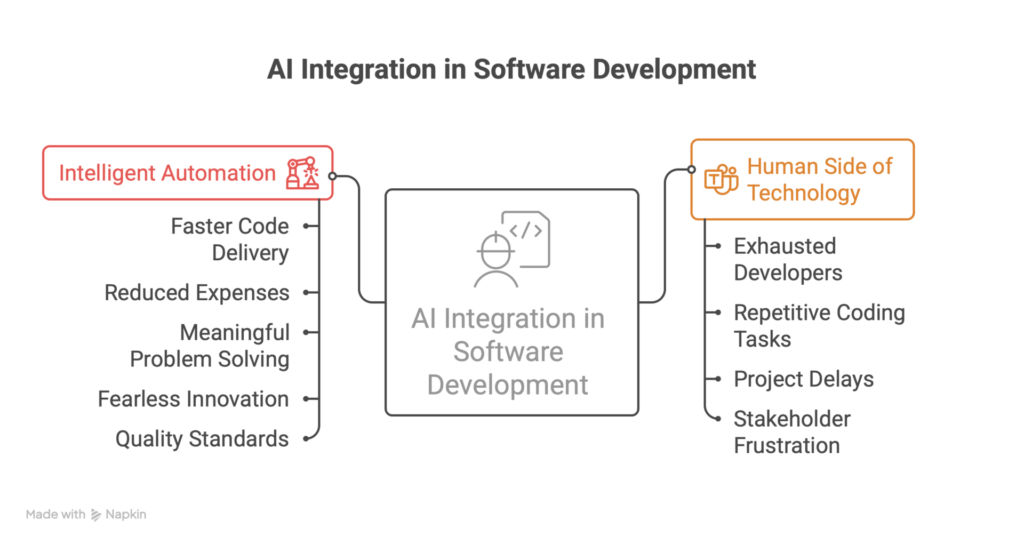
The Human Side of Technology
Picture this: It’s 9 PM on a Thursday evening, and your development team is still debugging issues that should have been caught hours ago. Your developers are exhausted from repetitive coding tasks. Your project manager watches the deadline slip further away. Meanwhile, your business stakeholders grow increasingly frustrated with delays and mounting costs.
This scenario plays out in countless organizations every day. The irony is striking—we build sophisticated technology to solve problems, yet our own teams struggle with outdated workflows and manual processes that drain productivity and morale. This is the fundamental challenge that modern businesses face: how to harness innovation while keeping the human experience at the center.
This is where the conversation shifts. When we talk about transforming software development, we’re not just talking about faster code delivery or reduced expenses. We’re talking about creating work environments where talented developers spend their time solving meaningful problems instead of wrestling with repetitive tasks. We’re discussing how to empower your team to innovate fearlessly while maintaining the quality standards your customers expect.
The solution lies in intelligent automation through artificial intelligence—but not the kind that replaces human creativity. Rather, it’s about augmenting your team’s capabilities and reimagining how development truly works in the modern era.
The Current State: Where Traditional Development Falls Short
Let’s be honest about the current landscape. Many software development teams operate with processes that haven’t fundamentally evolved in years. Developers spend considerable time on repetitive coding tasks that could be automated. Testing remains a bottleneck where manual processes slow down quality assurance. System integration requires extensive manual configuration that increases the risk of errors. Code reviews consume hours that could be invested in strategic thinking. Documentation gets neglected because teams prioritize delivery over knowledge preservation.
The consequences are real and measurable. According to recent industry research, organizations implementing AI-powered development achieve 30 to 60 percent reduction in operational costs and 40 to 70 percent acceleration in workflow execution. That’s not marginal improvement—it’s transformational change.
But the real cost extends beyond numbers on a spreadsheet. Your developers experience burnout from monotonous tasks. Your delivery timelines remain predictably missed. Your quality suffers from human error in repetitive work. Your innovation pipeline stalls because teams lack bandwidth for creative problem-solving.
The question isn’t whether to change, but how to change intelligently. This is where AI integration becomes essential—not as a replacement for human talent, but as a strategic partner that elevates your entire operation.
Understanding AI Integration in Software Development
Before diving into frameworks and implementation, it’s important to understand what AI integration actually means in the context of software development. It’s not about mysterious algorithms or replacing your team with robots. Instead, think of it as embedding intelligent capabilities directly into your development workflow.
AI integration in modern development encompasses several interconnected areas. Code generation uses AI assistants to suggest or create code based on context and natural language descriptions, dramatically reducing time spent on routine coding. Intelligent testing automates test case generation, identifies potential defects before they reach production, and adapts testing strategies based on historical data. System integration leverage AI to seamlessly connect disparate systems, ensuring clean data flow and reducing manual mapping errors. Workflow optimization uses AI to analyze your existing processes, identify bottlenecks, and recommend smarter paths forward. And decision intelligence applies AI insights to help teams make informed choices about architecture, performance, and resource allocation.
The beauty of this approach is that each component works independently, yet they amplify each other when working together. Your developers write better code because they receive intelligent suggestions. Your QA team catches more defects earlier because AI identifies edge cases humans might miss. Your systems integrate more reliably because AI handles the complex data transformation. Your projects stay on track because intelligent systems help allocate resources optimally.
This is the foundation upon which transformative efficiency is built—and it’s deeply human in its intent.
Introducing Effy’s 5-Step Efficiency Framework
At Effy, we’ve spent years understanding how organizations like yours can successfully integrate AI into their development processes without disruption or overwhelming complexity. The result is our proven 5-Step Efficiency Framework—a structured approach designed specifically for businesses that want transformation without chaos.
Think of this framework as a roadmap that guides your organization from current state to optimized operations. It accounts for your existing systems, your team’s skill levels, your business objectives, and the practical realities of implementation. Most importantly, it keeps people—your developers, your teams, your customers—at the center of every decision.
Step 1: Assessment and Opportunity Discovery
The journey begins with honest evaluation. Before implementing any AI solution, you need to understand your current landscape thoroughly.
This step involves analyzing your existing development workflows to identify high-impact opportunities where AI can deliver immediate value. Which processes consume the most time? Where do errors occur most frequently? Which bottlenecks directly impact your release timeline? What tasks do your developers find most repetitive and unfulfilling?
The assessment phase includes reviewing your current technology stack, understanding your data architecture, and evaluating team readiness for change. It’s also the stage where we identify quick wins—opportunities where implementing AI can deliver measurable benefits within 30 to 60 days. These early wins build organizational confidence and demonstrate tangible value.
Many organizations underestimate this step, eager to rush toward implementation. But teams that invest time in thorough assessment achieve significantly better outcomes. You’ll discover opportunities you didn’t know existed. You’ll build stakeholder alignment around shared objectives. You’ll establish realistic expectations that set your initiative up for success.
Step 2: Solution Design and Architecture Planning
With opportunities identified, the next step is designing a solution tailored to your specific context.
Generic, off-the-shelf implementations rarely deliver exceptional results. Your business has unique requirements, your technical environment is distinct, and your team has particular needs. This step involves creating a thoughtful architecture that aligns AI capabilities with these realities.
Solution design encompasses selecting the right AI tools and frameworks for your environment. Should you implement code generation assistants like GitHub Copilot or Amazon Q Developer? Which testing automation platforms align with your QA methodology? How should AI-powered workflow optimization connect to your existing ERP or development systems?
Architecture planning ensures these components integrate seamlessly. Rather than implementing isolated point solutions, you’re creating an interconnected system where AI capabilities enhance each other. Your code generation works better because it understands your system architecture. Your testing automation adapts intelligently because it accesses data from your deployment systems. Your workflow optimization learns from actual performance data.
This step also involves planning your data governance framework. AI systems deliver value proportional to data quality. Establishing clear data standards, security protocols, and compliance frameworks at this stage prevents costly corrections later.
Step 3: AI Model Development and System Integration
Now the actual integration happens. This is where your design becomes operational reality.
The development phase involves implementing AI capabilities into your existing systems and workflows. For code generation, this might mean integrating AI assistants directly into your IDE (Integrated Development Environment) so developers receive intelligent suggestions as they write. For testing, you’ll implement automated test generation that creates comprehensive test cases in a fraction of the traditional time. For system integration, you’ll establish AI-powered data pipelines that handle complex transformations with minimal manual intervention.
A crucial element in this step is training your models on domain-specific data. Generic AI models work adequately for general tasks, but your business has unique patterns, coding conventions, and architectural approaches. By training AI systems on your actual codebase, your historical data, and your specific requirements, you create models that understand your context far better than generic alternatives.
Integration also involves establishing monitoring systems. AI systems must continuously learn and adapt. You need visibility into how these systems perform, where they struggle, and how they’re influencing your development outcomes.
The development phase typically takes 8 to 12 weeks for comprehensive implementation, though many organizations see benefits within the first 2 to 3 weeks of partial implementation.
Step 4: Deployment and Change Management
Technology implementation is only half the battle. The other half—perhaps the more important half—involves helping your team embrace and effectively use these new capabilities.
Deployment involves rolling out AI capabilities to your development teams in a structured manner. Rather than turning everything on simultaneously, organizations typically follow a phased approach. You might start with code generation in a pilot team, gather feedback and insights, then expand to additional teams. This gradual rollout allows your teams to adapt at a sustainable pace while continuously improving the implementation based on real-world usage.
Change management is essential during this phase. Your developers need training to use these tools effectively. They need to understand how AI suggestions improve their work. They need reassurance that these systems are designed to enhance their capabilities, not replace them. Your architects need guidance on how AI-powered insights inform system design. Your project managers need visibility into how AI automation affects timeline and resource planning.
Organizations that invest in robust change management see adoption rates 3 to 4 times higher than those that simply deploy technology without supporting their people. Your team members are your greatest asset—supporting them through change directly impacts your success.
During deployment, you’ll also refine your processes. How do developers best use code generation suggestions? When should QA teams trust automated testing results? Which workflow optimizations actually improve team productivity without adding bureaucracy? Real-world usage reveals answers that theoretical planning cannot predict.
Step 5: Continuous Optimization and Performance Monitoring
Implementation isn’t the endpoint—it’s the beginning of an ongoing journey of improvement.
This final step establishes systems for measuring impact, identifying optimization opportunities, and continuously refining your AI-powered development environment. You’ll track metrics that matter: time to market, defect escape rates, developer satisfaction, cost per feature, and innovation pipeline velocity.
Continuous optimization means actively learning from data. As your AI systems process more information, they become smarter. As your team gains experience, you discover new ways to leverage capabilities. As your business evolves, you adapt your approach.
This phase involves regular reviews with stakeholders. Are you achieving the anticipated cost reductions? Are your developers more satisfied with their work? Is your innovation pipeline accelerating? Are customers experiencing better quality products? When results exceed expectations, you can expand implementation. When results fall short of targets, you can adjust and improve.
Organizations that excel at this phase view their AI implementation as a living system that continuously adapts and improves, rather than a static deployment that remains unchanged.
The Real-World Impact: What Transformation Looks Like
Understanding the framework intellectually differs from seeing how it actually transforms organizations. Let’s look at what becomes possible when these five steps work together.
Developers gain approximately 20 to 25 percent of their productive time back from routine tasks, freeing them to focus on complex problem-solving and architectural innovation. Rather than writing boilerplate code, they write sophisticated algorithms. Rather than debugging repetitive errors, they design elegant systems. This shift doesn’t just improve efficiency—it transforms the quality of work and job satisfaction.
Your development velocity increases substantially. Teams report 16 to 30 percent improvements in productivity and time-to-market. Your release cycles accelerate from quarterly to monthly or even weekly deployments. Your ability to respond to market opportunities and customer requests becomes dramatically faster.
Quality improves through multiple mechanisms. AI-powered testing identifies more edge cases and potential vulnerabilities than manual testing processes. Code suggestions incorporate best practices and reduce common errors. System integration errors decline substantially because AI handles complex transformations reliably. The result is software that performs better and fails less frequently.
Your team experiences meaningful impact. Developers tackle more interesting problems. Your architects make better-informed decisions powered by AI insights. Your project managers gain better visibility into realistic timelines. Your QA teams transition from manual testing to strategic quality oversight. People spend more time doing what brought them into technology in the first place—solving problems and creating solutions.
The Financial Reality
Numbers matter in business, so let’s address them directly. Organizations implementing comprehensive AI integration typically achieve 30 to 60 percent reductions in operational costs. This comes through multiple avenues: fewer rework cycles due to better quality, reduced testing time through automation, faster feature delivery reducing project overhead, and decreased manual system integration effort.
But cost savings, while real, are only part of the story. More significant is what cost efficiency enables. With equivalent resources, you can now build substantially more functionality. Your competitive position strengthens. Your market response time improves. Your innovation pipeline accelerates. The financial impact extends far beyond direct cost reduction into competitive advantage and market opportunity.
Addressing the Questions You’re Asking
If you’re considering AI integration for your organization, certain questions are probably forming in your mind. Let me address them directly.
Will AI replace my developers? No. The evidence consistently shows that developers equipped with AI tools become more productive and valuable, not less. AI handles routine work, freeing humans for strategic thinking. The developers who thrive are those who learn to work effectively alongside AI capabilities.
Won’t this be disruptive and destabilizing? Thoughtful implementation minimizes disruption. The phased approach we described allows teams to adapt gradually. Many organizations report that productivity actually increases immediately because A I removes frustrating bottlenecks. Change requires adjustment, but the changes are directionally positive.
How do we ensure our data is secure? Security is built into proper implementation from the ground up. Data governance frameworks, access controls, compliance monitoring, and security protocols are established during the design phase. Enterprises can implement A I while maintaining the highest security standards.
What’s the realistic timeline? Most organizations see measurable benefits within 4 to 8 weeks of beginning implementation. Comprehensive transformation typically takes 4 to 6 months. Some benefits accrue immediately; others grow over time as systems mature and teams develop proficiency.
What if our systems are legacy technology? Age of systems matters less than data accessibility. Even organizations with legacy infrastructure can implement A I successfully by establishing APIs and data bridges that enable A I systems to access necessary information. Modern A I can integrate with nearly any technical environment.
Beginning Your Journey
The path to transforming your software development through A I integration is clearer than many organizations realize. You don’t need massive upfront investment or complete technical overhaul. You need a thoughtful framework, commitment to change management, and partnership with experienced guides who understand both technology and your business context.
Effy’s framework exists because we’ve learned what actually works when organizations move from understanding the potential of A I to experiencing its transformative impact. We’ve helped teams everywhere from startup environments to Fortune 500 enterprises successfully navigate this transition.
The organizations thriving in 2026 and beyond aren’t those that waited for A I to become inevitable. They’re the ones who thoughtfully, deliberately, and humanely integrated A I capabilities into their development processes. They’re experiencing the dramatic efficiency gains, quality improvements, and team satisfaction that become possible when technology serves human potential.
Your development team has enormous capacity to create, solve, and innovate. The question isn’t whether to integrate A I into your development process. The question is when—and whether you’ll partner with experienced guides who understand that transformation means putting your people first.
The future of software development is already here. It’s not about artificial intelligence replacing human intelligence. It’s about businesses like yours discovering what becomes possible when you amplify human capability through intelligent technology, thoughtfully implemented and deeply human in approach.
Ready to explore how Effy’s 5-Step Efficiency Framework could transform your software development? Connect with our team for a confidential assessment of your current development process and discovery of where A I integration could deliver the greatest impact for your organization.




One Comment