
The End of Geographic Inequality in Hiring: Why Location Should Never Determine Opportunity 2026
Introduction
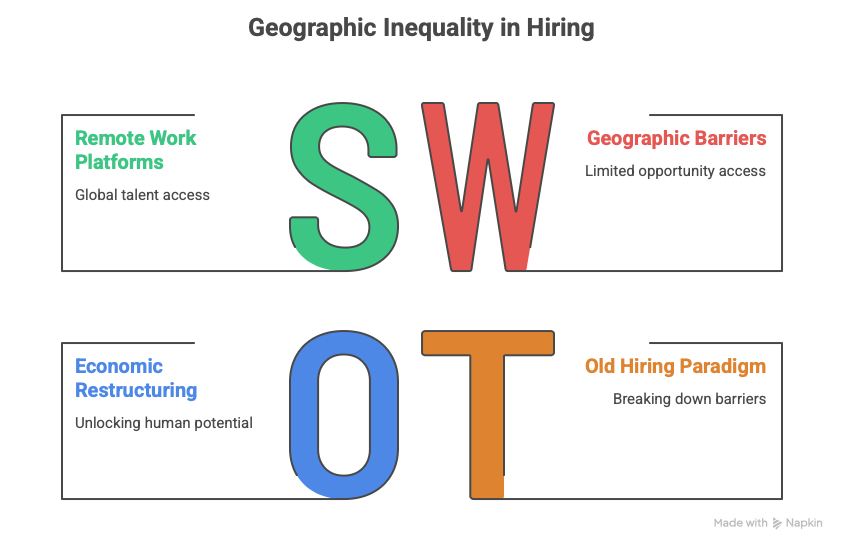
The old hiring paradigm is breaking. For decades, access to opportunity was gatekept by geography—a talented developer in rural Poland had to relocate to San Francisco; a brilliant data scientist in Lagos had to somehow reach Silicon Valley; a skilled engineer in a provincial Indian city faced years of commuting to major tech hubs. The location where you were born, or where you happened to live, determined whether you could access world-class opportunities.
That era is ending in 2026.
The convergence of remote work, global hiring platforms, and skills-based recruitment is fundamentally reshaping how companies build teams. Remote.com and platforms like it are eliminating the artificial barriers that have long restricted opportunity to geographic hotspots. For the first time in modern business history, talent and opportunity are decoupling from location. The result isn’t just a shift in how we hire—it’s a restructuring of economic access itself.
This isn’t a story about workplace flexibility or convenience. This is about fairness, efficiency, and unlocking human potential wherever it exists. And the data shows the transformation is accelerating.
The Geography Problem: How Location Created Inequality
Before we celebrate the end of geographic inequality, we need to understand how pervasive the problem was.
For most of the 20th and early 21st centuries, hiring geography wasn’t a choice—it was a constraint hardwired into the business model. Companies needed people in offices. Offices required physical buildings in expensive markets. Expensive markets meant talent pools were limited to those who could afford to live or commute there. This created a vicious cycle: talent concentrated in major cities, companies followed talent, real estate prices skyrocketed, and opportunity became increasingly inaccessible to anyone without significant resources.
Consider the economics. In 2020, a software engineer in San Francisco earned roughly $150,000–$200,000 annually. The same role in a Tier-2 city in India might pay $25,000–$40,000. The gap isn’t just compensation; it’s access. A talented engineer in Pune had to physically relocate to the U.S. to access first-world wages and career growth. Relocation required visa sponsorship, which companies rarely offered. Visa sponsorship required bureaucracy, cost, and risk. For most, the barrier was insurmountable.
The geographic inequality was compounded by credential gatekeeping. Companies didn’t just require you to be in the right place; they required you to have graduated from the right place. A programmer who learned through bootcamps or self-study in Bangkok was excluded not because of their capabilities, but because their path to learning didn’t match a credential matrix designed for graduates of American universities.
This system wasn’t just unfair—it was economically inefficient. Companies were systematically excluding talent that could perform. The best candidates weren’t always in San Francisco or London. They were scattered globally, constrained by the accident of birth or previous opportunity.
The Remote Revolution: From Constraint to Catalyst
The COVID-19 pandemic forced an unprecedented experiment. Companies that believed work required physical offices suddenly proved it didn’t. Remote work went from a perk offered to a handful of employees to a baseline operational model for millions.
But the pandemic merely accelerated what was already technically possible. Remote work has been feasible since broadband became ubiquitous. What changed in 2020 was culture and trust. Once companies saw that remote teams could deliver results, the geographic constraint dissolved.
The numbers confirm this shift. By end of 2026, 70% of the global workforce will work remotely at least five days per month. This isn’t a niche arrangement anymore—it’s the default. And with that default came an unexpected consequence: geographic inequality in hiring began to collapse.
The Productivity Paradox
One of the biggest surprises was that remote workers didn’t just maintain productivity—they exceeded it. Research shows remote talent works 1.4 additional days per month compared to office-based workers. Across industries, 77% of remote workers reported increased productivity versus their on-site counterparts.
The reasons are straightforward: reduced commute time, fewer office interruptions, flexibility to work during peak cognitive hours, and a work environment optimized for individual preference rather than corporate standardization.
For companies, this means hiring remotely isn’t a concession to employee flexibility—it’s a productivity upgrade. For workers, it means geography is no longer an excuse for underperformance. A remote engineer in Eastern Europe can deliver the same output as one in London, and companies now have proof.
Access Expands Dramatically
When geography stops constraining hiring, talent pools don’t just grow—they multiply.
Skills-based hiring (hiring based on demonstrated abilities rather than credentials) expands candidate pools by an average of 6.1 times globally. The variation by region is striking: the United States sees a 15.9-times increase in eligible candidates when companies move to skills-based hiring; Brazil experiences 12.9-times growth; the UK achieves 8.4-times larger pools. In some sectors, the expansion is even more dramatic. Farming, ranching, and forestry sectors see 21.5-times increases in candidate pools when geographic and credential barriers fall away.
This expansion matters because it changes who gets hired. Workers without bachelor’s degrees—often from disadvantaged backgrounds—experience 6% greater talent pool increases through skills-based hiring. In AI roles, women experience up to 24% greater representation when hiring shifts from credentials to demonstrated skills.
Companies benefit from this expansion in obvious ways: better quality candidates, lower recruitment costs, faster time-to-hire, and reduced employee turnover. They also benefit in subtle but powerful ways: more diverse teams, broader perspectives, and resilience through geographic distribution.
The Skills Revolution: Credentials Become Irrelevant
The shift from geography to skills is inseparable from a parallel revolution: the collapse of credentialism as a hiring metric.
For decades, hiring relied on a proxy: if you had a degree from a prestigious institution and work experience in a major city, you were probably capable. This proxy was never reliable, but it was convenient. It allowed companies to filter candidates at scale without subjective assessment.
Today, that proxy is broken. The skills market is moving too fast. By 2030, 39% of workers’ skills will transform. Traditional education institutions cannot iterate that quickly. A computer science degree from 2015 teaches technologies now obsolete. A bootcamp graduate in 2024 might know more about current development practices than someone who learned in a classroom three years ago.
This mismatch created an opportunity: hire for what people can actually do, not for where they learned to do it.
The data on skills-based hiring is compelling. Companies implementing skills-based approaches report that 94% of their hires outperform traditionally recruited counterparts. These employees show 9% longer retention. Most importantly, skills-based hiring is five times better at predicting job performance than degree-based methods.
Given these results, the shift is inevitable. In 2024, 81% of employers had increased their focus on skills-based hiring. By 2026, this is becoming the norm, not the exception.
What Skills-Based Hiring Means for Geographic Inequality
When companies hire for skills, geography becomes irrelevant in the assessment process. A developer in Lagos can demonstrate proficiency through a coding challenge regardless of where they learned. A marketer in Bogotá can show portfolio work regardless of what degree they hold. A product manager in Istanbul can prove capability through a case study conversation, not through an Ivy League diploma.
This shift has profound implications for opportunity. It removes the credentialing gatekeepers that concentrated opportunity in wealthy regions with elite universities. It means that self-taught programmers from emerging markets can compete fairly with university graduates from developed economies. It means that the best talent emerges from a much larger pool.
For workers, this is liberation. For companies, it’s selection from a talent pool 6–15 times larger than the traditional geographic + credential model allowed. The efficiency gains are staggering.
The Opportunity Window: Emerging Markets and Untapped Talent
As geographic constraints fall away, the global talent distribution becomes visible—and it’s deeply uneven.
India is the clearest example. With 1.4 billion people, a large English-speaking population, strong technical education in tier-1 and tier-2 cities, and proven experience working with global companies, India has become the remote hiring hub for technical talent. Indian tech professionals now lead the global market, offering deep expertise in software engineering, AI/ML, data science, and QA at competitive rates.
But India is just one node in an emerging global talent network. The Philippines leads in customer service and virtual assistant roles, with cultural alignment and excellent English fluency. Nigeria is Africa’s fastest-growing remote workforce, with a youth-driven tech and creative sector showing exceptional growth. Poland has become Eastern Europe’s outsourcing hub, offering EU-level talent at competitive rates. Vietnam is emerging as a cost-effective tech and digital services hub. Estonia has pioneered e-residency programs that make remote hiring seamless.
The common thread: these regions have talented, educated workforces that were previously excluded from global opportunity because they weren’t in traditional financial centers. Remote hiring is connecting these workers to companies worldwide, creating an enormous untapped talent pool.
The scale is significant. India’s hiring intent in 2026 is 11%, up from 9.75% the previous year. Global capability centers in India are experiencing 13% month-on-month growth and 7% year-on-year growth. These aren’t marginal trends—they represent a fundamental reallocation of where work happens and who gets to access it.
The Compensation Challenge: Toward Equitable Pay
But here’s where the narrative becomes complicated. Access to opportunity isn’t meaningful if it comes with exploitation.
One of the thorniest questions in remote hiring is compensation. When a company hires someone remotely, should they pay based on local market rates or global standards? Over 60% of global companies now adjust pay for remote employees based on location. Major tech companies like Google, Facebook, and Microsoft have reduced salaries by as much as 25% when employees relocate from expensive cities to cheaper regions.
On one level, this makes economic sense. A software engineer in San Francisco has higher costs of living than one in Sofia. If the company pays the same salary, the engineer in San Francisco is effectively underpaid relative to local living costs. The engineer in Sofia is overpaid relative to what local tech salaries offer.
But this logic has consequences. It creates a two-tier workforce: workers in wealthy countries paid one rate, workers in emerging markets paid another—despite doing identical work. For workers in emerging markets, it can feel like a ceiling on earnings. For companies, it creates retention challenges: an engineer who knows they’re paid 40% less than a colleague doing identical work, purely because of location, is more likely to leave.
India’s employment laws have already begun addressing this. The country now prohibits salary cuts based on location alone. Other governments are following: European and American jurisdictions increasingly require companies to explain wage differentials and ensure they’re not rooted in discriminatory practices.
The Emerging Solution: Performance-Based and Transparent Compensation
Smart companies are moving to alternatives. Some have adopted skills-based or performance-based pay, rewarding employees based on output and capability rather than zip code. Companies like Reddit and Zillow have shifted entirely to this model.
Others are adopting radical transparency. Buffer and GitLab publish their entire compensation frameworks, showing exactly how salaries vary by territory for analogous positions. This transparency removes the sting of geographic differentials because employees can see the logic and verify it against market data.
A third approach is location-independent, standardized salaries. Some fully remote companies set a global median salary for a role and pay that globally, regardless of location. This eliminates geographic pay inequality but comes with trade-offs: it means paying a premium in low-cost regions and potentially becoming uncompetitive in expensive markets.
None of these solutions is perfect. Geographic pay differentials reflect real differences in cost of living. But the trajectory is clear: geographic-based pay cuts are becoming increasingly controversial and, in many jurisdictions, legally problematic. Forward-looking companies are moving toward compensation models that reward capability and contribution rather than the accident of location.
The stakes are high. Organizations that prioritize pay equity are 1.5 times more likely to retain top talent. When compensation is perceived as fair, productivity increases by 16%. When compensation is perceived as unfair, the cost of employee disengagement can reach 34% of annual salary.
The Regulatory Framework: Compliance in a Borderless Workforce
As companies hire across borders, the regulatory landscape becomes more complex—but also more standardized.
Labor laws vary significantly by jurisdiction. Tax obligations differ. Employment classifications change. Data protection requirements multiply. For companies hiring one or two remote workers in different countries, this complexity is manageable. For companies building teams across 10–20 countries, compliance becomes a substantial operational burden.
However, several trends are making this easier. First, governments are harmonizing labor standards, particularly in regions like the EU. Second, platforms like Remote.com have built-in compliance infrastructure—they understand tax filing, employment classification, and contractual requirements across jurisdictions. Third, AI-driven compliance tools are making it easier for smaller companies to navigate these requirements without dedicated international HR teams.
The regulatory trend in 2026 is toward greater transparency and stricter compliance. The EU’s NIS2 directive and DORA framework (effective January 2025) require enhanced cyber resilience and data protection. The UK’s Making Tax Digital mandate (effective April 2026) requires quarterly digital reporting for businesses. These aren’t obstacles to remote hiring—they’re guardrails ensuring that global hiring doesn’t become a mechanism for tax avoidance or labor exploitation.
Companies that treat compliance as infrastructure investment rather than administrative burden gain competitive advantages. They can expand into new markets confidently. They avoid penalties and reputational damage. They build trust with regulators and employees.
The Efficiency Revolution: Speed, Scale, and Cost
Beyond the human and ethical dimensions, the economics of remote global hiring are overwhelming.
Hiring remotely costs 30–70% less than hiring locally in developed economies. A developer who costs $150,000 annually in San Francisco might cost $50,000 in Bangalore and deliver equivalent output. For companies, this multiplies hiring power: the same budget can build a larger team, hire more specialized skills, or invest in strategic roles.
But cost efficiency is only part of the story. There’s also speed. Remote hiring platforms can onboard contractors or full-time employees in different countries in days, not months. Visa sponsorship and relocation, which once took 6+ months, are eliminated. The time-to-productivity decreases dramatically.
There’s also quality. Because companies can hire from a global pool and use skills-based assessment, they select candidates from a much larger and more competitive cohort. The average hire quality increases even as cost decreases. It’s one of the rare win-wins in business.
And there’s resilience. A team distributed across time zones can operate 24/7 with no deliberate scheduling. A company with engineering in India, product management in Europe, and operations in the Americas has continuous productivity. Geographic distribution becomes a competitive advantage, not a constraint.
The efficiency gains are so substantial that companies that don’t embrace global remote hiring will find themselves at a disadvantage. They’re operating with smaller talent pools at higher cost and slower speed. As these disadvantages compound, they’ll lose talented employees to companies offering more opportunity, better compensation, and more flexibility.
The Diversity Dividend
Here’s something remarkable: eliminating geographic constraints on hiring naturally increases diversity.
This happens for several reasons. First, geographic privilege correlates with other forms of privilege. People in wealthy nations with elite education systems are disproportionately represented in traditional hiring pools. When companies expand to emerging markets and away from credential gatekeeping, they automatically access more diverse backgrounds.
Second, diverse teams demonstrate measurably better outcomes. Research shows that diverse teams deliver 60% better results and make better decisions in 87% of cases. They innovate more, solve problems more creatively, and avoid groupthink. This isn’t moral philosophy—it’s cold organizational performance.
Third, global teams develop better products for global markets. A team building software for users worldwide is better served by having engineers from different parts of the world. They bring cultural insights, local knowledge, and perspective that teams built entirely from one geography simply cannot replicate.
For women in particular, skills-based hiring in technical fields shows potential. AI roles show up to 24% greater female representation when hiring shifts from credentials to demonstrated capabilities. This reflects a broader pattern: women face particular barriers in credential gatekeeping (fewer women graduate from elite programs) but comparable barriers to men in skills-based evaluation.
The diversity benefits multiply across dimensions: gender, geography, socioeconomic background, educational path, and lived experience. A truly global, skills-based hiring approach creates teams that are more capable, more innovative, and more resilient.
Looking Forward: 2026 and Beyond
We’re at an inflection point. The infrastructure for global hiring is in place. Regulatory frameworks are evolving to support it. Companies have proven remote teams work. Talent pools have expanded dramatically. Platforms have solved the compliance and logistics problems.
What remains is cultural acceptance and deliberate strategy.
Some companies will continue hiring locally, limiting themselves to geographic talent pools. They’ll pay more for constrained talent, take longer to hire, and miss exceptional candidates who happen to live elsewhere. They’ll face disadvantages in a competitive market.
Others will embrace global hiring strategically. They’ll use remote platforms to access underutilized talent. They’ll adopt skills-based hiring to expand their candidate pools. They’ll design compensation models that are equitable without being naive about cost-of-living differences. They’ll invest in compliance infrastructure to hire confidently across borders. And they’ll build teams that are globally distributed, highly diverse, and exceptionally capable.
The winners in the next decade of competition will be companies that understand that talent is distributed globally, and that opportunity should be too.
Conclusion
For decades, geography was destiny in the job market. Where you were born, where you lived, and where you could afford to relocate determined your economic opportunity. The system was inefficient, unfair, and wasteful of human potential.
That system is ending. Remote work, global hiring platforms, skills-based recruitment, and regulatory evolution are dismantling geographic barriers faster than most people realize. In 2026, a talented software engineer in rural India, a brilliant designer in Lagos, or a capable marketer in a small Eastern European city has genuine access to global opportunity—not despite their location, but regardless of it.
This isn’t just good for workers, though it is. It’s good for companies. It’s good for innovation. It’s good for economic efficiency. And it’s good for building a more equitable global economy.
Talent is indeed everywhere. And thanks to platforms like Remote.com and the larger shift toward remote, global, skills-based hiring, opportunity finally can be too.







One Comment