
Align, Retain, and Scale: How Peoplebox’s AI Platform is Transforming Hiring and Talent Strategy in 2025
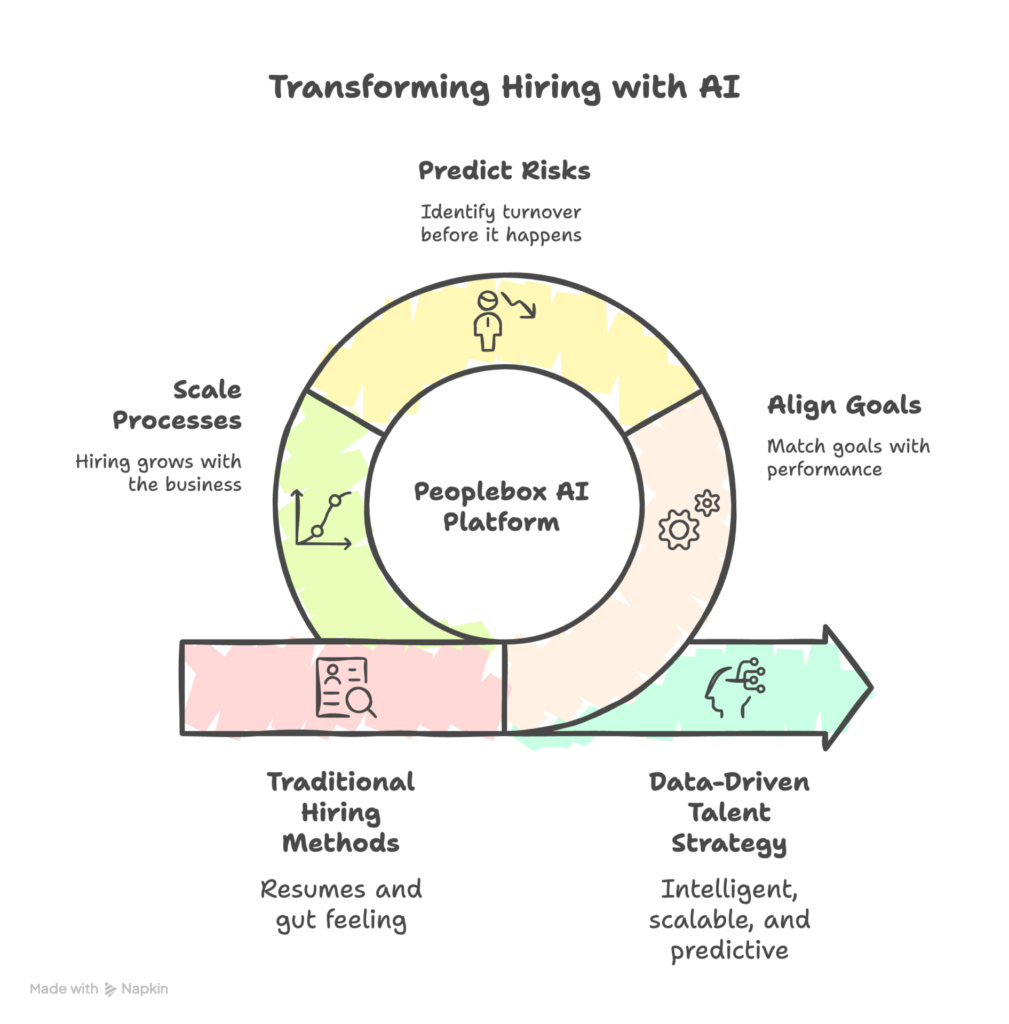
The modern workplace is evolving at an unprecedented pace. Companies today are no longer satisfied with traditional hiring methods that rely on resumes and gut feeling. Instead, they’re demanding intelligent, data-driven solutions that can align organizational goals with individual performance, predict talent risks before they become costly turnover, and build scalable hiring processes that grow with the business. This is where Peoplebox emerges as a game-changing platform—an integrated OKR, talent management, and people analytics solution that’s revolutionizing how organizations approach talent strategy in 2025.
The Talent Crisis: Why Traditional Approaches Are Failing
Organizations today face a mounting talent crisis. According to industry benchmarks, companies experience significant losses due to employee turnover, inefficient hiring processes, and misalignment between organizational goals and individual performance. The average time-to-hire has stretched across months, while retention rates continue to decline as employees seek roles where their growth aligns with company objectives.
Traditional talent management approaches rely on disconnected systems. HR teams manage recruitment in one tool, performance reviews in another, compensation in a third, and learning and development in yet another. This fragmentation creates information silos, prevents data-driven decision-making, and ultimately leads to hiring mistakes, talent loss, and missed business opportunities.
The stakes have never been higher. A single bad hire can cost organizations 30% of a new employee’s annual salary in lost productivity and onboarding expenses. Meanwhile, preventable turnover of top performers drains institutional knowledge and disrupts team momentum. Organizations need a unified platform that addresses the entire talent lifecycle while leveraging artificial intelligence to make smarter decisions faster.
Enter Peoplebox: A Unified Talent Platform for the Modern Enterprise
Peoplebox represents a fundamental shift in how organizations manage talent. Rather than offering a point solution for one aspect of talent management, Peoplebox provides a unified ecosystem that seamlessly integrates three critical functions: OKR (Objectives and Key Results) management, talent management, and people analytics.
This integrated approach enables organizations to connect strategic priorities directly to hiring decisions, align individual goals with company objectives, and use predictive analytics to identify retention risks before they materialize. By consolidating these functions into a single platform, Peoplebox eliminates the data silos that plague traditional HR tech stacks.
Key Features That Drive Results
Unified OKR Framework
At the core of Peoplebox is enterprise-ready OKR software that transforms strategies into outstanding results. Organizations can set cross-functional OKRs that break down silos and foster collaboration across departments. The platform enables companies to align strategic priorities and key initiatives in real-time, ensuring that organizational goals reflect the overall company strategy while maintaining clarity and focus throughout the organization.
Teams can track and review goal progress continuously, identifying red flags early and executing solutions with enhanced agility. This real-time visibility into goal alignment is particularly valuable in fast-moving industries where quarterly priorities can shift rapidly.
AI-Powered Performance Management
Unlike traditional performance review systems that feel like compliance rituals, Peoplebox’s AI coaching transforms every manager into a talent developer. The platform provides built-in coaching prompts and automatically generates review summaries, turning performance conversations into opportunities for growth rather than administrative checkboxes.
Continuous feedback loops replace annual appraisals, creating a culture where coaching and improvement are embedded into everyday workflows. Managers receive AI-powered nudges that guide them toward more effective conversations, while employees get real-time guidance on expectations and performance.
Predictive People Analytics
This is where Peoplebox truly differentiates itself. The platform’s predictive analytics engine can identify employees at risk of disengagement before they resign. By analyzing historical HR data alongside current behavioral patterns, the platform highlights early warning signs like declining engagement, reduced productivity, or lack of career progression alignment.
These insights enable HR teams to intervene proactively with personalized strategies—whether that’s adjusting compensation, creating new career development opportunities, or facilitating meaningful conversations about growth.
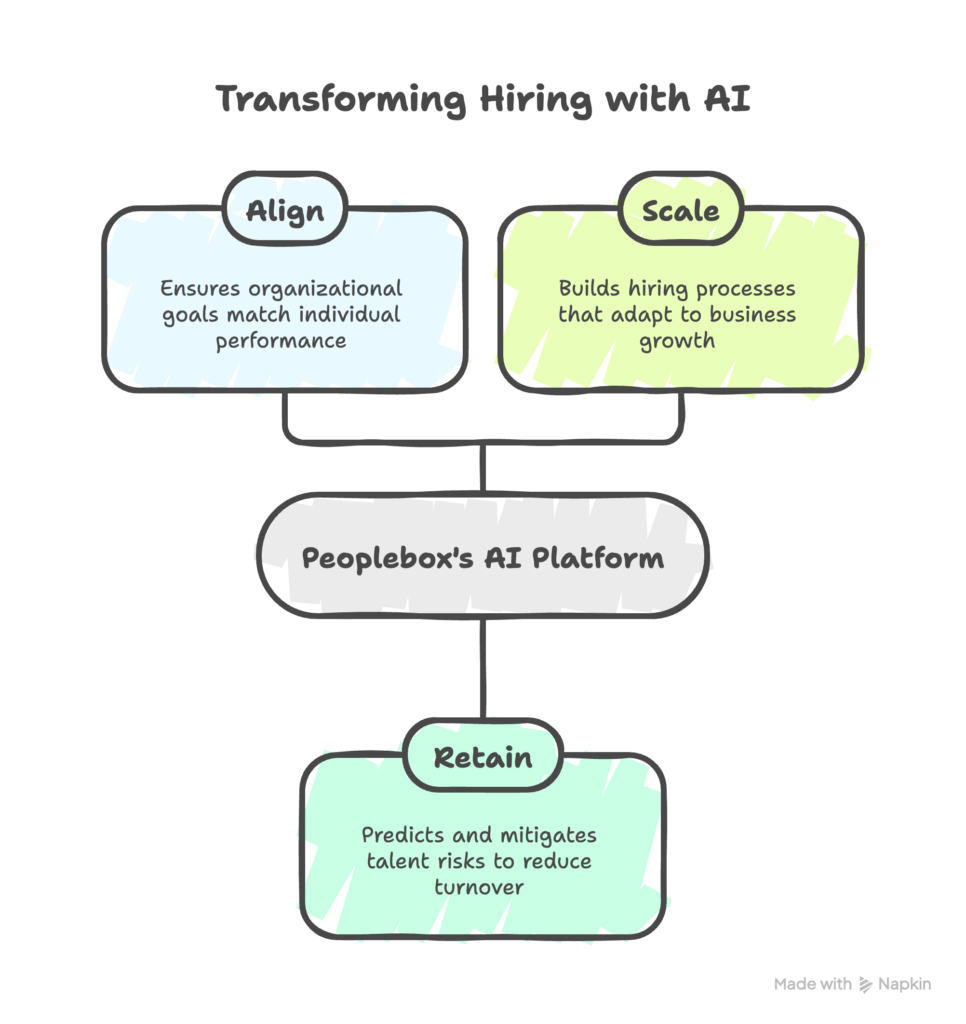
The Three Pillars: Align, Retain, and Scale
Pillar 1: Align – Connecting Strategy to Individual Performance
The first pillar of Peoplebox’s impact is alignment—connecting organizational strategy to individual performance in a way that creates clarity and direction.
The Alignment Challenge
In many organizations, employees don’t understand how their daily work contributes to company objectives. They attend meetings, complete tasks, and hit metrics, but struggle to see the bigger picture. This misalignment creates inefficiency, reduces engagement, and makes it difficult to make strategic hiring decisions.
Peoplebox solves this through its integrated OKR system. When organizations define company-level OKRs, they cascade these down to team and individual levels. Each employee sees exactly how their responsibilities connect to organizational priorities. During hiring, recruiters understand not just what skills are needed, but how candidates will contribute to strategic objectives.
AI-Driven Alignment Insights
The platform uses AI to analyze alignment across the organization. It highlights gaps where goals aren’t clearly connected and opportunities where cross-functional collaboration could amplify impact. Managers receive recommendations on how to structure team goals to maximize alignment with company strategy.
This level of sophistication transforms hiring from a tactical necessity into a strategic process. Recruiters don’t just fill open positions; they build teams positioned to achieve specific strategic objectives. When every hire directly contributes to company goals, time-to-productivity accelerates and overall hiring ROI improves dramatically.
Pillar 2: Retain – Predictive Analytics That Stop Turnover Before It Starts
The second pillar focuses on retention—using people analytics to identify and prevent preventable turnover.
The Retention Imperative
Employee turnover is both costly and disruptive. Retaining top talent requires understanding employee needs, predicting attrition patterns, and proactively enhancing job satisfaction. Organizations that leverage people analytics gain a strategic advantage by using data-driven insights to refine their retention strategies systematically.
Peoplebox’s predictive analytics engine works continuously in the background, analyzing multiple data streams: engagement survey responses, performance trends, one-on-one meeting notes, career development activities, and compensation alignment. The system learns patterns that indicate flight risk—not just obvious signals like poor performance reviews, but subtle indicators like declining meeting attendance, reduced collaboration with colleagues, or lack of new skill development.
Proactive Intervention Capabilities
When the system identifies an at-risk employee, it immediately alerts managers and HR teams with specific context. Rather than a generic “John might leave,” Peoplebox provides insights like “John’s engagement has declined 15% over the past two quarters, he hasn’t completed any learning activities in the current cycle, and his compensation is 8% below market for his role and experience level.”
Armed with this intelligence, managers can have targeted conversations addressing root causes. Perhaps the employee needs a new challenge or different project assignment. Maybe compensation adjustment is warranted. In other cases, a mentorship relationship or leadership development opportunity might be the retention lever.
Enhanced Employee Engagement
Peoplebox analyzes feedback from employee surveys, pulse checks, and performance reviews to measure engagement levels holistically. Rather than relying on annual engagement surveys that provide outdated insights, the platform processes continuous feedback signals, creating a real-time engagement pulse across the organization.
HR teams use these insights to tailor engagement initiatives—career development programs, mentorship opportunities, flexible work arrangements, or team-building activities—based on what actually drives engagement for different employee segments.
Pillar 3: Scale – Building Hiring Processes That Grow With Your Organization
The third pillar addresses scalability—creating hiring processes that efficiently manage volume while maintaining quality and speed.
The Scale Challenge
Many organizations discover that their hiring processes break down when they need to scale. What worked for hiring 20 people annually doesn’t function when the company needs to onboard 200. Manual processes create bottlenecks, consistency deteriorates, and top candidates slip away to competitors with faster processes.
Peoplebox’s platform includes AI-powered automation that transforms the hiring pipeline. Skills-based matching algorithms interpret job descriptions the way experienced recruiters would, extracting required and adjacent skills while understanding context. Candidates are ranked by how closely their experience aligns with requirements, dramatically reducing manual filtering time.
Efficiency Through Automation
According to industry benchmarks, organizations leveraging automated talent pipelines can reduce time-to-hire by 40-50%. For Peoplebox users, this translates to filling critical roles faster while improving quality-of-hire. Automated screening ensures consistency—every candidate evaluated against the same rigorous criteria, eliminating unconscious bias that often affects manual reviews.
Candidate engagement scales through AI-powered communication. Chatbots provide 24/7 responses to candidate inquiries, schedule interviews, and maintain engagement throughout the hiring process. This continuous communication keeps candidates warm and dramatically improves offer acceptance rates, particularly important when hiring volumes spike.
Real-Time Pipeline Visibility
Peoplebox dashboards provide recruiters, hiring managers, and HR leaders with real-time visibility into every stage of the hiring pipeline. Instead of discovering bottlenecks after the fact, teams see them in real-time and can adjust priorities accordingly. Custom reporting enables leaders to understand pipeline health, candidate quality, recruiter productivity, and hiring cycle trends.
This visibility supports data-driven decision-making at scale. Leaders can identify which recruiting channels produce the highest-quality candidates, which interview techniques predict job performance, and which onboarding practices minimize early-stage attrition.
AI as Your Strategic Talent Partner in 2025
Artificial intelligence powers Peoplebox’s transformation from a traditional HR platform to an active strategic partner in building exceptional teams.
Agentic AI: Beyond Recommendations to Action
In 2025, AI is evolving from providing recommendations to taking action autonomously. Peoplebox’s agentic AI capabilities mean that rather than simply suggesting that a candidate deserves a second interview, the system can autonomously schedule that interview, notify relevant parties, and coordinate logistics.
Similarly, the platform can identify that an at-risk employee would benefit from a mentorship relationship and automatically connect them with an appropriate mentor from within the organization. It can recommend career development paths based on skill gaps and marshal the right training programs, project assignments, and learning opportunities to support growth.
Ethical AI and Bias Mitigation
As organizations increasingly rely on AI for hiring and talent decisions, ethical considerations have become paramount. Peoplebox implements robust safeguards to ensure fairness and transparency in all AI-driven recommendations.
The platform detects and mitigates bias in hiring decisions, ensuring that candidates are evaluated based on skills and qualifications rather than demographic characteristics. Machine learning algorithms are continuously audited for fairness, and explainable AI features ensure that every recommendation includes reasoning visible to both users and compliance teams.
This commitment to ethical AI is increasingly important as regulatory frameworks like the EU’s AI Act and similar regulations in the US and Asia-Pacific require transparency and bias auditing in employment systems. Organizations using Peoplebox can confidently demonstrate that their talent decisions meet regulatory requirements while maintaining competitive advantage.
Natural Language Processing for Deeper Insights
Peoplebox leverages natural language processing to extract insights from unstructured data throughout the employee lifecycle. Feedback from performance reviews, one-on-one conversations, engagement surveys, and exit interviews is analyzed to identify patterns and themes that might not emerge from traditional metrics.
For example, NLP can identify early warning signs in one-on-one meeting notes—a manager might mention that an employee “seems less engaged” without explicitly connecting this to retention risk. Peoplebox’s algorithms recognize these patterns across thousands of conversations and alert HR teams to potential issues.
Transforming Hiring: From Reactive to Strategic
Peoplebox fundamentally changes how organizations approach hiring, moving from reactive processes focused on filling vacancies to strategic processes focused on building competitive advantage.
Skills-Based Hiring Over Credentials
In 2025, organizations are increasingly prioritizing skills over traditional credentials. A degree that seemed relevant five years ago might not prepare an employee for today’s rapidly evolving role. Peoplebox’s platform maps competencies rather than just credentials, enabling skills-based matching that predicts job success more accurately than traditional resume screening.
This shift opens opportunities for organizations to build diverse talent pipelines. A candidate without a traditional degree but with the right skills and learning ability becomes a viable candidate. This approach broadens the talent pool, reduces hiring bias, and often identifies candidates more motivated to prove themselves through performance.
Predictive Quality-of-Hire Indicators
Beyond the hiring metrics most organizations track—time-to-fill and cost-per-hire—Peoplebox enables measurement of quality-of-hire through predictive indicators. The platform analyzes historical hiring data to identify which candidates actually performed well after hire and what characteristics they shared during the recruitment process.
Using these patterns, the system identifies new candidates likely to become top performers. This dramatically shifts the hiring outcome, with organizations no longer simply filling positions but building teams of high-potential talent.
Accelerated Time-to-Productivity
A critical metric most organizations overlook is time-to-productivity—how long it takes a new hire to perform at the level of an experienced employee. Peoplebox optimizes this through intelligent onboarding.
The platform analyzes what new hire characteristics and onboarding approaches correlate with faster productivity. For example, it might identify that certain types of mentorship relationships accelerate learning, or that specific project assignments in the first 90 days better prepare new hires for full responsibility.
By implementing these insights systematically, organizations can cut time-to-productivity from months to weeks, dramatically improving ROI on recruitment investment.
Real-World Impact: How Organizations Benefit from Peoplebox
The impact of Peoplebox extends across organizations of different sizes and industries. Companies leveraging the platform report measurable improvements across critical metrics.
Recruitment Efficiency: Organizations reduce time-to-hire by 30-40%, enabling faster response to competitive talent markets. When top candidates are deciding between multiple offers, speed matters enormously.
Retention Improvements: With predictive analytics identifying at-risk employees, proactive interventions prevent 20-30% of potentially preventable turnover. For large organizations, this translates to millions in avoided turnover costs.
Alignment and Engagement: By connecting individual goals to company strategy through OKRs, employees feel more engaged and purposeful. Engagement surveys show measurable increases when employees understand how their work contributes to organizational success.
Hiring Quality: Quality-of-hire metrics improve as skills-based matching replaces credential-based screening. New hires become productive faster and tend to perform at higher levels than traditionally recruited peers.
Cost Reduction: Automation of routine recruiting tasks reduces recruiter workload by 35-40%, enabling smaller recruiting teams to handle significantly larger volume. Combined with reduced turnover, total talent acquisition costs decline even as hiring volume increases.
Implementing Peoplebox: Key Considerations for 2025
Organizations considering Peoplebox should approach implementation strategically to maximize impact.
Start With Strategy Alignment: Before implementing OKR software, ensure your organization has clear strategic priorities. Peoplebox amplifies strategic clarity, but can’t create strategy where none exists.
Invest in Change Management: Moving from disconnected legacy systems to an integrated talent platform requires cultural shift. Employees and managers need training to adopt new workflows and trust AI-powered recommendations.
Prioritize Data Quality: People analytics capabilities are only as valuable as the data feeding them. Ensure your employee data is accurate, complete, and regularly maintained.
Define Success Metrics: Before implementation, identify which metrics matter most to your organization—whether reducing time-to-hire, improving retention, increasing alignment, or some combination. Track these metrics closely to measure ROI.
Leverage Integration Ecosystem: Peoplebox integrates with numerous HR systems, business tools, and communication platforms. Strategic integrations enable seamless data flow and eliminate manual entry.
The Future of Talent Management: Unified, Intelligent, Human-Centered
As we progress through 2025, talent management is evolving toward a new paradigm. The traditional HR technology stack of disparate systems is giving way to unified platforms that consolidate OKR management, performance management, talent acquisition, and people analytics. Within these platforms, artificial intelligence operates not as a replacement for human judgment but as a strategic partner that handles routine work, surfaces insights, and enables humans to focus on what machines cannot replicate—building relationships, demonstrating empathy, and making nuanced decisions.
Peoplebox exemplifies this evolution. It combines powerful AI capabilities with deeply human-centered design. The platform automates the mechanical aspects of talent management while creating space for more meaningful conversations between managers and employees, more strategic decisions by HR leaders, and more purposeful work by individual contributors.
Conclusion: Align, Retain, and Scale Your Talent Strategy
The businesses succeeding in 2025 are those that treat talent as their most critical strategic asset. They invest in platforms that provide real-time visibility into goal alignment, predict talent risks before they become crises, and build hiring processes that scale without sacrificing quality.
Peoplebox delivers exactly this capability. By unifying OKR management, talent management, and people analytics in a single AI-powered platform, Peoplebox enables organizations to align their teams around shared strategy, identify and retain top talent, and build scalable hiring processes that drive growth.
Whether you’re a high-growth startup scaling from 100 to 1,000 employees, an established enterprise refining your talent strategy, or a global organization managing talent across geographies, Peoplebox provides the unified visibility and AI-powered intelligence needed to win in the war for talent.
In a world where top talent is increasingly scarce and the cost of turnover increasingly significant, aligning your team, retaining your best performers, and scaling your hiring capability isn’t optional—it’s the competitive advantage that separates market leaders from the rest. Peoplebox provides the platform to make this possible.
FAQ’s
1. What is the main difference between Peoplebox and traditional HR software?
Unlike traditional HR software that operates as disconnected point solutions—with recruitment in one system, performance reviews in another, and compensation management in a third—Peoplebox provides a unified ecosystem. It seamlessly integrates OKR management, talent acquisition, performance management, and people analytics into a single platform. This unified approach eliminates data silos, enables real-time visibility across the entire talent lifecycle, and allows organizations to connect strategic priorities directly to hiring and development decisions. The result is better-informed talent decisions and significantly improved time-to-productivity for new hires.
2. How does Peoplebox’s AI help reduce hiring bias?
Peoplebox implements multiple layers of bias mitigation throughout the AI hiring pipeline. The platform uses explainable AI features that provide transparent reasoning for every candidate recommendation, enabling hiring teams to understand how decisions are made. Machine learning algorithms are continuously audited for fairness across demographic groups, and the system flags potential bias indicators. Additionally, skills-based matching moves evaluation beyond credentials and traditional resume screening—factors that often embed historical biases—toward objective competency assessment. The platform also supports diverse candidate sourcing by identifying qualified candidates who might be overlooked by traditional methods, broadening your talent pool while maintaining hiring quality.
3. Can Peoplebox integrate with our existing HR tech stack?
Yes, Peoplebox is designed with integration in mind. The platform connects seamlessly with numerous HR systems, business tools, and communication platforms including ATS (Applicant Tracking Systems), payroll software, employee communication tools, calendar systems, and business intelligence platforms. Through APIs and pre-built connectors, Peoplebox can pull data from your existing systems and synchronize information in real-time. This integration capability means you don’t need to replace your entire tech stack—Peoplebox can become the unified layer that connects and enhances your existing tools while eliminating manual data entry and ensuring data consistency across systems.
4. How long does it typically take to implement Peoplebox across an organization?
Implementation timelines vary based on organization size and complexity, but typically range from 2-4 months for comprehensive deployment. The timeline includes several phases: initial system setup and configuration, data migration from legacy systems, stakeholder training, pilot testing with specific teams or departments, and full rollout. Peoplebox provides implementation support through onboarding specialists and offers training programs for managers and HR teams. Organizations can accelerate implementation by running parallel pilots—implementing with high-priority departments first while other teams continue with existing processes—and then rolling out company-wide once workflows are optimized.
5. What ROI should we expect from implementing Peoplebox?
Research indicates that organizations leveraging unified talent platforms like Peoplebox typically see measurable returns across several metrics. Time-to-hire typically reduces by 30-40%, cutting hiring cycle costs significantly. Retention improvements of 20-30% for preventable turnover translate directly to cost savings, as a single employee replacement can cost 30% of annual salary. Quality-of-hire improvements mean new employees become productive faster, reducing ramp-up time from months to weeks. Additionally, automation reduces recruiting team workload by 35-40%, enabling smaller teams to manage larger hiring volumes. Most organizations recoup their Peoplebox investment within 6-12 months through these combined efficiency and retention gains.
6. How does Peoplebox’s predictive analytics identify at-risk employees?
Peoplebox’s predictive analytics engine continuously analyzes multiple data streams throughout the employee lifecycle, including engagement survey responses, performance trends, one-on-one meeting notes, learning activity participation, collaboration patterns, and compensation data. The system learns which combinations of signals correlate with actual turnover by analyzing historical HR data. When current employee patterns match these predictive models, the platform alerts managers and HR teams with specific context—not just “John might leave,” but “John’s engagement declined 15%, he hasn’t completed learning activities this quarter, and his compensation is 8% below market.” This specificity enables targeted interventions addressing root causes rather than generic retention attempts.
7. Is Peoplebox suitable for small companies, or is it designed only for enterprises?
Peoplebox serves organizations across the spectrum, from growth-stage startups to large enterprises. The platform offers flexible pricing tiers starting at $7 per person per month for talent management functionality and $8 per person per month for OKR platform access, scaling up to $15 per month for comprehensive premium suites with dedicated customer success management. For smaller organizations, starting with either the OKR platform or talent management module and expanding later is common. Peoplebox’s scalability means the platform grows with your organization—processes that work for 50 employees can scale efficiently to 5,000 without architecture changes. This scalability makes Peoplebox practical for organizations at any growth stage.
8. How does Peoplebox ensure employee data privacy and security?
Peoplebox prioritizes employee data privacy through multiple security measures. The platform implements encryption for data in transit and at rest, employs role-based access controls ensuring employees see only relevant data, and maintains compliance with major regulatory frameworks including GDPR, CCPA, and similar regulations. Importantly, Peoplebox distinguishes between data necessary for operational decisions and sensitive personal information—using a “collect what you need” approach rather than surveillance-style data gathering. The platform supports transparent communication with employees about what data is collected and how it’s used, which research shows actually improves employee trust and engagement rather than creating privacy concerns. Regular security audits and penetration testing ensure ongoing protection against emerging threats.
9. How can we ensure manager adoption of Peoplebox’s tools and features?
Manager adoption is critical to Peoplebox success, and the platform supports this through several mechanisms. First, comprehensive manager training programs help teams understand how Peoplebox simplifies their daily work rather than adding burden. The platform includes AI coaching prompts that guide managers toward more effective one-on-ones and performance conversations, with automated summary generation reducing administrative work. Gradual rollout starting with early-adopter managers who champion the platform to peers builds momentum. Executive sponsorship emphasizing how Peoplebox enables strategic talent decisions (not just compliance) helps secure manager buy-in. Additionally, Peoplebox provides ongoing support and quick-win success stories showing managers how the platform improves their effectiveness.
10. Can Peoplebox help with succession planning and internal mobility?
Absolutely. Peoplebox’s integrated approach makes succession planning significantly more effective than traditional methods. The platform uses people analytics to identify high-potential employees likely to succeed in leadership roles, mapping skill gaps between current and target positions. OKR alignment reveals which employees are executing at strategic priority levels, often indicating readiness for expanded responsibility. The talent management module tracks learning activities and development progress, showing who is actively preparing for career advancement. Additionally, skills-based job matching enables internal mobility by identifying employees whose capabilities exceed current role requirements and suggesting lateral or advancement opportunities. This proactive approach to succession planning and internal mobility improves retention of top talent while filling leadership gaps from within rather than expensive external recruiting.
11. How does Peoplebox’s OKR cascading work, and why is it important?
OKR cascading is the process where company-level strategic objectives flow downward through organizational hierarchy, with each level translating company OKRs into their own objectives. This cascading ensures strategic alignment throughout the organization. In Peoplebox, executives set company OKRs first; department leaders review these and define their team OKRs in support of company priorities; individual employees then set personal OKRs supporting their team’s objectives.
This creates a visible chain of logic connecting an individual employee’s daily work to company strategy. The importance is profound: research shows organizations with strong alignment demonstrate higher engagement, faster strategy execution, and better hiring decisions because recruiting teams understand not just what roles are needed, but how they support strategic priorities. Peoplebox automates the cascading process and provides transparency so every employee sees how their work contributes to company success.
12. What does Peoplebox’s AI coaching for performance management actually do?
Peoplebox’s AI coaching transforms performance management from annual compliance rituals into continuous development. The system provides built-in coaching prompts that guide managers toward more effective one-on-one conversations, suggesting discussion topics based on employee progress against goals and development needs. During performance reviews, the platform automatically generates summaries of the review period, extracting themes from throughout the year rather than relying on recent-memory bias.
The AI identifies patterns in feedback that might indicate skill development opportunities or potential concerns requiring intervention. Importantly, coaching focuses on strengths-based development rather than purely deficit-focused criticism. This continuous feedback approach creates a culture where coaching and development are embedded into normal workflows, improving employee engagement and retention while reducing the administrative burden of traditional review processes.
13. How does Peoplebox improve hiring speed without sacrificing quality?
Peoplebox accelerates hiring through strategic automation of routine tasks without compromising quality decisions. Skills-based matching algorithms rapidly screen candidates, identifying those whose experience aligns with role requirements much faster than manual review. Automated candidate communication—scheduling interviews, answering FAQs, maintaining engagement—eliminates administrative delays that extend hiring timelines. Real-time hiring pipeline dashboards reveal bottlenecks immediately, allowing teams to address delays before they compound.
Quality is maintained because humans focus on high-judgment decisions: candidate conversations, cultural fit assessment, and final hiring authority. By automating the mechanical aspects, hiring teams spend more time on substantive evaluation rather than paperwork. Additionally, predictive quality-of-hire indicators help teams prioritize strongest candidates, improving offer acceptance rates and reducing time spent on unlikely candidates.
14. What’s the difference between Peoplebox’s talent management and professional service implementation approaches?
Peoplebox offers different implementation approaches depending on customer needs and sophistication. Basic talent management focuses on recruitment, performance management, and engagement—delivering core HR functionality. Professional service implementations, often called the “Full Suite – Premium” offering at $15 per person per month, include dedicated customer success management, customized onboarding, and manager training ensuring the organization maximizes platform value.
Enterprise implementations add SSO (Single Sign-On), custom integrations with proprietary legacy systems, and tailored workflows reflecting your unique HR processes. The professional service approach is recommended for larger organizations or those with complex HR needs, while smaller organizations often start with basic offerings and upgrade as they expand. All approaches include the same underlying AI and analytics capabilities—the difference is in implementation support and customization level.
15. How can we measure whether Peoplebox is delivering promised business outcomes?
Peoplebox enables measurement across multiple success dimensions, and establishing baseline metrics before implementation is critical. Key metrics to track include: Time-to-hire (comparing pre- and post-implementation hiring cycle length); Cost-per-hire (total recruitment expenses divided by hires); Quality-of-hire (new employee performance and retention at 6 and 12 months); Employee retention rate (especially for high-performers identified by analytics); Time-to-productivity (how long until new employees perform at experienced employee levels); Manager adoption rate (percentage using coaching and OKR features); OKR alignment score (percentage of team OKRs visibly connected to company strategy); and Total Cost of Ownership (recruiting, learning, and HR operational costs).
Peoplebox’s built-in reporting dashboards provide visibility into most metrics automatically. Comparing metrics at 3-month, 6-month, and 12-month intervals shows whether improvements are tracking toward projected ROI. Organizations typically see meaningful improvements in hiring efficiency within 3 months and retention improvements within 6 months.





One Comment