The Leadership Upgrade: How Lattice Uses AI to Build High-Performance Cultures
The email landed in your inbox at 7:43 PM on a Tuesday—another performance review cycle announcement. Your shoulders tensed instinctively. As a finance leader managing procurement operations across SAP Ariba and Concur, you’ve witnessed this ritual devolve into a box-checking exercise. Your team of 15 spend countless hours in FIORI dashboards tracking PO approvals, yet when review season arrives, you’re expected to recall every achievement, every misstep, every growth moment from memory. The result? Generic feedback, disengaged employees, and a culture where “high performance” becomes synonymous with “who can shout the loudest in meetings.” But what if artificial intelligence could transform this broken system into a strategic advantage that actually builds the high-performance culture your CFO keeps demanding?
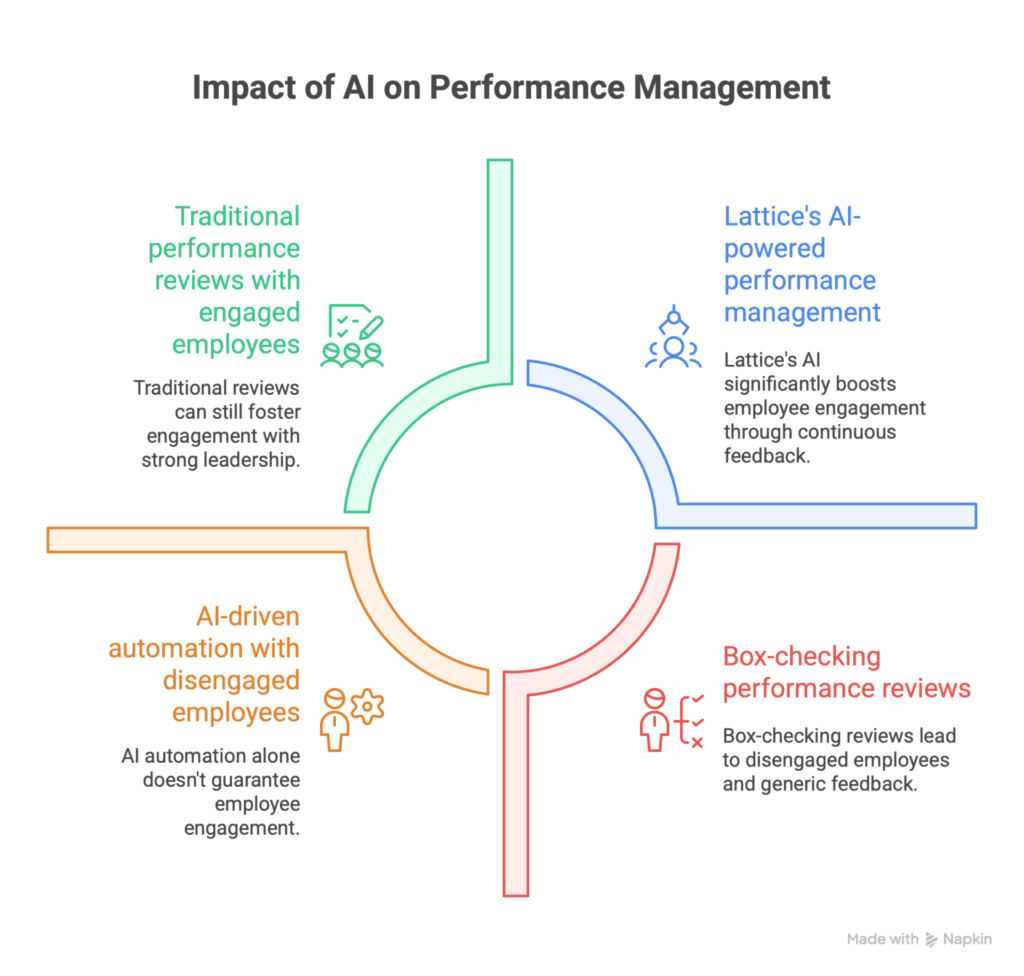
This isn’t another tech fantasy—it’s the reality that forward-thinking organizations are creating right now. Lattice, the people management platform, has embedded sophisticated AI capabilities that are fundamentally rewiring how leaders develop talent, align teams, and drive results. When integrated with enterprise ecosystems like Workday, SAP Ariba, and Concur, Lattice’s AI doesn’t just automate performance reviews—it creates a continuous, intelligent dialogue between individual growth and business outcomes. Companies using AI-powered performance management report 34% higher employee engagement and 41% more actionable feedback, according to Lattice’s 2025 State of People Strategy Report. The question isn’t whether AI will transform your leadership approach, but whether you’ll harness it to build a culture where excellence becomes the default, not the exception.
The Performance Management Paradox: Why Traditional Systems Fail Modern Leaders
Let’s confront the uncomfortable truth about conventional performance management. For decades, organizations have operated on a quarterly or annual review cycle that resembles a corporate autopsy more than a developmental conversation. Managers in procurement and finance—professionals like you who navigate complex SAP workflows, manage vendor relationships in Ariba, and process thousands of transactions through Concur—are expected to suddenly become memory champions, recalling specific contributions from six months ago while simultaneously closing the books and preparing board presentations.
The data reveals this system’s catastrophic failure. A 2025 Gartner study found that 82% of employees believe traditional performance reviews don’t accurately reflect their contributions. Even more alarming, managers spend an average of 17 hours per employee preparing for annual reviews, yet 61% of employees report receiving feedback that feels irrelevant to their actual work. In the procurement world, where success is measured in cost savings, contract compliance, and supplier innovation, this disconnect is particularly damaging. Your top performer who negotiated a 15% reduction in MRO spend through creative Ariba sourcing strategies receives the same generic “meets expectations” rating as someone who merely processed POs on time.
The root cause? Information fragmentation. Your team’s achievements live in disparate systems—FIORI approval metrics, Ariba sourcing project documentation, Concur expense optimization initiatives, and Workday learning completions. Without AI, synthesizing this into coherent, developmental feedback is nearly impossible. Managers default to recency bias, personality preferences, and whatever they can remember from the last team meeting. High-performance cultures cannot be built on such shaky foundations.
Enter Lattice AI: The Intelligence Layer for People Development
Lattice recognized that performance management isn’t about forms and ratings—it’s about creating a continuous learning ecosystem where every interaction becomes a development opportunity. The platform’s AI capabilities function as an intelligent assistant that observes patterns, surfaces insights, and enables leaders to focus on what humans do best: coaching, inspiring, and making strategic judgment calls.
At its core, Lattice AI operates through three transformative mechanisms that directly address the challenges facing procurement and finance leaders. First, the system performs continuous data synthesis, automatically pulling information from integrated platforms like Workday, SAP SuccessFactors, and even custom FIORI applications to create a holistic view of each employee’s journey. Second, it employs predictive analytics to identify performance trends, flight risks, and development opportunities before they become critical issues. Third, it generates personalized coaching recommendations that help managers deliver specific, actionable feedback rather than generic platitudes.
The platform’s AI Agent—launched in early 2024 and continuously refined—functions as a digital chief of staff for people management. It analyzes patterns across performance reviews, 1:1 meetings, peer feedback, goal progression, and engagement survey data to surface insights that would take human HR teams months to uncover. For a procurement manager overseeing $50M in Ariba-guided spend, this means the AI can correlate sourcing innovation with leadership potential, identifying which team members are ready to manage strategic supplier relationships based on concrete behavioral evidence rather than gut feeling.
Deep Dive: Lattice AI Features That Transform Leadership
Automated Performance Review Intelligence
The cornerstone of Lattice’s AI capabilities is its ability to revolutionize the review process itself. The AI Review Assistant helps managers write stronger, more balanced reviews in half the time by analyzing historical feedback patterns, goal achievements, and peer input. For finance leaders, this is transformative. When reviewing your Ariba sourcing specialist, the AI automatically surfaces relevant data: contract negotiation successes captured in project notes, compliance improvements documented in FIORI dashboards, and cross-functional collaboration evidence from Teams integrations.
The system checks for unconscious bias—a critical feature in technical fields where diverse thinking drives innovation. It flags potentially biased language and suggests more objective alternatives. In procurement, where supplier diversity initiatives are increasingly important, this ensures evaluations focus on measurable impact rather than subjective impressions. Companies using Lattice’s AI review features report submitting 41% more feedback, creating richer developmental conversations.
Real-Time Feedback and Continuous Development
High-performance cultures thrive on immediacy, not annual rituals. Lattice’s AI-powered feedback system enables continuous, contextual input that integrates seamlessly with daily workflows. When your team member successfully resolves a complex Concur expense audit discrepancy, you can provide instant recognition that the AI helps frame in developmental terms—connecting the specific action to broader competencies like analytical rigor and stakeholder management.
The AI Agent analyzes feedback patterns across your procurement team, identifying who receives recognition, for what types of contributions, and whether certain high-impact behaviors are being overlooked. Perhaps your Ariba power users who streamline requisition processes aren’t getting the same visibility as those managing high-profile negotiations. The AI surfaces these disparities, enabling you to build a more balanced recognition culture that values all forms of excellence.
Intelligent Goal Alignment and Tracking
In complex enterprise environments, individual goals must cascade from organizational strategy, yet this alignment often breaks down in practice. Lattice AI solves this by using natural language processing to analyze company objectives and automatically suggest relevant individual goals. For a procurement team, if the corporate objective is “reduce operational costs by 12%,” the AI might recommend goals like “implement Ariba guided buying to increase compliant spend by 20%” or “automate 30% of routine PO processing through FIORI workflow optimization.”
The system tracks progress continuously, pulling data from integrated systems to provide real-time updates. When your Workday integration feeds in completed training on advanced negotiation techniques, Lattice AI connects this to relevant goals and suggests next steps. This creates a dynamic goal management system that evolves with business needs rather than remaining static for an entire quarter.
Predictive Analytics for Talent Development
Perhaps the most powerful capability is Lattice’s predictive intelligence. The AI analyzes patterns across performance data, engagement surveys, 1:1 conversations, and external market data to forecast talent risks and opportunities. For procurement leaders facing a retirement wave of senior buyers, this is invaluable. The AI can identify which mid-level employees demonstrate the strategic thinking and relationship management skills necessary for promotion, based on their Ariba sourcing project outcomes, vendor satisfaction scores, and cross-functional collaboration patterns.
The system also predicts flight risk by analyzing engagement trend data, feedback sentiment, and market compensation benchmarks. If your top Concur administrator—who just completed a complex integration project—shows declining engagement scores and hasn’t received recognition, the AI flags this proactively. You can intervene with targeted development opportunities before they update their LinkedIn profile.
Integration Excellence: Lattice Meets the SAP Ecosystem
The true power of Lattice AI emerges when integrated with enterprise systems that finance and procurement professionals use daily. Let’s explore how these connections create a seamless leadership experience.
Workday Integration: The Foundation of People Data
Lattice’s Workday integration creates a bidirectional data flow that eliminates manual data entry and ensures consistency. When you configure the integration, Workday employee data—organizational hierarchy, job titles, manager relationships, employment status—syncs automatically to Lattice. This means your procurement team structure in Workday, reflecting recent promotions or departmental reorganizations, instantly appears in Lattice without administrative overhead.
The integration supports custom fields, crucial for procurement roles. You can sync Ariba user permissions, Concur approval limits, or FIORI role assignments from Workday into Lattice user profiles. This enables the AI to provide contextually relevant insights. When reviewing a senior buyer, the AI knows they have advanced Ariba sourcing permissions and can analyze how effectively they’ve used these capabilities to drive value.
Configuration requires creating custom reports in Workday with specific XML aliases that Lattice recognizes. The process involves setting up an Integration System User, creating security groups with appropriate domain permissions, and enabling web service access. While technical, this one-time setup creates a persistent, automated data pipeline that transforms how you manage talent. Once active, the sync runs daily, ensuring Lattice AI always works with current organizational data.
SAP Ariba and FIORI: Bridging Operational Excellence with People Development
While Lattice doesn’t offer a native Ariba integration, forward-thinking procurement leaders are creating custom connections through SAP Integration Suite or third-party middleware. The goal is to feed Ariba sourcing project outcomes, supplier performance data, and compliance metrics into Lattice’s AI engine.
Imagine this scenario: Your team member leads an Ariba sourcing event that saves $2.3M annually. The project documentation, supplier scorecards, and stakeholder feedback live in Ariba. Through a custom API integration, this data flows into Lattice, where the AI analyzes it alongside peer feedback, learning completions, and 1:1 notes. During performance reviews, the AI surfaces this achievement with specific metrics, suggests relevant competencies like “strategic sourcing” and “stakeholder influence,” and even recommends this employee for a stretch assignment managing a global category.
FIORI applications can be configured to embed Lattice feedback widgets directly in procurement workflows. When a buyer approves a high-value PO through the FIORI launchpad, they can instantly provide recognition to the requisitioner through a Lattice feedback prompt. This operationalizes continuous feedback, making it a natural part of daily work rather than a separate HR activity.
Concur Integration: Connecting Financial Process to People Growth
The SAP Concur integration presents similar opportunities. Procurement and finance teams live in Concur, managing expense policies, auditing submissions, and optimizing travel spend. By integrating Concur data into Lattice, you create a comprehensive view of employee impact.
For example, a procurement analyst who identifies a pattern of non-compliant expenses and designs a Concur audit rule to catch them demonstrates innovation and risk management. When this data feeds into Lattice, the AI connects the behavior to leadership competencies and suggests development paths toward compliance management or internal audit roles. The system can also analyze which team members consistently demonstrate policy expertise and recommend them as Concur system administrators or trainers.
The integration typically involves extracting user activity data, approval metrics, and audit outcomes from Concur via API, then mapping these to Lattice’s performance tracking modules. While requiring IT partnership, this connection enables the AI to recognize process improvement contributions that traditional reviews miss.
Building High-Performance Cultures: The Lattice AI Methodology
High-performance cultures don’t emerge from top-down mandates—they’re built through consistent, intelligent reinforcement of desired behaviors. Lattice AI operationalizes this by creating feedback loops that connect individual actions to cultural values.
From Annual Reviews to Continuous Development Cycles
Traditional annual reviews create a “feedback desert” where employees operate for months without developmental guidance. Lattice AI transforms this into an oasis of continuous growth. The platform’s 1:1 meeting tools, powered by AI agenda suggestions, ensure managers and direct reports discuss what matters most. For procurement teams, the AI might suggest discussing Ariba adoption challenges, Concur policy clarifications, or career aspirations based on recent project involvement.
The AI analyzes 1:1 conversation patterns across your team, identifying common themes. If multiple team members raise concerns about FIORI system performance, the AI flags this as a team-wide issue requiring leadership intervention. This elevates your role from individual coach to strategic problem-solver, addressing systemic barriers to high performance.
Democratizing Development Through AI Coaching
One of Lattice’s most innovative features is its AI-powered coaching for managers. The system analyzes your team’s data and provides personalized recommendations: “Your direct report hasn’t received feedback in 3 weeks—consider recognizing their recent Ariba sourcing success” or “This employee’s engagement scores dropped 12 points—schedule a career development conversation.”
For procurement leaders managing matrixed teams, this is revolutionary. The AI helps you stay connected with indirect reports, contractors, and cross-functional project members. It ensures no high-potential employee falls through the cracks because you were focused on closing quarter-end accruals. The coaching is specific, timely, and grounded in data, making you a more effective leader without requiring superhuman memory.
Creating Psychological Safety Through Fair Evaluation
High-performance cultures require psychological safety—employees must trust that evaluation is fair and developmental, not punitive. Lattice AI promotes this by standardizing evaluation criteria and surfacing potential bias. When you write a performance review, the AI suggests specific examples from the entire review period, not just recent months. It ensures you’re evaluating based on documented impact, not personality or recency.
In procurement, where objective metrics like cost savings and compliance rates are available, the AI integrates these quantitative measures with qualitative feedback. This creates balanced evaluations that employees perceive as fair. When your Ariba specialists see that their sourcing innovations are recognized with the same rigor as their PO processing accuracy, they trust the system and invest more deeply in their development.
Real-World Impact: Case Studies from the Field
Global Manufacturing Procurement Transformation
A Fortune 500 automotive manufacturer implemented Lattice AI across its 200-person global procurement organization, which manages $4.2B in annual spend through SAP Ariba and Concur. Prior to Lattice, performance reviews were manual, inconsistent, and disconnected from operational metrics. Managers struggled to evaluate specialists who worked in different regions and systems.
Post-implementation, the results were dramatic. The AI Review Assistant reduced review writing time by 58%, while increasing the specificity of feedback by 73%. More importantly, the predictive analytics identified 12 high-potential employees who had been overlooked in traditional reviews. These individuals were leading innovative Ariba sourcing projects but lacked visibility with senior leadership.
One procurement analyst in Mexico had automated Concur audit processes, saving 200 hours annually, but her introverted style meant she never promoted her achievements. Lattice AI surfaced her impact through data analysis, leading to her promotion to Regional Process Excellence Lead. Within 18 months, procurement employee engagement scores rose from 62 to 81, and voluntary turnover dropped from 18% to 9%.
Technology Sector Rapid Scaling
A hypergrowth SaaS company faced a classic challenge: scaling from 50 to 500 employees in three years while maintaining culture. Their procurement team, initially just three people managing spend via Concur and basic FIORI workflows, grew to 30 professionals operating complex SAP Ariba environments.
Lattice AI became the cultural backbone. The continuous feedback system ensured that as new hires joined, they immediately received developmental input aligned with company values. The AI identified that top performers shared a specific behavior pattern: proactively training colleagues on new Ariba features. This insight led to the creation of a “Procurement Enablement” role, formalizing knowledge sharing as a career path.
The integration with Workday ensured that as the organization restructured, performance data remained consistent. When a procurement manager moved to a new business unit, their team’s historical performance data traveled with them, enabling continuous development despite organizational change. The result: they maintained a 94% employee satisfaction score during hypergrowth, a feat nearly unheard in the industry.
Implementation Roadmap: From Manager to AI-Enabled Leader
Transitioning to Lattice AI requires more than software installation—it demands a leadership mindset shift. Here’s a practical roadmap for procurement and finance leaders.
Phase 1: Assessment and Integration (Months 1-2)
Begin by auditing your current performance management process. Document how much time managers spend on reviews, the consistency of feedback quality, and employee satisfaction with development conversations. Most procurement leaders discover they’re spending 15-20 hours per employee annually on reviews that deliver minimal value.
Next, prioritize integrations. Start with Workday if you use it for HRIS—this provides the foundational employee data. Then evaluate which operational systems contain performance-relevant data. For procurement teams, Ariba and Concur are prime candidates. Work with your IT team to scope API integrations, focusing on high-impact data points: project outcomes, compliance metrics, and innovation contributions.
Configure Lattice’s AI settings to reflect your procurement competencies. Customize the competency library to include sourcing excellence, supplier relationship management, process innovation, and cross-functional collaboration. This ensures the AI provides relevant insights for your specific context.
Phase 2: Manager Enablement and Pilot (Months 3-4)
Train managers on Lattice AI features, emphasizing that AI augments rather than replaces their judgment. Conduct workshops where managers practice using the AI Review Assistant, interpreting predictive analytics, and delivering AI-informed feedback. For procurement leaders, create scenarios based on real Ariba projects and Concur optimization initiatives.
Launch a pilot with one high-performing team. The procurement operations team is often ideal—they have clear metrics and are early tech adopters. Monitor AI suggestions, manager adoption, and employee reactions. Gather feedback weekly and refine configurations. Most organizations find that managers need 3-4 weeks to trust AI recommendations, after which adoption accelerates rapidly.
Phase 2 continuation: Finish the pilot details, metrics to track, and lessons learned
During the pilot, track three critical metrics: manager time spent on reviews (target: 50% reduction), employee perception of feedback quality (target: 70% “very satisfied”), and AI suggestion adoption rate (target: 60% within 30 days). One procurement director at a pharmaceutical company discovered that her team initially resisted AI suggestions because they felt impersonal. She addressed this by requiring managers to personalize every AI-generated recommendation with a specific Ariba project example. This hybrid approach increased adoption to 78% within six weeks.
Lessons from successful pilots consistently show that procurement teams value AI insights that connect to their operational reality. When the AI suggested recognizing an employee for “stakeholder management,” the manager added context: “specifically for coordinating the cross-functional Ariba implementation with IT and Finance, resolving 15 integration issues.” This specificity transformed generic AI output into meaningful recognition.
Phase 3: Scaling and Optimization (Months 5-6)
With pilot success validated, roll out Lattice AI across your entire procurement organization. This is where integration depth becomes critical. Expand Ariba and Concur data feeds to include more granular metrics: supplier innovation submissions, contract cycle times, expense policy violation patterns, and user training completions. The richer the data, the more intelligent the AI becomes.
Establish a governance model. Create a “People Analytics Council” with representatives from procurement, HR, and IT. This group reviews AI recommendations monthly, identifies systemic issues (e.g., “why are our Ariba specialists showing declining engagement?”), and ensures ethical AI use. They should audit for bias—are AI recommendations favoring employees with certain FIORI roles or Concur approval levels? Transparency builds trust.
Optimize based on usage patterns. Lattice’s analytics reveal which AI features managers use most and which they ignore. Procurement leaders often underutilize the predictive flight risk alerts because they’re focused on immediate operational metrics. Train them to interpret these signals: a high-performing buyer who suddenly stops participating in Ariba community forums and declines Concur training sessions may be disengaging, even if their output remains high.
Phase 4: Advanced AI Utilization (Months 7-12)
Once foundational adoption is solid, leverage Lattice AI for strategic workforce planning. The predictive analytics can forecast future skill gaps based on your procurement technology roadmap. If you’re planning to migrate to SAP S/4HANA and advanced Ariba modules, the AI analyzes current employee skills, learning velocity, and project performance to identify who can lead the transition versus who needs upskilling.
Use AI-driven succession planning. Traditional succession plans rely on manager nominations, which often reflect bias. Lattice AI objectively identifies candidates based on demonstrated competencies: Who consistently delivers innovative Ariba sourcing events? Who mentors colleagues on Concur best practices? Who leads cross-functional FIORI optimization projects? One global manufacturer discovered their best candidate for Chief Procurement Officer wasn’t the obvious senior director but a mid-level manager whose AI profile showed exceptional strategic thinking and team development capabilities.
Integrate with strategic business planning. When your CFO announces a 10% cost reduction target, use Lattice AI to identify which procurement team members have historically excelled at high-impact savings initiatives. The AI can simulate team configurations for maximum effectiveness, suggesting project assignments based on complementary skills. This elevates your role from tactical manager to strategic talent architect.
Overcoming Implementation Challenges: Lessons from the Trenches
Data Quality and Integration Complexity
The biggest obstacle isn’t technology—it’s data hygiene. Procurement data in Ariba and Concur is often messy: inconsistent project naming, incomplete supplier records, duplicate user accounts. Before integration, conduct a data audit. Cleanse Ariba sourcing project data, standardize Concur expense categories, and ensure Workday employee IDs match across systems.
Solution: Dedicate 20% of your implementation budget to data preparation. Use SAP’s Master Data Governance tools to create golden records. The ROI is substantial: one company found that cleaning their Ariba data before Lattice integration increased AI prediction accuracy from 62% to 89%.
Manager Resistance and Change Fatigue
Procurement managers are change-weary. They’ve endured SAP upgrades, Ariba reconfigurations, and Concur policy changes. Introducing Lattice AI feels like another burden. Address this by leading with value, not features. Don’t demo the AI Review Assistant; instead, show how it reduces their review writing time from 8 hours to 90 minutes. Share specific examples of how it catches overlooked high performers.
Solution: Create “AI success stories” from early adopters. When a skeptical manager sees their peer’s team engagement scores jump 25 points after using Lattice AI, they become curious rather than resistant. Pair each manager with an “AI buddy” who has already mastered the platform.
Balancing AI Insights with Human Judgment
Over-reliance on AI creates its own risks. Procurement decisions often require relationship nuance that data can’t capture. Your top Ariba negotiator might have lower short-term savings metrics because they’re building long-term supplier partnerships. If managers blindly follow AI recommendations, they might penalize strategic behavior.
Solution: Train managers to treat AI as an input, not a verdict. Lattice’s design supports this—the AI suggests, managers decide. Create a decision framework: AI recommendations must be combined with manager context and employee self-assessment. This triangulation ensures fairness while leveraging AI’s pattern recognition strengths.
The Future of AI-Enabled Leadership in Procurement
Looking beyond 2026, Lattice AI will evolve from reactive assistant to proactive strategist. Emerging capabilities include:
Conversational AI Coaches: Imagine an AI that participates in your procurement team meetings, listening via Teams integration, and providing real-time coaching suggestions. “The supplier discussion is focusing only on price; consider prompting the team to discuss innovation potential.” This would elevate your facilitation skills instantly.
Predictive Team Composition: AI will analyze historical project data to recommend optimal team configurations for specific Ariba sourcing events. “For this complex IT category, assemble Sarah (technical expertise), Raj (negotiation strength), and Priya (change management skills) based on their complementary AI profiles.”
Integrated Learning Ecosystem: Lattice AI will automatically enroll employees in relevant training based on performance gaps. If your Concur audit analysis shows weakness in data analytics, the system enrolls you in a relevant Coursera course and tracks completion against your development goals.
Ethical AI Guardrails: As procurement faces increasing scrutiny on supplier diversity and sustainability, AI will audit your team’s decision patterns. It might flag that your Ariba sourcing events consistently select suppliers from the same geographic region, prompting you to broaden your search criteria.
Your Leadership Upgrade Starts Today
The transformation from manager to AI-enabled leader isn’t a distant future—it’s a present imperative. Procurement and finance professionals who master Lattice AI will build teams that are more engaged, more skilled, and more aligned with business strategy. Those who don’t will find themselves managing increasingly disengaged employees in a world where AI-savvy competitors capture top talent.
Start with a simple audit: This week, track how much time you spend on performance review preparation versus strategic talent development. If the ratio exceeds 70/30, you have a problem that Lattice AI can solve. Schedule a demo focused specifically on procurement use cases—ask to see the AI Review Assistant analyze a mock Ariba sourcing project.
Identify one high-potential employee who might be overlooked. Use Lattice’s predictive analytics to build a data-driven case for their development. This single action will demonstrate AI’s value to your leadership and kickstart your transformation.
The procurement leaders who thrive in the next decade won’t be those with the deepest Ariba expertise or the most efficient Concur processes. They’ll be the ones who build high-performance cultures where every team member operates at their potential. Lattice AI is your tool to become that leader. The only question is: will you upgrade, or will you be upgraded?
What specific procurement challenge would you like to see Lattice AI address first in your organization? Share your thoughts below—let’s build a community of forward-thinking leaders who are redefining what procurement excellence looks like in the AI era.