
The Complete Guide to Launching Your Dream Tailoring Boutique in Bengaluru 2026
Bengaluru pulses with creative energy. From the bustling streets of Commercial Street to the trendy neighborhoods of Indiranagar and Koramangala, this city breathes fashion. Every corner tells a story of style evolution, where traditional silk sarees meet contemporary western wear, and where discerning customers seek personalized fashion experiences. This vibrant tapestry creates the perfect canvas for your tailoring boutique dream.
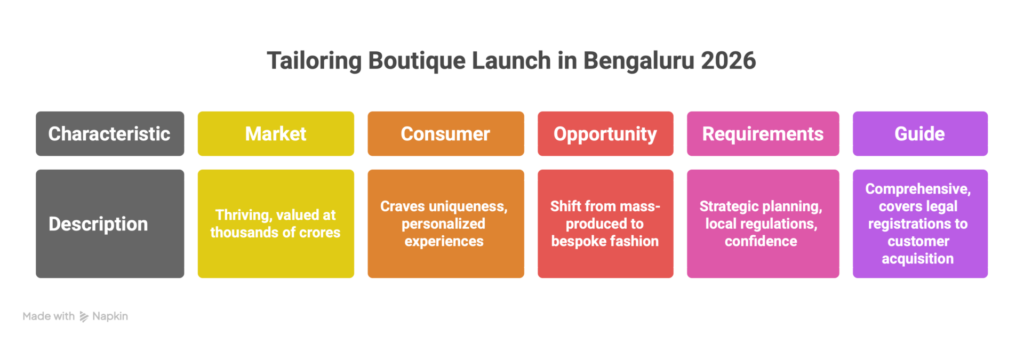
Starting a tailoring boutique here means stepping into a market valued at thousands of crores, where customization reigns supreme over ready-made garments. The modern Bengaluru consumer—whether a tech professional in Whitefield or a creative entrepreneur in HSR Layout—craves uniqueness. They want outfits that tell their story, fit perfectly, and reflect their personality. This shift from mass-produced clothing to bespoke fashion has opened unprecedented opportunities for skilled tailors and fashion entrepreneurs.
Yet, transforming your passion for fashion into a thriving business requires more than just sewing skills. It demands strategic planning, understanding local regulations, and navigating the bureaucratic landscape with confidence. This comprehensive guide walks you through every step of establishing your tailoring boutique in Bengaluru, from legal registrations to customer acquisition, ensuring your venture stands on solid foundation.
Why Bengaluru Offers Unmatched Opportunities for Tailoring Boutiques
Bengaluru’s cosmopolitan population creates a diverse customer base with varied fashion needs. The city hosts over 12 million residents, including a significant working professional segment with disposable income and fashion consciousness. Areas like MG Road, Brigade Road, and Jayanagar see constant foot traffic from shoppers seeking quality tailoring services.
The city’s climate plays a crucial role too. With moderate temperatures year-round, residents invest heavily in both traditional and western wardrobes, requiring regular tailoring services for office wear, festive occasions, and casual outfits. Moreover, Bengaluru’s status as a wedding destination means continuous demand for bridal wear customization and designer outfits.
Financial projections indicate that a well-positioned boutique serving 250+ regular clients can achieve monthly revenues of ₹1-1.5 lakhs, with established businesses reporting annual sales of ₹10-13.5 lakhs and healthy profit margins of 15%. The key lies in understanding local preferences while maintaining quality craftsmanship.
Understanding the Market Landscape (Tailoring Business)
Before stitching your first garment, invest time in market research. Walk through different neighborhoods and observe existing boutiques. Notice what they offer, their pricing strategies, and customer flow. Commercial Street and Chickpet represent traditional markets, while Indiranagar 100 Feet Road and Koramangala 80 Feet Road cater to premium clientele.
Identify gaps in the market. Perhaps there’s demand for sustainable fashion using organic fabrics, or maybe plus-size tailoring services are underserved. Talk to potential customers in your target area. Understand their pain points—are they frustrated with long turnaround times? Do they seek better fabric quality? This intelligence shapes your unique value proposition.
Consider specializing in specific niches:
- Bridal and occasion wear: High-margin but requires exceptional skill
- Corporate wear: Steady demand from working professionals
- Plus-size fashion: Growing market with limited quality providers
- Sustainable fashion: Appeals to environmentally conscious consumers
- Fusion wear: Combining Indian and western elements
Step-by-Step Registration Process
Choosing Your Business Structure (Tailoring Business)
Your first decision involves selecting the appropriate legal structure. Most tailoring boutiques start as sole proprietorships due to simplicity and minimal compliance requirements. However, if you plan to partner with someone or seek external investment, consider a partnership firm or private limited company.
Sole Proprietorship: Ideal for individual entrepreneurs. Requires minimal documentation and offers complete control. Registration involves obtaining PAN card and address proof.
Partnership Firm: Suitable when two or more people collaborate. Requires a partnership deed outlining profit-sharing and responsibilities.
Private Limited Company: Best for larger operations planning significant expansion. Requires incorporation certificate, Memorandum of Association (MOA), and Articles of Association (AOA).
Shop and Establishment Registration (Tailoring Business)
The Karnataka Shops and Commercial Establishments Act, 1961 mandates registration within 30 days of starting operations. This certificate, valid for five years and renewable, legitimizes your business and enables various operational benefits.
Registration Process:
- Visit the e-Karmika portal (Department of Labour’s official platform)
- Select ‘New Registrations’ and create an account using your mobile number and email
- Fill Form ‘A’ with establishment details, including business name, address, and employee information
- Upload required documents: Aadhaar card, PAN card, recent photograph, address proof, and rental agreement with No Objection Certificate (NOC) from property owner
- Pay registration fees based on employee count:
- Submit the application and await verification by Senior Labour Inspector
- Download certificate upon approval, typically within 3-7 working days
BBMP Trade License (Tailoring Business)
The Bruhat Bengaluru Mahanagara Palike (BBMP) trade license ensures your business complies with safety, sanitation, and zoning regulations. Schedule X of the Karnataka Municipal Corporation Act, 1976 makes this mandatory for all commercial establishments.
Eligibility Requirements:
- Business must operate within BBMP limits
- Location must align with zoning regulations (commercial or mixed-use areas)
- Premises must meet structural safety standards
- Property must have proper ventilation, lighting, and fire safety measures when required
Required Documents:
- Identity proof (Aadhaar, PAN card)
- Address proof
- Property ownership documents or rental agreement with NOC
- Latest property tax receipt
- Layout plan of premises
- Professional Tax Receipt
Application Process:
- Access BBMP trade license portal
- Complete application form with business activity details
- Upload supporting documents
- Await inspection by BBMP officials
- Pay applicable fees upon approval
- Receive license, typically within 15-30 days
Additional Registrations (Tailoring Bsuiness)
GST Registration: Mandatory if annual turnover exceeds ₹20 lakhs (₹10 lakhs for special category states). Even below this threshold, voluntary registration helps claim input tax credits on fabric and equipment purchases.
Professional Tax: Karnataka requires professional tax registration for businesses employing staff. Register through the same e-Karmika portal.
MSME Registration: Registering as a Micro, Small, or Medium Enterprise unlocks government scheme benefits, including subsidized loans and priority sector lending.
Finding the Perfect Location (Tailoring)
Location determines your boutique’s success. Bengaluru offers diverse options across different budget ranges:
High-Street Areas (Commercial Street, Brigade Road, Indiranagar 100 Feet Road):
- Pros: High footfall, premium positioning, established shopping destinations
- Cons: Expensive rentals (₹50,000-1,50,000 monthly), intense competition
Residential Localities (Jayanagar, Rajajinagar, Malleshwaram):
- Pros: Loyal local clientele, moderate rents (₹20,000-40,000), community trust
- Cons: Limited walk-in customers, need strong local marketing
Upcoming Areas (HSR Layout, Sarjapur Road, Whitefield):
- Pros: Young professional demographic, growing population, reasonable rents
- Cons: Developing infrastructure, requires digital marketing focus
Key Location Criteria:
- Ground floor visibility for walk-in customers
- Parking availability
- Proximity to main roads and public transport
- Safety and security
- Adequate space (minimum 300-500 sq ft for small boutique)
When evaluating spaces, consider future expansion needs. A boutique starting with basic alterations might evolve into full-fledged garment manufacturing, requiring additional workspace.
Setting Up Your Boutique Space (Tailoring Business)
Your boutique’s ambiance influences customer perception and willingness to pay premium prices. Design a space that reflects your brand identity while ensuring functionality.
Essential Zones:
- Reception Area: Welcoming space with seating, fabric samples, and design catalogs
- Measurement Section: Private area with proper lighting for accurate measurements
- Cutting and Sewing Zone: Well-ventilated workspace with organized tool storage
- Fitting Rooms: Comfortable, well-lit rooms with full-length mirrors
- Display Area: Showcase finished garments and fabric options
Interior Design Tips:
- Use warm lighting (4000-5000K) for accurate color representation
- Install full-length mirrors at multiple angles
- Create fabric display walls for easy browsing
- Ensure proper ventilation, especially in sewing areas
- Add comfortable seating for waiting customers
- Use neutral wall colors to make fabrics pop
Infrastructure Requirements:
- Stable electricity with backup power for sewing machines
- Adequate water supply for washing and ironing
- Proper drainage system
- Fire safety equipment (extinguishers, smoke detectors)
- Security system for valuable fabrics and equipment
Essential Equipment and Tools (Tailoring)
Quality equipment ensures consistent output and customer satisfaction. Prioritize durability over initial cost savings.
Basic Sewing Equipment:
- Industrial sewing machines (2-3 units for different operations)
- Overlock machine for finishing edges
- Embroidery machine for decorative work
- Steam iron and ironing board
- Cutting tables (minimum 6×4 feet)
- Dress forms in various sizes
- Measuring tools (tapes, rulers, curves)
Supporting Equipment:
- Computer with design software
- Printer for invoices and design prints
- CCTV cameras for security
- Air conditioning for customer comfort
- Storage racks for fabrics and finished garments
Initial Investment: Basic setup costs range from ₹2-5 lakhs, depending on equipment quality and quantity. Consider leasing expensive equipment initially to preserve working capital.
Sourcing Quality Materials and Fabrics (Tailoring)
Fabric quality defines your boutique’s reputation. Bengaluru offers excellent sourcing opportunities through local markets and direct manufacturer relationships.
Local Sourcing Options:
- Cotton and linen: Ideal for Bengaluru’s climate, available from local mills
- Silks: Source from Karnataka’s traditional silk weavers in Mysore and Ramanagara
- Synthetic blends: For contemporary western wear, connect with Surat and Mumbai suppliers
- Embellishments: Chickpet market offers buttons, zippers, laces, and decorative elements
Vendor Selection Strategy:
- Request fabric samples to assess quality, color fastness, and texture
- Negotiate credit terms (typically 30-60 days) to manage cash flow
- Build relationships with 2-3 primary vendors for each fabric category
- Visit textile exhibitions in Bengaluru and Chennai to discover new suppliers
- Consider sustainable options like organic cotton and handloom fabrics for differentiation
Inventory Management:
- Start with 20-30 fabric varieties across different price points
- Maintain minimum stock levels for fast-moving items
- Track seasonal trends—light fabrics for summer, rich textures for festive seasons
- Implement FIFO (First In, First Out) system to prevent fabric deterioration
Building Your Team (Tailoring)
Your team represents your boutique’s quality promise. Hire skilled professionals who share your vision for excellence.
Key Positions:
- Master Tailor: Experienced professional who oversees quality and trains junior tailors
- Tailors: 2-3 skilled workers for cutting and sewing operations
- Sales Consultant: Personable individual who understands fashion and can guide customers
- Helper: For ironing, packaging, and basic assistance
Hiring Strategy:
- Source talent from tailoring institutes like NIFT Bengaluru or local vocational centers
- Conduct practical tests—ask candidates to stitch sample garments
- Check references and previous work portfolios
- Offer competitive salaries (₹15,000-25,000 for skilled tailors) plus performance incentives
- Provide continuous training on new techniques and customer service
Employee Retention:
- Create positive work environment with proper lighting and ventilation
- Offer skill development opportunities
- Implement fair wage structure with growth potential
- Recognize and reward exceptional work
- Maintain clear communication about business goals and individual contributions
Creating Your Service Portfolio (Tailoring)
Define clear service offerings that cater to your target market while maximizing profitability.
Core Services:
- Basic Alterations: Hemming, resizing, minor adjustments (₹100-500)
- Custom Stitching: Complete garment creation from scratch (₹1,500-5,000)
- Designer Wear: Premium outfits for special occasions (₹5,000-25,000)
- Bridal Wear: High-end customization requiring multiple fittings (₹10,000-50,000)
- Corporate Wardrobe: Office wear packages for professionals (₹3,000-8,000 per outfit)
Value-Added Services:
- Personal styling consultations
- Wardrobe planning sessions
- Express delivery for urgent requirements
- Home visits for measurements (premium service)
- Fabric sourcing assistance
Service Differentiation:
Develop signature offerings that set you apart. Perhaps specialize in sustainable fashion using organic fabrics, or offer fusion wear that blends traditional Karnataka textiles with contemporary silhouettes. Consider plus-size fashion—an underserved market with immense potential.
Pricing Strategy (Tailoring)
Pricing affects both profitability and market positioning. Research competitor pricing but don’t undervalue your craftsmanship.
Cost-Plus Pricing Model:
- Calculate fabric cost
- Add labor charges (₹300-800 per day per tailor)
- Include overheads (rent, electricity, marketing)
- Add profit margin (40-60% for standard items, 100-200% for designer wear)
Market-Based Pricing:
- Basic alterations: ₹150-500
- Simple kurtas: ₹800-1,500
- Designer anarkalis: ₹3,000-8,000
- Bridal lehengas: ₹15,000-50,000
Psychological Pricing:
- Use charm pricing (₹1,999 instead of ₹2,000)
- Offer package deals (3 kurtas for ₹4,000)
- Implement tiered pricing (basic, premium, luxury)
Payment Terms:
- 50% advance for custom orders
- Balance on delivery
- Accept multiple payment modes (cash, UPI, cards)
- Consider EMI options for high-value bridal wear
Marketing Your Boutique (Tailoring)
In Bengaluru’s competitive market, strategic marketing drives visibility and customer acquisition.
Digital Marketing:
- Instagram and Facebook: Showcase finished garments, behind-the-scenes processes, and customer testimonials. Post daily stories featuring new designs and fabric arrivals.
- Google My Business: Essential for local search visibility. Encourage satisfied customers to leave reviews.
- WhatsApp Business: Share catalogs, send order updates, and maintain customer relationships.
- Website: Create simple website displaying services, pricing, and contact information. Include online appointment booking.
Offline Marketing:
- Distribute pamphlets in residential areas within 3-5 km radius
- Partner with local beauty parlors and wedding planners for referrals
- Participate in community events and exhibitions
- Offer referral discounts (10% off for referrer and referee)
- Display attractive signage visible from main road
Customer Retention:
- Implement loyalty program (e.g., free alteration after 5 orders)
- Send festive greetings with special offers
- Remember customer preferences and special occasions
- Offer exclusive previews of new collections to regular clients
- Provide exceptional service that generates word-of-mouth publicity
Financial Planning and Investment (Tailoring)
Realistic financial planning prevents cash flow crises and ensures sustainable growth.
Initial Investment Breakdown:
- Shop deposit and advance rent: ₹1-2 lakhs
- Interior setup and furniture: ₹1-1.5 lakhs
- Equipment and machinery: ₹1-2 lakhs
- Initial fabric inventory: ₹50,000-1 lakh
- Licenses and registrations: ₹10,000-20,000
- Working capital (3 months): ₹1-2 lakhs
- Total: ₹4.5-8.5 lakhs
Funding Options:
- Personal Savings: Lowest cost option, maintains complete control
- Family and Friends: Flexible terms, but maintain clear agreements
- Bank Loans: MSME loans under government schemes offer subsidized interest rates
- NBFCs: Faster processing but higher interest rates
- Crowdfunding: For unique concepts with strong social media presence
Revenue Projections:
- Conservative: 5 orders daily at ₹1,000 average = ₹1.5 lakhs monthly
- Moderate: 8 orders daily at ₹1,500 average = ₹3.6 lakhs monthly
- Optimistic: 12 orders daily at ₹2,000 average = ₹7.2 lakhs monthly
Break-Even Analysis:
With monthly expenses of ₹60,000-80,000 (rent ₹25,000, salaries ₹30,000, overheads ₹15,000), you need 60-80 orders monthly at ₹1,000 average to break even. Achievable within 4-6 months with consistent marketing.
Common Challenges and Solutions (Tailoring)
Challenge 1: Skilled Labor Shortage
Finding experienced tailors who understand contemporary fashion trends while maintaining traditional craftsmanship proves difficult. Many skilled artisans prefer established workshops or migrate to other cities for better opportunities.
Solution: Partner with local tailoring institutes and vocational training centers. Offer apprenticeship programs where you train fresh graduates in your specific techniques. Provide competitive wages and growth opportunities. Create a positive work environment with modern equipment and fair treatment. Consider hiring tailors from smaller towns around Bengaluru who seek urban opportunities but appreciate stable employment.
Challenge 2: Seasonal Demand Fluctuations
Bengaluru experiences demand peaks during wedding season (November-February) and festival periods (August-October), with slower periods during monsoon and summer months.
Solution: Diversify services to maintain steady income. During slow periods, focus on corporate clients needing office wear alterations, offer wardrobe makeover packages, or conduct fashion workshops. Build relationships with event management companies for consistent bulk orders. Create a subscription model for regular customers needing monthly alterations or styling services.
Challenge 3: Intense Competition
Established players and new entrants create saturated markets in prime locations, making customer acquisition challenging.
Solution: Differentiate through specialization. Focus on underserved niches like sustainable fashion, plus-size clothing, or fusion wear. Develop signature styles that become your trademark. Build strong personal relationships with customers—people return to tailors who remember their preferences and body types. Leverage digital marketing to reach customers beyond your immediate vicinity.
Challenge 4: Cash Flow Management
Initial months often see irregular income while expenses remain constant, creating cash flow stress.
Solution: Maintain 3-6 months of working capital before starting. Implement strict advance payment policies (50% for custom orders). Negotiate credit terms with fabric suppliers (30-60 days). Start with minimal inventory and order fabrics based on confirmed orders. Track expenses meticulously and separate personal and business finances. Consider offering premium express services for immediate cash flow.
Challenge 5: Quality Consistency
Maintaining consistent quality across different tailors and during high-volume periods challenges even experienced entrepreneurs.
Solution: Develop standard operating procedures for every garment type. Create measurement templates and cutting guides. Implement quality checks at each production stage. Photograph finished garments for reference and customer approval. Invest in good equipment that produces consistent results. Conduct regular training sessions to align all tailors with your quality standards.
Technology Integration for Modern Boutiques (Tailoring)
Embracing technology streamlines operations and enhances customer experience, setting you apart from traditional tailoring shops.
Design Software: Use CAD software like Optitex or Gerber for precise pattern making and virtual fittings. These tools reduce fabric wastage and improve accuracy.
Measurement Apps: Digital measurement tools capture precise body dimensions, storing customer profiles for future reference. Apps like MySize or custom solutions eliminate manual recording errors.
Inventory Management: Implement simple inventory software to track fabrics, trims, and finished garments. This prevents overstocking and identifies fast-moving items.
Customer Relationship Management: Use CRM tools to maintain customer databases, track order histories, send automated reminders for pickups, and manage loyalty programs.
Online Presence: Develop basic e-commerce capability for customers to browse fabric options, schedule appointments, and track order status. Even simple WhatsApp catalogs improve customer convenience.
Sustainability and Ethical Practices (Tailoring)
Modern consumers increasingly value sustainable and ethical fashion. Positioning your boutique as environmentally conscious attracts discerning customers and commands premium pricing.
Sustainable Practices:
- Source organic cotton and handloom fabrics from Karnataka weavers
- Implement zero-waste cutting techniques
- Use natural dyes and eco-friendly materials
- Offer repair and alteration services to extend garment life
- Package finished garments in reusable cloth bags instead of plastic
Ethical Employment:
- Pay fair wages above minimum requirements
- Provide safe working conditions with proper ventilation
- Offer skill development opportunities
- Maintain reasonable working hours
- Create inclusive workplace respecting all backgrounds
Marketing Your Values: Share your sustainability journey on social media. Customers pay 20-30% premiums for ethically produced garments when they understand the story behind their clothes.
Scaling Your Boutique Business (Tailoring)
Once established, consider expansion strategies to grow your business and increase profitability.
Vertical Expansion:
- Add complementary services like personal styling, wardrobe consulting, or fashion workshops
- Introduce ready-to-wear collections alongside custom tailoring
- Offer home delivery and pickup services
- Create seasonal collections for festive wear
Horizontal Expansion:
- Open additional outlets in different Bengaluru neighborhoods
- Franchise your successful business model
- Partner with fashion designers for exclusive collections
- Supply to boutiques and retail stores
Digital Expansion:
- Launch online store for ready-made collections
- Offer virtual consultation services
- Create fashion blogs and YouTube tutorials establishing expertise
- Develop mobile app for seamless customer experience
Success Stories from Bengaluru (Tailoring)
Anita’s Boutique, Jayanagar: Started in 2018 with ₹3 lakhs investment, focusing on sustainable fashion using Karnataka handlooms. Today serves 300+ regular clients with monthly revenues exceeding ₹2 lakhs. Key success factor: Strong Instagram presence showcasing eco-friendly practices and customer transformations.
Stitch & Style, Indiranagar: Began as home-based alteration service in 2019, expanded to full boutique by 2021. Specializes in plus-size fashion, filling market gap. Achieved break-even within 8 months through targeted Facebook advertising to specific demographic groups.
Heritage Threads, Malleshwaram: Traditional boutique combining modern designs with Karnataka’s Ilkal and Mysore silk traditions. Built loyal clientele through participation in local exhibitions and word-of-mouth referrals. Annual turnover crossed ₹15 lakhs in third year.
These success stories share common elements: clear niche positioning, consistent quality, strong digital marketing, and deep understanding of target customers.
Final Checklist Before Launch (Tailoring)
Legal Compliance:
- Shop and Establishment registration completed
- BBMP trade license obtained
- GST registration (if applicable)
- Professional tax registration
- MSME registration for benefits
Infrastructure:
- Premises secured with proper lease agreement
- Interior setup completed with functional zones
- Equipment installed and tested
- Safety measures in place (fire extinguishers, first aid)
Operations:
- Vendor relationships established
- Initial fabric inventory procured
- Team hired and trained
- Standard operating procedures documented
- Pricing structure finalized
Marketing:
- Social media accounts created and populated
- Google My Business listing claimed
- Initial promotional materials printed
- Website or landing page launched
- Local partnerships initiated
Financial:
- Business bank account opened
- Accounting system set up
- Working capital secured for 3-6 months
- Insurance coverage obtained
- Payment systems (UPI, card machine) arranged
Conclusion – Tailoring
Launching a tailoring boutique in Bengaluru represents more than starting a business—it means becoming part of the city’s fashion ecosystem. The journey demands dedication, skill, and strategic thinking, but rewards those who persevere with creative fulfillment and financial independence.
Success doesn’t happen overnight. It builds through consistent quality, genuine customer relationships, and continuous learning. Every perfectly fitted garment, every satisfied customer, and every repeat order strengthens your foundation. The city’s diverse population ensures that whatever your specialization—be it bridal wear, corporate fashion, sustainable clothing, or plus-size couture—an appreciative audience awaits.
Remember, the most successful boutiques combine technical excellence with emotional intelligence. They understand that customers seek more than clothes; they desire confidence, self-expression, and personal attention. Your boutique becomes the place where fashion dreams materialize, where traditional craftsmanship meets contemporary style, and where every stitch tells a story of passion and precision.
The regulatory landscape, while seemingly complex, exists to protect your business and customers. Completing registrations and obtaining licenses isn’t just compliance—it’s building credibility. Customers trust registered businesses more, banks offer better terms to compliant enterprises, and suppliers extend favorable credit to legitimate operations.
Bengaluru’s entrepreneurial spirit supports newcomers. Leverage government schemes for MSMEs, join local business associations, network with fellow entrepreneurs, and never hesitate to seek guidance. The city’s startup ecosystem, while tech-focused, offers valuable lessons in customer acquisition, digital marketing, and scaling operations applicable to fashion businesses.
Your tailoring boutique journey begins with a single step—registering your business, finding your space, or perfecting your first sample. Each action moves you closer to owning a thriving enterprise that reflects your creative vision and serves Bengaluru’s fashion-conscious community.
The market awaits your unique contribution. The customers seek your craftsmanship. The city offers its opportunities. Now, armed with comprehensive knowledge and strategic insights, you’re ready to transform your tailoring dream into Bengaluru’s next fashion success story.
This guide provides general information based on current regulations and market conditions. Consult legal and financial professionals for advice specific to your situation. Business success depends on various factors including location, execution, market conditions, and individual effort.







One Comment