
What AI Skills Should You Master in 2026? The Complete 9-Step Roadmap
A practical, no-fluff guide to the AI capabilities that actually matter for your career
Introduction: The Skills Gap Nobody Is Talking About
Here is an uncomfortable truth that nobody likes to admit: most professionals in 2026 still treat AI like a fancy search engine. They open ChatGPT or Claude, type a question, copy the answer, and call it innovation. They’ve integrated a single tool into their day, told themselves they are now AI-savvy, and moved on with their lives.
The professionals who are actually winning right now think very differently. They don’t just use AI — they architect with it. They understand that prompting is just the front door to a much larger house. And they’ve quietly developed a stack of skills that separates them from the ninety percent of the workforce still scratching the surface.
This guide breaks down the nine AI skills that genuinely matter in 2026. Not the buzzword versions you’ll find on LinkedIn. Not the hyped certifications that look good on a resume but teach you almost nothing useful. The actual capabilities — based on hands-on practice and lessons learned the hard way — that will determine who builds an AI-powered career and who watches from the sidelines.
These skills build on each other. You don’t need to master all nine to be effective, but understanding how they connect is what turns AI from a productivity hack into a genuine competitive advantage. By the end of this guide, you’ll have a clear map of where you stand today, where to go next, and the contrarian insights that separate practitioners from spectators.
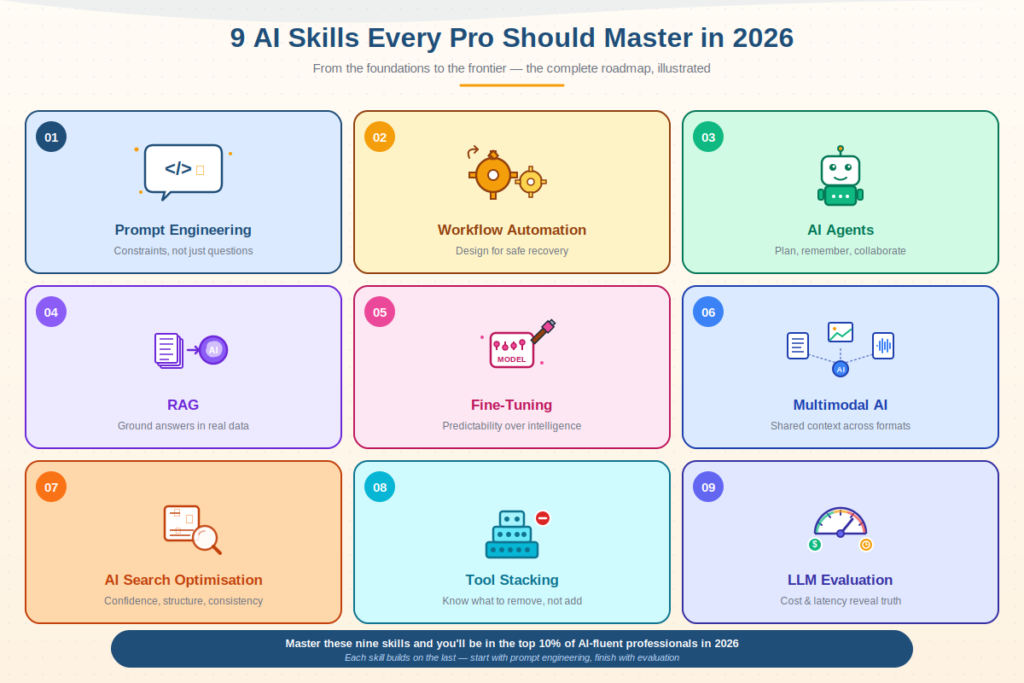
AI Skills: Most people in 2026 still don’t know these skills exist — and that gap is your opportunity.
Skill 1: Prompt Engineering — The Foundation Everyone Underestimates
If you’ve spent any time in the AI conversation, you’ve heard prompt engineering dismissed as “just typing better questions.” That dismissal is precisely why most people remain stuck at the beginner level forever. They never get past the surface because they never realised there was anything below it.
Real prompt engineering isn’t about asking better questions. It’s about communicating with precision: giving the model clear, structured, goal-driven instructions that include context, constraints, and expected output formats. The difference between a casual prompt and an engineered one is the difference between a vague brief and a specification. One leaves the AI guessing; the other leaves no room for ambiguity.
Modern prompt engineering involves role assignment such as “act as a senior compliance officer,” output constraints like “respond only in valid JSON,” few-shot examples that demonstrate the pattern you want, and chain-of-thought prompts that force the model to reason step by step before answering. Tools like ChatGPT, Claude, and Gemini all reward this kind of disciplined input — and quietly punish casual users with generic, watery responses they’ll never realise could have been so much better.
But the deepest insight about prompt engineering is something that took most practitioners years to internalise: good prompts don’t ask for answers — they limit what the AI is allowed to do. A well-engineered prompt is more like a fence than a question. It defines the boundary of acceptable output. It tells the model what not to do, which formats to avoid, which topics to skip, and what the failure mode should look like.
Good prompts don’t ask for answers. They limit what the AI is allowed to do.
This single mindset shift changes everything. Instead of trying to coax better answers out of the AI, you start designing constraints that make bad answers nearly impossible. That’s the real skill — and it’s the foundation everything else in this guide builds on. Without solid prompting, every more advanced capability becomes shaky.
Skill 2: AI Workflow Automation — The Glue That Makes AI Useful
Owning the world’s best prompts means nothing if you’re still manually copying outputs from one browser tab to another. The next leap is workflow automation: connecting AI models to the rest of your tool stack so they can do real work without you sitting in the middle of every step.
Platforms like Zapier, Make, and n8n have evolved from simple integration tools into full-blown AI orchestration platforms. You can now build flows where a customer email automatically triggers an AI analysis, which updates a CRM, drafts a response, schedules a follow-up, and notifies the right team member — all without a single human touch. This is where AI starts paying off financially, because every automated step is a step you no longer pay someone to do.
But here is where most people go wrong: they obsess over building beautiful, complex flows that work perfectly in testing. Then they push to production and watch helplessly as the flow breaks the first time the API returns an unexpected response, the document format changes, or a tool quietly updates its schema overnight.
Automation breaks more often than it runs. The skill is designing safe recovery, not perfect flows.
This isn’t a flaw of the technology; it’s the nature of connecting independent systems that were never designed to work together. The skill isn’t designing flows that never break. The skill is designing safe recovery — graceful degradation, automatic retries, human-in-the-loop fallbacks, and monitoring that alerts you the moment something goes off the rails.
A senior automation builder spends as much time on the failure paths as on the happy path. They assume things will break and design accordingly. That mindset, more than any specific tool, is what separates someone who plays with automation from someone who runs critical business processes on it.
Skill 3: AI Agents — Autonomy with a Side of Caution
If automation is rule-based plumbing, agents are something more ambitious. An AI agent doesn’t just execute predefined steps. It plans, decides, remembers context across actions, and can collaborate with other agents to tackle multi-step problems that no single prompt could ever solve.
Frameworks like CrewAI, LangGraph, and AutoGen have made agent-building accessible to anyone with coding experience and patience. You can spin up a research agent that scans dozens of sources, summarises findings, and drafts a report — all autonomously. You can build an agent team where one specialises in writing, another in fact-checking, and a third in formatting. The possibilities are genuinely thrilling.
They are also genuinely dangerous if you don’t respect them.
Agents fail silently. If you can’t explain why an agent acted, it’s already dangerous.
Unlike traditional software, an agent doesn’t throw a clean error when something goes wrong. It just decides — sometimes confidently, sometimes nonsensically — to take an action that doesn’t make sense. It hallucinates a tool call. It misremembers a prior step. It loops endlessly trying to solve a problem that has no solution within its tools.
And if you can’t explain why an agent did what it did, you’ve already lost. You’re deploying a system whose behaviour you can’t audit, whose mistakes you can’t trace, and whose risks you can’t bound. That’s the real frontier of this skill. It’s not about wiring agents together — anyone can do that with a tutorial. It’s about building observable, traceable, governable agent systems where every decision is logged and every action has a reason you can point to.
The professionals who master this will run the next generation of business processes. The ones who don’t will eventually find themselves in a board meeting trying to explain why an agent made a six-figure mistake nobody caught in time.
Skill 4: RAG — Teaching AI Your Private World (AI skills)
Large language models know an impressive amount about the public internet up to their training cutoff. They know almost nothing about your company’s internal documents, your specific clients, your proprietary processes, or anything that happened last week. That gap is exactly what Retrieval-Augmented Generation — RAG — was designed to close.
RAG is the architecture that connects a language model to a private knowledge base. When a user asks a question, the system retrieves relevant documents from a vector database, injects them into the prompt as context, and lets the model generate an answer grounded in actual source material. Tools like LangChain, LlamaIndex, and Vectara have made this dramatically easier than it was just a couple of years ago. RAG is now the single most important pattern for enterprise AI applications because it eliminates hallucinations, keeps answers current, and respects data boundaries.
But here is the dirty secret nobody talks about at AI conferences: most RAG systems fail before retrieval ever happens. People obsess over which embedding model to use, which vector database is supposedly best, and which similarity metric scores highest in benchmarks. Meanwhile, the real problem is sitting upstream, in the chunking step that almost nobody pays attention to.
Most RAG systems fail before retrieval. The real problem is bad chunking, not embeddings.
How you split your documents — how big each chunk is, where the breaks fall, what metadata travels with each piece — determines whether your retrieval surfaces relevant context or random noise. Bad chunking destroys good embeddings. Good chunking redeems mediocre ones. Yet ninety percent of RAG tutorials treat chunking as an afterthought, mentioned in a single line and never revisited.
If you want to actually master RAG, spend less time comparing embedding models and more time studying how your documents are structured, how questions get asked, and how to design chunks that align with the way humans actually look for information. The teams that get this right ship RAG systems that feel like magic. The ones that don’t ship systems that confidently make things up.
Skill 5: Fine-Tuning and Custom GPTs — Personality Over Intelligence (AI skills)
Sooner or later, prompting and RAG reach their limits. You want the model to behave a certain way every single time, sound like your brand, follow your formatting conventions, and never drift into territory you don’t want it touching. That’s where fine-tuning and custom GPT-style assistants come in.
Platforms like OpenAI’s GPT Builder, Hugging Face, and Cohere let you adapt models to specific tasks, industries, or brand voices. You can train a model on your customer support transcripts so it adopts your tone. You can fine-tune on your technical documentation so it speaks your company’s vocabulary fluently. You can build custom assistants that handle narrow tasks with surprising consistency.
But there is a common misconception about what fine-tuning actually does — and it leads people to spend serious money in the wrong places.
Fine-tuning rarely improves intelligence. It mainly improves predictability.
A fine-tuned model isn’t going to suddenly understand quantum physics if it didn’t already understand quantum physics. What it will do is consistently produce outputs in your preferred format, follow your style guide reliably, and reduce the variance that makes raw models frustrating for production use.
This sounds like a downgrade, but it’s actually exactly what most businesses need. Predictability is more valuable than raw intelligence for almost every commercial use case. When you’re deploying AI at scale, you don’t want surprises. You want a model that says the same thing in the same way every time, that fails in known ways, and that can be reasoned about reliably by the team supporting it.
So when someone tells you fine-tuning is the next leap in capability, push back gently. It’s not. It’s a leap in consistency, and that distinction matters enormously when you’re deciding how much time and money to invest in this skill.
Skill 6: Multimodal AI — Beyond the Text Box (AI skills)
For most of the last few years, AI essentially meant text. You typed, the model typed back, and the conversation lived inside a chat window. Multimodal AI shatters that limitation. Modern models like GPT-4, Gemini, and Grok can process images, audio, video, and text — often within the same conversation, often in the same prompt.
This unlocks workflows that were genuine science fiction just a few years ago. You can show a model a photograph and have it explain the chart in the background. You can paste a spreadsheet, a screenshot of a dashboard, and a written brief, then ask the model to synthesise all three. You can hand it a video, ask for a summary, and get back not just transcribed text but actual interpretation.
But here is where most people misunderstand the skill entirely. Multimodal AI isn’t really about handling images or audio. Anyone can upload a picture to a chatbot and get a description. The actual skill — the part that separates real practitioners from dabblers — is about shared context across formats.
Multimodal isn’t about images or audio. It’s about shared context across formats.
When you give a model an image and a text question in the same prompt, the magic isn’t that it can see the image. The magic is that it can reason about how the image relates to your words, and weave a response that incorporates both into a single line of thinking. The same applies to audio, video, and tables. Mastery means designing prompts that intentionally combine modalities to get insights you couldn’t get from any single one alone.
The real professionals are already building workflows that mix screen recordings with written annotations, voice notes with diagrams, and photographs with spreadsheets — all in one prompt. They are not impressed that the model can describe a picture. They are focused on how multiple modalities together create context that text alone could never deliver. That is the future of how we will work with AI.
Skill 7: AI Search Optimisation — The New SEO (AI skills)
For two decades, getting found online meant optimising for Google. You knew the playbook by heart: keywords, backlinks, page speed, schema markup. That playbook still works, but it is no longer the only game in town.
A growing share of search queries now happen on AI-powered platforms like Perplexity, ChatGPT, Claude, and Gemini. People don’t just want links anymore; they want answers. And AI engines don’t pick those answers the same way Google picks its top ten results. This new field — sometimes called AI search optimisation, generative engine optimisation, or AEO — is reshaping how content gets discovered, and tools like Profound and Perplexity’s own analytics surfaces are leading the way.
If you assume traditional SEO still rules this new world, you will be lapped by competitors who understood the shift sooner.
AI search doesn’t rank content. It ranks confidence, structure, and consistency.
When an AI engine decides whether to cite your content, it is not measuring keyword density. It is evaluating whether your content reads as authoritative, whether claims are clearly attributed, whether facts are structured in a way the model can extract cleanly, and whether your information is consistent across the web.
That means the new playbook looks different. You write for clarity over keyword stuffing. You structure content with explicit definitions, clear hierarchies, and unambiguous claims. You build a consistent presence across multiple sources so AI engines can triangulate your authority. You invest in expertise signals — author credentials, citations, structured data — that signal trustworthiness to a model trying to decide what to recommend to its users.
Marketers and content creators who learn this skill now will own the next decade of organic discovery. The ones who wait for official guidelines will eventually discover that AI search doesn’t work that way. There won’t be a single algorithm to optimise for. There will be principles to embody, and the people who embody them earliest will reap the rewards longest.
Skill 8: AI Tool Stacking — The Art of Subtraction (AI skills)
Every week, a new AI tool launches promising to revolutionise some narrow workflow. Every week, a new framework arrives claiming to be the missing piece in your stack. Every week, professionals fall into the same trap: they keep adding.
Tool stacking — the practice of combining multiple AI and productivity tools into coherent end-to-end workflows — is genuinely a skill in 2026. Platforms like LangChain and Zapier sit at the centre of complex stacks where a single business outcome flows through five, ten, or even fifteen different services. And when done well, the result is remarkable: workflows that feel almost magical, where insights surface automatically and decisions get made in seconds instead of hours.
But here is the trap. Every added tool increases hidden complexity. Every integration is a potential failure point. Every dependency is something you will have to update, debug, and maintain. Every shiny new tool you bolt onto an existing stack might solve one problem and create three others you won’t notice for months.
Every added tool increases hidden complexity. The skill is knowing what to remove, not what to add.
The mature insight is counterintuitive: the real skill in tool stacking isn’t knowing what to add. It is knowing what to remove. Senior practitioners look at a sprawling stack and ask which pieces are actually load-bearing. Which are nice-to-have versus essential. Which exist because they solve a real problem versus because someone got excited about them last quarter and never came back to evaluate.
This kind of disciplined subtraction is rare because it feels boring. Adding tools feels productive. Removing them feels like loss. But every removed dependency is a removed failure mode, a removed maintenance cost, a removed cognitive burden on whoever has to operate the system. The best AI stacks aren’t the biggest. They are the smallest stacks that still get the job done — and they are invariably built by people who learned to say no.
Skill 9: LLM Evaluation and Management — How You Know It’s Actually Working (AI skills)
The last skill on this list is the one that operationalises everything else. You can have brilliant prompts, sophisticated agents, perfectly tuned RAG, and a beautifully orchestrated stack — and still ship a disaster if you can’t measure what’s actually happening in production.
LLM evaluation and management is the discipline of measuring AI system performance: accuracy, cost, latency, consistency, drift, and dozens of other dimensions that quietly determine whether your investment pays off or silently bleeds money. Tools like Helicone, PromptLayer, and TruLens have built increasingly sophisticated observability layers for AI systems, letting you trace every prompt, log every response, and analyse patterns over time.
But here is the trap of evaluation that catches almost everyone: accuracy metrics lie. A model can score ninety-five percent on your eval suite while quietly producing terrible answers in production. The eval set might be too small, too clean, too unrepresentative of real user queries. Or worse, your accuracy metric might not measure what actually matters for your use case. A customer support bot with ninety-five percent factual accuracy can still feel cold, unhelpful, and infuriating to users — and the accuracy metric will tell you nothing about why.
Accuracy metrics lie. Cost and latency usually reveal problems first.
In practice, cost and latency usually reveal problems before accuracy does. When response times start creeping up, when token usage spikes inexplicably, when monthly bills outgrow projections — those signals tend to surface real issues much faster than offline benchmarks. They are harder to ignore because they hit your bottom line directly.
The mature approach is to instrument everything, measure relentlessly, and trust signals from production more than signals from your test set. Build alerts on cost and latency, sample real outputs regularly, and treat your AI system the way you would treat any other critical infrastructure: with healthy paranoia and rigorous observability. That is how you ship AI that actually works.
Conclusion: How These Skills Connect (AI skills)
The nine skills in this guide aren’t a menu. They are a stack. Prompt engineering is the foundation everything else rests on. Automation gives prompts hands and feet. Agents give them autonomy. RAG gives them memory of your private world. Fine-tuning gives them personality. Multimodal capability gives them senses. AI search optimisation makes their output discoverable. Tool stacking integrates everything into a coherent whole. And LLM evaluation tells you the whole system is actually working.
You don’t need to master all nine to be effective. Most professionals will go deep on three or four, depending on their role. A marketer might prioritise prompt engineering, AI search optimisation, and tool stacking. An engineer might focus on agents, RAG, and evaluation. A leader might invest more heavily in automation strategy and management practices. The point isn’t to become an expert in everything — it is to understand the map so you can navigate it intentionally.
What separates the AI-fluent professional from the AI-aware one isn’t just knowing more tools. It is understanding how these skills interact, where each one tends to break, and how to design systems where the failures of one part don’t cascade into the failures of the whole. That perspective is rare. It is the perspective that wins.
And here is the surprising part: most people in 2026 still don’t know any of this. They use AI as a chatbot, save themselves a few minutes a day, and call it transformation. The ones who go deeper — who build systems instead of using interfaces — will define the next generation of work. There is still time to be in that group. It just takes a decision to stop dabbling and start learning seriously.
The skills are listed. The roadmap is here. The rest is up to you.
Key Takeaways (AI Skills)
- Prompts are constraints, not questions. Good prompts limit what the AI is allowed to do, not what it should produce.
- Automation needs recovery, not perfection. Design for failure paths first; the happy path will take care of itself.
- Agents must be explainable. If you can’t trace an action, you can’t trust the system that made it.
- RAG lives or dies on chunking. Better chunks beat better embeddings almost every time.
- Fine-tuning sells consistency, not intelligence. Use it for predictability, not capability gains.
- Multimodal is about shared context. Combine formats to unlock insights no single modality can deliver.
- AI search rewards structure and clarity. Confidence and consistency beat keyword density.
- The best stacks are the smallest ones that work. Subtraction is a skill; addition is a habit.
- Trust production over benchmarks. Cost and latency reveal problems long before accuracy metrics do.
Frequently Asked Questions About AI Skills in 2026
Which AI skill should I learn first?
Start with prompt engineering. It is the foundation that every other skill on this list builds on, and it is the most immediately useful. Once you can reliably get high-quality, structured output from a language model, every subsequent skill — automation, agents, RAG — becomes dramatically easier to learn. Trying to jump straight to agents or RAG without strong prompting fundamentals is like trying to build a house without learning to use a hammer first.
Do I need a technical background to learn these AI skills?
For about half of the skills on this list — prompt engineering, workflow automation, AI search optimisation, and tool stacking — the answer is no. These are accessible to anyone willing to practise consistently. For agents, RAG, fine-tuning, and LLM evaluation, some basic familiarity with code helps significantly. You don’t need to be a software engineer, but you should be comfortable reading documentation and following technical tutorials without panicking.
How long does it take to become proficient with AI tools?
Genuine proficiency with one or two of these skills takes roughly three to six months of consistent, deliberate practice. Surface-level familiarity takes a few weeks. The mistake most people make is spreading themselves across all nine simultaneously and never going deep on any single one. Pick two or three that align with your role, go deep, and you will be more valuable than someone who has skimmed everything.
Will these AI skills be obsolete in a few years?
The specific tools certainly will change — that is the nature of this industry. But the underlying skills are far more durable. The principles behind prompt engineering, system observability, retrieval design, and tool simplicity will outlast any individual product. Focus on understanding the why behind each skill, not just the how of any particular tool. That mindset future-proofs your investment in learning.
Are AI skills replacing traditional jobs?
AI skills are reshaping jobs more than replacing them. The pattern we are seeing in 2026 is that professionals who learn to work with AI are taking on responsibilities that used to require entire teams. Roles aren’t disappearing wholesale; they are being redefined around AI-augmented productivity. The professionals who learn these skills aren’t losing their jobs — they are absorbing the work that less-skilled colleagues used to do.
What’s the best AI tool to start with as a beginner?
For pure conversational AI, start with ChatGPT or Claude. They are accessible, well-documented, and forgiving of beginner mistakes. For automation, start with Zapier — it has the gentlest learning curve and the widest tool integration library. Avoid trying to learn complex frameworks like LangChain or CrewAI until you have solid fundamentals; jumping into deep technical tools before you understand basics is the fastest way to get discouraged and quit.
— End of Article —





One Comment