
How Indian Small Businesses Are Saving 15+ Hours a Week with n8n WhatsApp Automation (2026 Playbook)
N8N WhatsApp automation for small business:Walk into almost any small business in India today — a dental clinic in Pune, a boutique apparel label shipping out of Jaipur, a coaching centre in Coimbatore, a real-estate desk in Gurugram — and you will find the same quiet crisis playing out on a single phone screen. WhatsApp is buzzing. Enquiries are stacking up. Half-answered conversations are scrolling out of view. And somewhere in that chaos, a genuinely interested customer who messaged at 9:47 PM is silently deciding to buy from a competitor who replied first.
This is not a marketing problem. It is an arithmetic one. India now has over 500 million active WhatsApp users, and more than 50 million Indian businesses use the WhatsApp Business app in some form. For most small and medium enterprises, WhatsApp has already displaced the phone call and the email as the default channel of customer communication. The opportunity is enormous — but WhatsApp was engineered for conversation, not for scale. Managing hundreds of daily messages by hand produces slow responses, dropped follow-ups, and a perpetually exhausted team.
The businesses pulling ahead in 2026 have figured out something specific: the repetitive, predictable 80% of those conversations can be handled by an automation engine that never sleeps, never forgets a follow-up, and never gets tired of answering the same question for the hundredth time. The tool of choice for the technically ambitious among them is n8n — an open-source workflow automation platform that, wired into the WhatsApp Business API, routinely reclaims 15 or more hours of human time every single week.
This is the playbook. Not a sales brochure — an actual operational map of where those hours hide, which workflows recover them, and how to build the system without setting fire to your budget or your data-protection obligations.
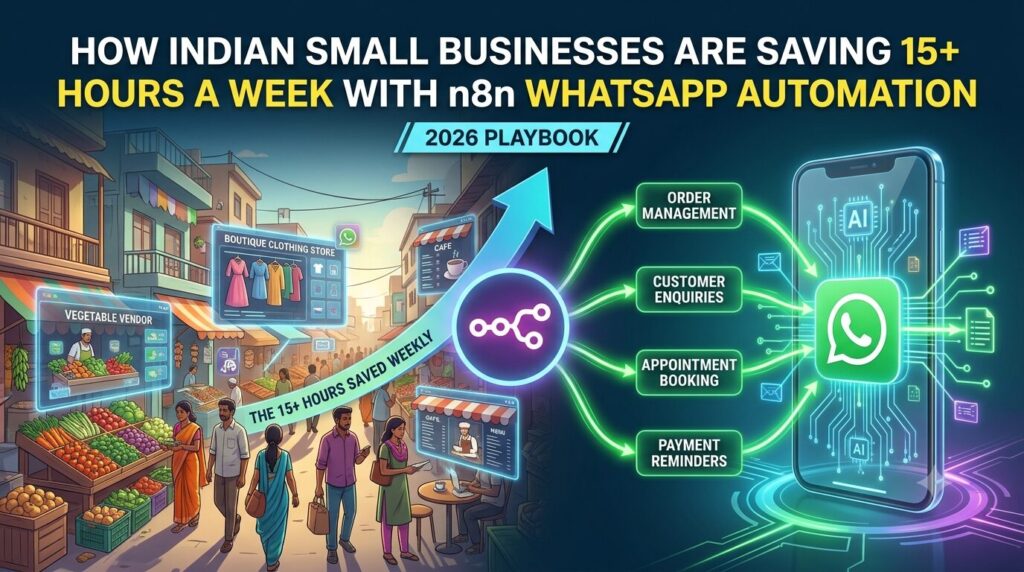
First, where do the 15 hours actually go?
Before automating anything, it is worth being honest about where small-business time genuinely leaks. When you audit a typical Indian SMB’s WhatsApp activity, the lost hours cluster into a handful of recognisable buckets.
The largest is repetitive question-answering. “What are your timings?” “Do you deliver to my pincode?” “What’s the price of the blue one?” “Is the doctor available tomorrow?” A staff member retyping the same five answers forty times a day can easily burn two hours daily. Across a six-day week, that single category alone is twelve hours gone.
The second bucket is lead intake and routing — capturing a name, a phone number, an enquiry type, and getting it to the right person before the lead goes cold. Research consistently shows that businesses responding to a lead within the first minute are dramatically more likely to convert, with one widely cited figure putting the uplift around 40%. Doing that manually at volume is simply impossible; leads sit in an inbox while the human catches up.
The third is follow-up and reminders — the abandoned enquiry never chased, the appointment never confirmed, the quotation never nudged. These are the highest-value, most-neglected tasks in any small business, precisely because they require discipline that humans under pressure cannot sustain.
The fourth is operational notifications — order confirmations, dispatch updates, payment reminders, post-service feedback requests. Each is trivial individually and collectively devours an afternoon.
n8n’s value proposition is that every one of these buckets is automatable, and the time saved compounds because, in the language of modern automation, you are building hyperautomation — chaining whole sequences so each completed step feeds the next, rather than automating isolated tasks in isolation.
Why n8n specifically — and a clear-eyed note on the WhatsApp connection – n8n WhatsApp automation for small business
n8n (pronounced “n-eight-n,” short for nodemation) is node-based, open-source, and self-hostable under a fair-code licence, which means it can run on your own server at effectively zero software cost. It carries over 400 native integrations and draws on a community library of more than 50,000 workflow templates — many of them WhatsApp-specific and ready to import. For Indian businesses, self-hosting on a modest ₹800-per-month VPS eliminates the per-task charges that make Zapier punishingly expensive at scale.
A point of technical honesty that separates a real practitioner’s guide from marketing copy: there are two routes to connect WhatsApp, and they are not interchangeable. The first and recommended route is the official Meta WhatsApp Business API (the WhatsApp Business Cloud), reached either through n8n’s built-in WhatsApp node or via HTTP Request nodes pointing at a BSP such as AiSensy, WATI, or Interakt. This route keeps you compliant, gives you green-tick eligibility, and is the only legitimate path for broadcasting and marketing.
The second route uses unofficial libraries like WAHA (WhatsApp HTTP API), which work well for reactive bots responding to incoming messages but are not suitable for mass marketing or broadcasting and carry account-ban risk. This playbook assumes the official API throughout. Cutting that corner is the single fastest way to get your business number permanently banned.
With that settled, let us walk through the workflows that actually move the needle, roughly in the order most businesses should adopt them.
Workflow 1 — The instant lead-capture and routing engine
This is almost always the first automation worth building, because it touches revenue directly.
The structure is straightforward. A Webhook trigger node listens for new submissions — from a Facebook or Instagram Lead Ad, a website form, an IndiaMART enquiry, or a QR code on your packaging.
When a lead arrives, n8n parses the payload, creates or updates a contact in your CRM (Zoho, HubSpot, or Vtiger), and then fires a WhatsApp message two ways at once: an instant acknowledgement to the customer (“Thanks for reaching out — a team member will be with you shortly, here’s our catalogue meanwhile”), and a notification to the assigned salesperson containing the lead’s name, number, and source. A Switch node can route the lead geographically, so a Chennai enquiry lands with the Chennai rep automatically.
The payoff is the elimination of the dead window between a customer raising their hand and a human noticing. The customer feels attended to within seconds, even at 2 AM, and the lead is logged before it can evaporate. For a sales team, this is conservatively three to eight hours a week recovered from manual data entry and prospect chasing — and the conversion uplift from sub-minute response often matters more than the time itself.
Workflow 2 — The 24/7 AI support agent with memory
This is the workflow that most dramatically attacks the “repetitive question” bucket, and it is where n8n’s AI integrations earn their keep.
A naive auto-reply bot that only recognises keywords frustrates customers. What replaces a human support agent is a conversational agent with two specific capabilities: memory and grounding.
Memory means storing the last several messages per phone number in a database — PostgreSQL is the standard choice — so that when a new message arrives, the workflow loads the prior context and includes it in the prompt sent to the language model. The agent then “remembers” what the customer said earlier in the conversation, rather than treating every message as a cold start.
Grounding is delivered through a RAG pipeline — Retrieval-Augmented Generation. Rather than relying on a model’s generic training data (which knows nothing about your specific products, prices, or policies), you upload your product catalogue, FAQs, and support documents into a vector database such as Pinecone, Qdrant, or Supabase’s pgvector. When a customer asks a question, n8n embeds the question, retrieves the most relevant passages from your own documents, and feeds those to the model. The answer is therefore accurate to your business — correct prices, correct policies, correct stock.
The flow in practice: a WhatsApp Trigger captures the incoming message; an AI Agent node identifies intent; if the query is informational, it answers from the RAG store; if the customer is confused, frustrated, or explicitly asks for a person, the automation pauses and escalates to a human with a notification. Voice notes are transcribed automatically via a Whisper-style speech-to-text node, and images can be read with a vision model — so a customer sending a photo of a product or a voice message in Hindi is still understood without manual intervention. Every interaction is logged to Google Sheets or a CRM for tracking.
Businesses that deploy this report a 30% to 50% reduction in support workload. For a team fielding hundreds of messages a day, that is comfortably the largest single chunk of the 15 hours.
Workflow 3 — Appointment booking and confirmation for service businesses
If you run a clinic, salon, coaching centre, consultancy, or any appointment-driven business, this workflow alone can justify the entire system.
Salon and clinic staff routinely spend hours juggling booking calls, checking availability, and managing reschedules. An n8n booking agent handles the whole conversation conversationally over WhatsApp: it understands a request like “Can I get an appointment Saturday evening?”, parses the date and time (an AI node reformats messy human date input into a clean calendar entry), checks Google Calendar for a free slot with conflict validation to prevent double-booking, creates the event, and confirms back to the customer — all without a human touching it.
The compounding win is the automated confirmation and reminder layer. A scheduled trigger fires every morning at, say, 8 AM, lists the next day’s appointments from the calendar, and sends each patient or client a WhatsApp confirmation. Replies — “yes, confirmed” or “can we move it to 4?” — are routed back to the appropriate logic, which updates the calendar and notifies staff. No-shows drop, the front desk stops playing phone tag, and a genuinely time-consuming, error-prone process becomes a background hum.
Mature versions of this pattern run as multi-agent systems: a parent workflow orchestrates the conversation and delegates to specialised sub-workflows — one agent for CRM logging, another for calendar logic — which keeps each component simple, testable, and independently scalable. That modular architecture is one of n8n’s quiet strengths over monolithic no-code builders.
Workflow 4 — Abandoned-cart recovery for e-commerce
For any business selling online, this is among the highest-ROI automations in existence, because roughly 70% of Indian e-commerce carts are abandoned and manual follow-up at scale is impossible.
The flow: a WooCommerce or Shopify webhook fires when a cart sits abandoned for thirty minutes. n8n sends a gentle WhatsApp nudge — “You left something behind!” — with a direct link back to the cart. If there’s no purchase within six hours, a Wait node releases the next step: an email carrying a small discount code. If still nothing at twenty-four hours, a final “last chance” WhatsApp goes out. Every event logs to a Google Sheet for conversion tracking.
The reported revenue lift sits around 10% to 18% cart recovery, and the workflow replaces dedicated cart-recovery SaaS tools that charge ₹3,000 to ₹8,000 a month — so it saves money on two fronts simultaneously, recovered revenue and eliminated subscription.
Workflow 5 — Order, dispatch, and payment notifications
This is the unglamorous workhorse that quietly clears an afternoon a week. Connect your store and payment gateway — Razorpay webhooks are natively friendly to n8n — so that an order confirmation, a dispatch update with a Shiprocket tracking link, a payment-received receipt, and a post-delivery feedback request all fire automatically at the right moments. Inventory can update in Zoho Inventory in the same pipeline, and settlements can reconcile against Zoho Books invoices, flagging discrepancies for your accountant. The customer stays informed at every step without a single manual message, and trust rises precisely because communication becomes reliable.
Doing the time math honestly
Stack these workflows and the 15-hour figure stops sounding like marketing and starts looking conservative. Independent assessments of n8n automation place individual workflows in the range of 5 to 20 hours saved per week each, depending on volume. A realistic, layered SMB deployment might look like this:
The AI support agent absorbs the repetitive-question load — call it eight to ten hours weekly. Lead capture and routing recovers three to eight. Appointment confirmation and reminders save a service business another three to five. Order and dispatch notifications clear two to three. You do not need all five workflows firing to cross fifteen hours; two or three well-chosen ones usually get you there, which is exactly why the disciplined advice is to not try to build everything at once. Identify your single most repetitive, revenue-sensitive task, automate it well, measure the hours saved against a clean baseline, and only then scale to the next.
That measurement discipline matters because the broader mood among decision-makers in 2026 has shifted from “let’s experiment with AI” to “show me the hours saved.” Automate where the value is provable, instrument it, and let the data justify the next build.
The build: what it actually takes
There is no need to romanticise the effort, nor to exaggerate it. Here is the realistic picture.
The infrastructure is a single command. n8n runs in Docker, and a basic deployment is one docker run away on any VPS — a 2GB DigitalOcean droplet in the Bengaluru region at roughly ₹800 a month is more than adequate to start. You will want a domain with HTTPS, because WhatsApp webhooks require it; Cloudflare’s free SSL plus an ₹800-a-year domain handles that. For an experienced developer, the base setup is about 45 minutes.
The Meta side — getting WhatsApp Business API access through a BSP, verifying your business, and connecting the number — typically takes 24 to 72 hours, most of it waiting on verification rather than active work. Once your number is live, the actual n8n workflow for a first AI agent can be built in well under an hour, especially if you start from one of the community templates and adapt the system prompt to your business’s tone and rules.
The skill curve is real but gentle. A beginner workflow — form to CRM to WhatsApp — takes thirty to sixty minutes once you understand the canvas. An advanced workflow with AI nodes, error handling, and database logging takes four to eight hours to build and test properly the first time; with practice, experienced builders assemble complex automations in under two hours. If you have no internal technical capacity at all, a managed n8n VPS with Indian data residency and backups runs around ₹1,400 to ₹1,800 a month, or you engage a freelancer or agency for the initial build.
A non-negotiable engineering note for production: do not run a high-traffic WhatsApp bot on a naive single instance. If one heavy workflow saturates the CPU, incoming webhooks get queued or dropped — and because Meta requires a webhook acknowledgement within three seconds, a blocked process can cause Meta to disable your webhook subscription entirely.
The fix is n8n’s Queue Mode, which uses Redis to buffer incoming requests so the main instance stays responsive while stateless worker nodes process the heavy lifting and scale horizontally during spikes like a festive-season sale. Build this in before you need it, not after a Diwali rush takes you offline.
The compliance layer you cannot skip
Saving fifteen hours is worthless if it costs you your WhatsApp number or invites a regulatory penalty, so treat compliance as part of the build, not an afterthought.
India’s Digital Personal Data Protection (DPDP) Act, 2023 is in active force, and WhatsApp automation sits squarely within its scope. Three rules are foundational. Opt-in consent is mandatory — the customer must have initiated contact or explicitly agreed to be messaged, so collect consent through forms, QR codes, or click-to-WhatsApp ads before you ever broadcast.
Every marketing message must offer a clear way to unsubscribe. And marketing templates must be submitted to Meta for approval before they go out; spammy templates get rejected. Cross the line and customers will report your number, at which point WhatsApp can ban it permanently — there is no appeal worth relying on.
Self-hosting n8n also gives you a compliance advantage the SaaS tools struggle to match. Running your instance on a VPS located in an Indian data centre keeps sensitive conversation logs and customer data within Indian jurisdiction — a meaningful safeguard for clinics handling patient information or any business touching financial data, and a far stronger position than routing everything through servers on another continent. Pair that with a human-in-the-loop escalation rule for sensitive or high-stakes conversations, and you have automation that is both efficient and defensible.
A realistic 30-day rollout
For a business starting from zero, a sane sequence looks like this. In the first week, provision the server, get WhatsApp Business API access through a BSP, and connect the number — most of this is waiting on verification, so begin immediately. In the second week, build and launch a single workflow: the instant lead-capture engine or a basic FAQ auto-responder, whichever maps to your biggest pain.
Run it, watch it, fix the rough edges. In the third week, layer in the AI support agent with memory and a small RAG store seeded with your real FAQs and catalogue; keep the human escalation path obvious. In the fourth week, add the operational layer — appointment confirmations, or order and dispatch notifications, depending on your model — and instrument everything so you can see executions, failures, and time saved in a dashboard or a simple Google Sheet.
By the end of the month you will have a measurable number to point at, and the confidence to extend the system deliberately rather than chaotically.
The bottom line
The fifteen hours a week are not hypothetical. They are sitting in your team’s WhatsApp inbox right now, scattered across retyped answers, missed leads, forgotten follow-ups, and manual order updates. n8n does not magically conjure those hours back; it requires a real, if modest, investment of technical effort and a disciplined respect for compliance. But once built, a self-hosted WhatsApp automation stack runs at the cost of a daily coffee, scales without punishing your growth, keeps your data on Indian soil, and works the night shift you cannot.
The Indian small businesses winning in 2026 are not the ones with the biggest teams. They are the ones whose smallest, most repetitive tasks have quietly been handed to a machine — so the humans can finally spend their hours on the work that actually grows the business. Start with one workflow. Measure it. Then build the next.






2 Comments