
AI-Powered GST Filing & Accounting Automation: A Complete Guide for Indian MSMEs (2026)
Introduction – AI accounting software for Indian MSMEs
Running a small or medium business in India in 2026 means wearing more hats than most owners ever signed up for. Beyond serving customers and managing staff, every MSME owner is also, by default, a part-time tax compliance officer. Between GSTR-1 and GSTR-3B filings, e-invoicing mandates, e-way bills, TDS deductions, and bank reconciliations, compliance work alone can eat up several hours every week — time that could otherwise go into growing the business.
This is precisely where artificial intelligence has quietly become one of the most practical investments an Indian MSME can make. Not the flashy, futuristic kind of AI — but the boring, dependable kind that reads a bank statement, matches it against an invoice, flags a mismatch before a GST return goes out, and forecasts whether there’s enough cash to survive the next lean month.
This guide walks through how AI is reshaping GST filing and accounting for small businesses in India, which tools are actually delivering value in 2026, and how to think about adopting these tools without disrupting the way your business already runs.
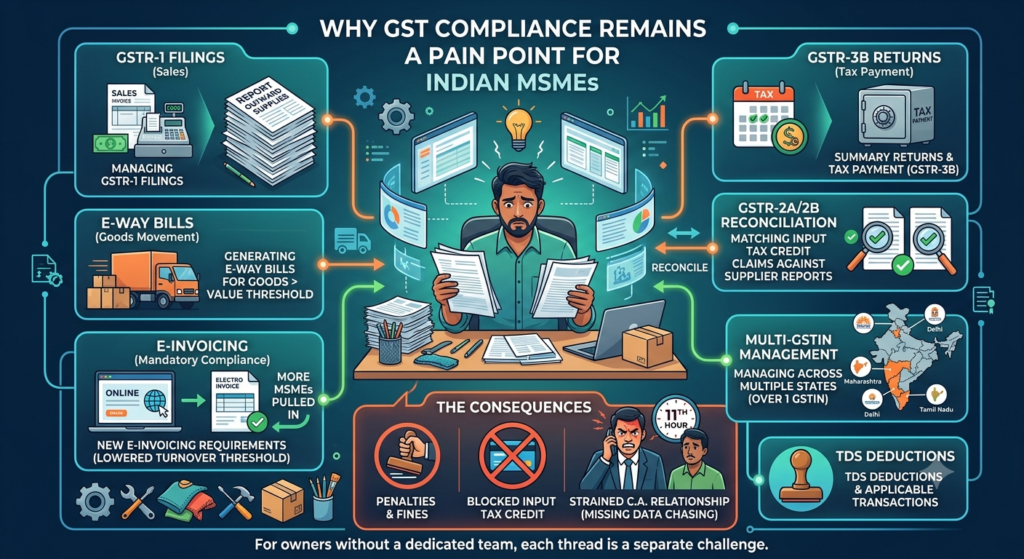
Why GST Compliance Remains a Pain Point for Indian MSMEs (AI accounting software for Indian MSMEs)
India’s GST framework, now several years into its life, is more mature than it was at launch — but for small businesses, it hasn’t necessarily gotten simpler. A typical MSME today needs to manage:
- GSTR-1 filings that report outward supplies (sales)
- GSTR-3B summary returns for tax payment
- GSTR-2A/2B reconciliation to match input tax credit claims against what suppliers have actually reported
- E-invoicing requirements, which have progressively lowered the turnover threshold, pulling more MSMEs into mandatory compliance
- E-way bills for the movement of goods above specified value thresholds
- TDS deductions and filings for applicable transactions
- Multi-GSTIN management for businesses operating across more than one state
For a business owner without a dedicated finance team, each of these is a separate mental thread to track, and missing any one of them can mean penalties, blocked input tax credit, or a strained relationship with a chartered accountant who’s chasing missing data at the eleventh hour.
The traditional workaround has been to hire a CA or bookkeeper and hope they catch everything manually. That approach still works, but it scales poorly. As transaction volumes grow — more invoices, more vendors, more customers — manual reconciliation becomes a bottleneck rather than a safety net. This is the gap AI-powered accounting tools are built to close.
What “AI-Powered” Actually Means in Accounting Software
It’s worth pausing on what AI actually does inside these tools, because the term gets used loosely. In the context of GST and accounting automation, AI generally handles four categories of work:
- Data extraction — reading bank statements, scanned invoices, and receipts, and converting unstructured data into structured ledger entries, without a human retyping every line.
- Transaction categorization — learning from past patterns to automatically classify a payment as, say, “office rent” or “raw material purchase,” instead of leaving every entry to be manually tagged.
- Reconciliation and anomaly detection — matching your recorded invoices against what’s reflected on the GST portal (GSTR-2A/2B), and flagging mismatches, duplicate entries, or unusual transactions before they become compliance problems.
- Forecasting — using historical cash flow patterns to predict upcoming shortfalls or surpluses, which is especially valuable for seasonal businesses.
None of this replaces a qualified accountant. What it does is remove the repetitive, error-prone manual work so that the accountant — or the owner, if there isn’t one — can spend time on decisions rather than data entry.
The Core Problem: Manual GST Reconciliation
To understand why AI reconciliation tools have become so valuable, it helps to look at what manual GST reconciliation actually involves. Every month, a business needs to compare:
- The invoices it has recorded internally (in Tally, Excel, or another system)
- The invoices its suppliers have reported on the GST portal (reflected in GSTR-2A and GSTR-2B)
Any mismatch — a supplier who hasn’t filed, a wrong invoice number, a different tax amount — can result in denied input tax credit. For a business with a handful of vendors, this reconciliation might take an hour. For a distributor or manufacturer with hundreds of monthly transactions across multiple vendors, doing this by hand is not just slow, it’s a leading cause of return-filing errors.
AI-powered reconciliation tools pull data directly from the GST portal via API integrations (many providers, including Zoho, are registered GST Suvidha Providers), match it automatically against internal records, and surface only the exceptions that need human review. Instead of checking every line item, the business owner or accountant reviews a short list of flagged discrepancies.
Leading AI Accounting Tools for Indian MSMEs in 2026
There is no single “best” tool for every business — the right choice depends on whether you’re a service business, a trader, a manufacturer, or a business with a CA managing your books offline. Here’s how the major platforms stack up.
Zoho Books
Zoho Books has established itself as one of the most widely adopted cloud accounting platforms among Indian MSMEs, and its AI assistant, Zia, is central to that appeal. Zia handles automatic bank feed categorization, flags anomalies in transactions, and automates recurring invoice workflows and payment reminders.
On the compliance side, Zoho is a registered GST Suvidha Provider, meaning it can file GSTR-1 and GSTR-3B directly from within the software, without a separate trip to the GST portal. It also supports e-invoicing and e-way bill generation for businesses that cross the applicable turnover thresholds.
For cost-conscious MSMEs, Zoho Books offers a free plan for businesses with annual revenue below a defined threshold (roughly ₹25–50 lakh, depending on the specific plan terms at the time), with paid tiers scaling up as transaction volume and feature needs grow. It integrates natively with the rest of the Zoho ecosystem — CRM, Inventory, Payroll — which makes it a strong fit for service businesses, consultancies, and agencies that want one connected system rather than several disconnected tools.
The trade-off: Zoho Books is not purpose-built for manufacturing. Businesses that need bill-of-materials tracking or job-work costing typically need to pair it with Zoho Inventory as an add-on, and per-user pricing can add up for larger teams.
Tally Prime (with AI-Enabled Add-Ons)
Tally remains the dominant player among Indian businesses that operate with a CA-managed, desktop-first accounting setup — and it’s not going anywhere. Its strength lies in deep ledger control, statutory reporting, and a level of accounting rigor that many finance teams have relied on for decades.
What’s changed in 2026 is the layer of AI-driven automation now available around Tally rather than purely inside it. Tools like Vyapar TaxOne (formerly known as Suvit) connect to Tally and use AI to extract data from bank statements, invoices, and receipts, converting them directly into ledger entries. On the compliance side, these add-ons automate reconciliation across GSTR-1, GSTR-2A, and GSTR-2B, running dozens of automated checks before a return is filed — catching errors that would otherwise surface only after submission.
For CA firms and MSMEs that have built years of process and staff training around Tally, this “augment, don’t replace” approach is often more realistic than switching platforms entirely. The trade-off is that Tally itself is a desktop-first product, so real-time, anywhere access typically depends on the connected cloud add-ons rather than Tally’s native experience.
QuickBooks India
QuickBooks brings a globally recognized accounting platform to the Indian market, with its Intuit Assist AI feature built directly into the dashboard. Rather than manually digging through reports, business owners can ask plain-language questions — for example, which customers have overdue invoices, or how this month’s profit compares with the previous one — and get an immediate answer.
QuickBooks tends to appeal to businesses that already operate internationally or expect to scale beyond India, since it offers strong multi-currency support and integrates well with global payment gateways. Its India-specific GST features, however, are generally considered less deep than Zoho Books or Tally, which were built around Indian compliance requirements from the ground up.
HostBooks
HostBooks is a cloud-based platform built specifically with Indian GST logic in mind. It includes automated invoice processing, return-filing assistance, and compliance dashboards designed for businesses that prioritize staying audit-ready over having the most feature-rich general ledger. It’s a reasonable option for compliance-heavy SMEs that want a lighter, India-first alternative to Zoho or Tally without sacrificing GST automation.
Specialized AI Layers: AI Accountant and Similar Tools
A newer category of tools operates as an automation layer on top of existing accounting software rather than as a replacement for it. These tools focus narrowly on automated transaction import, intelligent categorization, and ledger mapping from bank statements and financial documents — plugging directly into platforms like Zoho Books to reduce manual entry for high-transaction-volume businesses. For MSMEs that already like their core accounting software but are drowning in data entry, this kind of add-on can deliver a fast return on investment without requiring a full platform migration.
Vyapar
Vyapar deserves a separate mention because it serves a slightly different segment: retail shop owners, distributors, and traders who need GST-compliant billing and inventory tracking more than deep accounting. It works offline, has a mobile-first interface, and generates GSTR-ready reports — but it’s fundamentally a billing and stock-management tool with accounting features layered on top, rather than a full-fledged accounting system. For a small retailer whose primary need is fast, compliant invoicing at the counter, this trade-off is often the right one.
How AI Reduces Errors in GST Return Filing
The single biggest source of GST-related stress for MSMEs is the fear of an error surfacing after a return has already been filed — because corrections are slower and more painful than catching a mistake before submission. AI-driven tools reduce this risk in a few concrete ways:
Automated matching against GSTR-2A/2B. Instead of manually cross-checking every purchase invoice against what suppliers have uploaded, the software runs this match automatically and flags only the exceptions — a missing supplier filing, a duplicate entry, or a tax amount that doesn’t line up.
Duplicate and anomaly detection. AI models trained on transaction patterns can spot an invoice that looks unusual relative to a business’s typical activity — an unusually large payment, a vendor billed twice in the same period, or a tax rate applied inconsistently across similar line items.
Pre-filing checks. Some platforms run dozens of automated compliance checks — verifying GSTIN formats, tax rate consistency, and return-period alignment — before a return is submitted, catching issues that would otherwise only be visible after the fact, when the GST portal or a supplier flags them.
Reduced manual re-entry. Every time a human retypes an invoice number or a tax amount, there’s a chance of a transposition error. By extracting data directly from source documents, AI tools cut out one of the most common causes of small, avoidable mistakes.
None of this guarantees an error-free filing every time — no software can fully substitute for a knowledgeable accountant’s judgment — but it does shift the review process from “check everything manually” to “review what’s been flagged,” which is a meaningfully lighter workload for a small team.
Flagging Mismatched Invoices Before They Become Problems
Mismatched invoices are one of the most common — and most avoidable — reasons Indian MSMEs lose input tax credit. A mismatch typically happens when:
- A supplier hasn’t yet filed their own GST return, so their outward supply doesn’t appear in your GSTR-2A/2B
- An invoice number, date, or tax amount is entered slightly differently on each side
- A supplier has filed under the wrong GSTIN or in the wrong return period
AI reconciliation tools address this by continuously pulling data from the GST portal (rather than waiting for month-end) and comparing it against the business’s own records in near real time. When a mismatch is detected, the system can flag it immediately — giving the business time to follow up with the supplier well before the filing deadline, instead of discovering the gap only when the return is due.
For businesses working with a large or shifting vendor base — common among traders and distributors — this proactive flagging can be the difference between claiming full input tax credit and quietly losing money every month to unreconciled invoices.
Cash Flow Forecasting for Seasonal Businesses
Many Indian MSMEs — retailers around festival seasons, textile and apparel traders, agricultural input suppliers, tourism-linked businesses — deal with sharply seasonal revenue. A shop might do 40% of its annual revenue in the two months around Diwali, then face a lean stretch for the rest of the year. Managing working capital through these swings has traditionally been guesswork, based on the owner’s intuition and whatever cash happens to be in the bank.
AI-powered forecasting changes this by analyzing historical transaction data — sales patterns, payment cycles, recurring expenses — to project cash positions weeks or months ahead. In practice, this means a business owner can ask a plain-language question like “how is my profit this month compared to last year” or get an automatic projection of an upcoming cash shortfall, rather than only discovering the shortfall when a payment bounces.
For seasonal businesses, this kind of forecasting supports a few concrete decisions:
- When to draw down or top up working capital — timing a short-term loan or credit line before a lean period, rather than reacting to it
- When to offer early-payment discounts to customers — pulling cash forward if a forecast shows a dip coming
- When to hold off on large purchases — delaying inventory buys or capital expenditure if the forecast shows a tight month ahead
- How much buffer to keep for GST and TDS payments — since these are fixed, date-driven obligations regardless of how sales are trending
This isn’t a substitute for financial planning, but it does turn a vague sense of “cash feels tight this month” into a specific, forward-looking number a business owner can act on.
Choosing the Right Tool for Your Business Type
There’s no universal winner among these platforms — the right fit depends heavily on your business model:
Service businesses and consultancies — Zoho Books tends to be the strongest fit, given its clean interface, GST automation, and native integration with CRM and inventory tools if the business ever needs them.
Businesses with a CA-managed, offline setup — Tally Prime, paired with an AI-enabled add-on for bank statement extraction and GSTR reconciliation, offers a way to modernize without abandoning a system the accounting team already knows well.
Retailers and traders needing fast, compliant billing — Vyapar or similar mobile-first billing tools are often a better starting point than a full accounting suite, especially for businesses where GST-compliant invoicing at the point of sale matters more than deep financial reporting.
Manufacturing businesses — these typically need inventory and bill-of-materials functionality that goes beyond what a pure accounting tool offers, making Tally (for its inventory depth) or Zoho Books plus Zoho Inventory more suitable than a lightweight billing app.
Businesses planning to scale internationally — QuickBooks’ multi-currency support and global payment integrations may outweigh its comparatively lighter India-specific GST tooling.
CA firms managing multiple MSME clients — a combination of Tally (for ledger depth) plus an AI extraction layer like Vyapar TaxOne, alongside client-facing tools for document collection, tends to scale better than manually onboarding every client onto a single cloud platform.
Implementation: How to Adopt AI Accounting Without Disrupting Your Business
Switching accounting systems — or adding a new AI layer to an existing one — always carries some risk of disruption. A phased approach tends to work better than an abrupt cutover:
Step 1: Audit your current process. Before choosing a tool, map out where time is actually being lost — is it invoice data entry, GST reconciliation, chasing overdue payments, or something else? This determines which AI features matter most for your business.
Step 2: Start with a pilot period. Most platforms offer either a free tier or a trial period. Run the new system in parallel with your existing process for one full GST filing cycle before fully switching over, so any data migration issues surface while you still have your old system as a fallback.
Step 3: Clean your existing data before migrating. Import features that pull data from Tally, Excel, or another accounting tool depend heavily on how consistent your existing records are. Messy historical data will produce messy automated categorization, at least initially.
Step 4: Keep your accountant in the loop early. If a CA manages your compliance, involve them in the tool selection rather than presenting them with a fait accompli. Many platforms are built with accountant-facing dashboards specifically because CAs remain the final check on anything the software flags.
Step 5: Review AI-flagged items, don’t rubber-stamp them. The value of these tools comes from directing human attention to what actually needs review — not from removing human judgment entirely. Treat every anomaly flag as a starting point for investigation, not an automatic action.
Step 6: Reassess after one full compliance cycle. GST filing is monthly or quarterly depending on the scheme a business is under. After completing at least one full cycle on the new system, review time saved, errors caught, and whether the tool’s pricing tier still matches your transaction volume.
Common Concerns and How to Address Them
“Will AI make mistakes I don’t catch?” AI tools are best understood as very fast, very consistent pattern-matchers — not as infallible decision-makers. The right posture is to treat every automated flag or categorization as a suggestion that a human reviews, particularly during the first few months of use, until you’ve built confidence in how the system handles your specific transaction patterns.
“Is my financial data safe on a cloud platform?” Reputable providers in this space — Zoho, Tally’s cloud partners, QuickBooks — maintain security certifications and encrypted data storage, and being a registered GST Suvidha Provider itself requires meeting certain government-mandated security standards. That said, it’s worth reviewing each vendor’s specific data residency and security documentation before committing, especially for businesses handling sensitive customer or financial data.
“What if my accountant doesn’t want to change systems?” This is common, and often reasonable — a CA who has built years of process around Tally has legitimate reasons for resisting a wholesale switch. The augmentation-layer approach (keeping Tally as the core ledger, adding an AI tool for bank statement extraction and reconciliation) tends to be an easier sell than asking an accountant to abandon a familiar system entirely.
“Is this worth it for a very small business?” For a business with a handful of transactions a month, the return on investment may be marginal, and a simpler billing tool might suffice. The value of AI-driven reconciliation and forecasting scales with transaction volume — it becomes most valuable once a business is handling enough invoices, vendors, or customers that manual tracking has become genuinely time-consuming.
The Road Ahead
A few trends are worth watching as this space continues to develop through 2026 and beyond:
- E-invoicing thresholds will likely keep tightening, pulling more MSMEs into mandatory compliance and making automated invoice generation and GST return preparation less optional and more of a baseline requirement.
- AI features are increasingly becoming a standard part of the base product, rather than a premium add-on — meaning that even budget-conscious small businesses will likely have access to at least basic automation without paying for a separate premium tier.
- Integration between billing, inventory, and accounting systems will keep deepening, reducing the need for businesses to maintain separate tools that don’t talk to each other, which has historically been a major source of reconciliation headaches.
- WhatsApp-based interactions are emerging as a genuine interface option, particularly for smaller retailers and traders who are more comfortable receiving compliance reminders and sharing documents through a messaging app than logging into a dashboard.
Conclusion
For Indian MSMEs, GST compliance isn’t going away, and its administrative burden isn’t shrinking on its own. What has changed is the availability of genuinely useful AI tools that take on the repetitive, error-prone parts of that burden — reading bank statements, matching invoices against the GST portal, flagging anomalies, and forecasting cash flow — while leaving judgment calls to the business owner or their accountant.
The right choice isn’t necessarily the platform with the most features; it’s the one that matches how your business actually operates, whether that’s a cloud-first service business on Zoho Books, a CA-managed manufacturing unit layering AI extraction on top of Tally, or a retailer running fast, compliant billing through a mobile-first app. Whichever path you choose, the underlying goal is the same: spend less time reconciling spreadsheets, and more time running the business.
This guide reflects the Indian accounting software landscape as of 2026. Pricing, features, and compliance thresholds change frequently — always verify current details directly with each provider and consult a qualified chartered accountant before making compliance-related decisions for your business.







One Comment