n8n vs. WhatsApp SaaS Chatbots (AiSensy, WATI, Interakt): Which Should Your Indian Business Actually Choose in 2026?
Introduction – n8n vs WhatsApp SaaS chatbots India
Sooner or later, almost every growing Indian business hits the same wall: WhatsApp has become the primary place customers reach out, and the volume has outgrown what one person can manually reply to. At that point, a search for “WhatsApp automation” turns up two very different answers, often within the same afternoon of research.
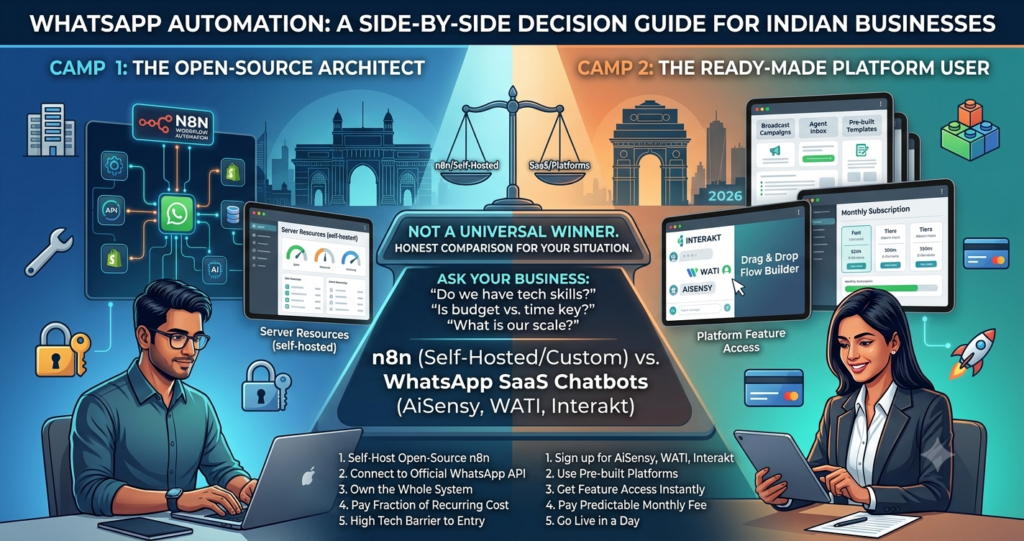
One camp says: sign up for a ready-made platform — AiSensy, WATI, or Interakt — pay a monthly fee, drag a few blocks into a flow builder, and go live in a day. The other camp says: skip the subscription, self-host an open-source automation tool called n8n, wire it to the same official WhatsApp Business API, and own the whole system for a fraction of the recurring cost.
Both camps are right, for different businesses. This article isn’t here to declare a universal winner — it’s here to give you an honest, side-by-side comparison so you can make the call for your specific situation, without paying for capability you’ll never use or under-investing in a system that needs to scale.
First, a Quick Clarification: What Are We Actually Comparing? (n8n vs WhatsApp SaaS chatbots India)
It helps to be precise about what sits where in this comparison, because the two options aren’t quite parallel.
The WhatsApp Business API is the official Meta channel that allows automated, business-scale messaging. Neither n8n nor the SaaS platforms are this API — both are ways of connecting to it. You cannot get direct API access from Meta as an individual business; you go through a Business Solution Provider (BSP), a Meta-approved partner that handles number verification and message routing.
SaaS chatbot platforms like AiSensy, WATI, and Interakt are BSPs that also bundle a no-code chatbot builder, a shared team inbox, broadcast tools, and analytics — all inside one polished dashboard you pay a monthly subscription for.
n8n is not a BSP. It’s an open-source, self-hostable workflow automation tool that you connect to a BSP’s API (or, in some cases, to Meta’s Cloud API more directly) using its own WhatsApp-capable nodes. In other words, when you “build WhatsApp automation with n8n,” you are typically still going through a BSP for the actual message-sending infrastructure — you’re just replacing the BSP’s built-in chatbot builder and dashboard with your own custom-built logic.
This distinction matters because it reframes the choice correctly: it’s not “BSP vs. no BSP.” It’s “a BSP’s own no-code builder vs. a self-hosted automation engine that you configure yourself, often on top of a leaner BSP plan.”
The Case for SaaS Chatbot Platforms
What You’re Actually Paying For
Platforms like AiSensy, WATI, Interakt, and Gallabox exist to remove the technical burden entirely. You get:
- A visual, no-code flow builder for FAQ bots, order confirmations, and broadcast campaigns
- A shared team inbox where multiple staff can see and respond to conversations from one number
- Pre-built templates for common flows — abandoned cart nudges, appointment reminders, payment confirmations
- Native integrations with tools many Indian businesses already use, such as Shopify, Razorpay, and HubSpot
- Meta verification and compliance handling done largely on your behalf
- Customer support from the platform itself when something breaks
The monthly subscription for these platforms in India generally runs from around ₹999 for basic tiers up to ₹5,000–₹15,000 for higher tiers with more seats and automation depth, on top of Meta’s own per-conversation charges.
Who This Fits Best
Non-technical founders and small teams. If nobody on your team can read a JSON payload or debug a broken webhook, a SaaS platform’s visual builder is the only realistic starting point. You configure it yourself over a weekend, using a browser, with no server to maintain.
Businesses that want to be live quickly. SaaS platforms typically get you from signup to a working FAQ bot in days, not weeks, because the infrastructure, hosting, and uptime are the provider’s problem, not yours.
Teams that value a single point of accountability. When something breaks on a SaaS platform, there’s a support ticket you can raise and a vendor whose job it is to fix it. With a self-hosted system, you (or whoever built it) are that vendor.
E-commerce sellers who want pre-built commerce flows. Interakt, for instance, has plug-and-play automations built specifically for Shopify sellers — abandoned-cart recovery, order confirmations — that you can turn on rather than construct from scratch.
Where SaaS Platforms Show Their Limits
The trade-offs tend to surface as a business scales or wants something the platform wasn’t originally built for:
Per-message and per-seat costs compound. A ₹999-a-month “Basic” plan can look attractive until message volume crosses a threshold where markup on Meta’s conversation charges, or added-seat fees, push the effective monthly cost well past what a self-hosted alternative would cost at the same volume.
Customization has a ceiling. No-code flow builders are excellent for linear, predictable conversations, but once you need genuinely custom logic — pulling live inventory data from three different systems before replying, for instance — you’re often limited by what the platform’s builder supports, not by what’s technically possible.
Your data lives on their infrastructure. For most businesses this is a non-issue, but for those handling sensitive customer data (health records, financial details), where your conversation logs are stored and processed becomes a real due-diligence question.
Vendor lock-in is real. Flows, templates, and conversation history built inside one platform’s proprietary builder don’t always migrate cleanly if you decide to switch providers later.
The Case for Self-Hosted n8n
What You’re Actually Building
n8n is a node-based, open-source automation platform that you either self-host on your own server or run through n8n’s own cloud offering. Instead of a pre-built chatbot builder, you assemble your own workflow: a trigger that listens for an incoming WhatsApp message, logic that decides how to respond, and an action that sends the reply — with as much or as little sophistication as you choose to build in.
Because it’s self-hosted, the core software itself carries no per-message or per-seat licensing cost. Your recurring cost is largely just server hosting — commonly in the range of a modest VPS plan per month for a small-to-mid-volume deployment — plus whatever the underlying AI model or BSP conversation charges cost on top.
This is also where the ceiling on customization essentially disappears. You can wire in a database to give the bot memory of past conversations, connect a vector database so it answers from your actual product catalogue and policies rather than generic training data, add a step that checks live inventory before quoting a price, or build an escalation path that only a human handling a specific complaint type ever sees.
Who This Fits Best
Businesses with in-house technical capacity, or a willingness to hire it once. Someone needs to build the initial workflow, understand the underlying WhatsApp API mechanics, and be available when something needs debugging. This doesn’t require a large team — often a single developer or a capable freelancer is enough — but it does require someone.
Businesses whose conversations don’t fit a template. If your customer interactions genuinely need custom branching logic, integration with three or four internal systems, or a conversational AI grounded in a large, frequently updated knowledge base, a self-built system can be shaped exactly to that need rather than bent to fit a generic builder.
Cost-sensitive businesses at meaningful message volume. Once monthly message volume is high enough that a SaaS platform’s markup on Meta’s per-conversation charges adds up to a significant sum, the cost gap between a flat-fee self-hosted server and a scaling SaaS subscription tends to widen in n8n’s favor.
Businesses that want data control. Self-hosting on a server located in an Indian data centre keeps your customer conversation logs within Indian jurisdiction under your own control — relevant for businesses in healthcare, finance, or anywhere data residency is a genuine compliance concern, not just a preference.
Where n8n Shows Its Limits
There’s a real setup cost before any value shows up. Someone has to provision a server, connect it to a BSP, build and test the initial workflow, and handle the inevitable early bugs. This is measured in hours to days for simple flows, and can stretch to weeks for a fully custom AI agent with memory and knowledge-base grounding.
You own the uptime. If your server goes down, or a workflow silently fails, there’s no vendor support ticket to raise — someone on your side needs to notice and fix it. WhatsApp’s own rules add pressure here: Meta expects a webhook acknowledgement within a few seconds, and a workflow that’s overloaded or misconfigured can, in a worst case, cause Meta to flag or disable your integration.
It’s a platform, not a product. n8n gives you the engine; you still have to design the actual customer experience. A poorly built workflow with n8n is no better — and is arguably worse, since there’s no vendor guardrail — than a mediocre SaaS chatbot.
Compliance is entirely your responsibility. Consent capture, opt-outs, and adherence to India’s Digital Personal Data Protection Act sit with whoever built and operates the system, not with a vendor’s built-in safeguards.
Head-to-Head Comparison
| Factor | SaaS Chatbot Platforms (AiSensy/WATI/Interakt) | Self-Hosted n8n |
| Setup time | Hours to a couple of days | Hours for a simple bot; days to weeks for a custom AI agent |
| Technical skill required | None — visual, no-code builder | Moderate to high — someone needs to build and maintain workflows |
| Monthly cost (typical) | ₹999–₹15,000+ depending on tier and volume | Roughly a modest VPS fee, plus BSP/Meta conversation charges |
| Customization ceiling | Limited to what the builder supports | Effectively unlimited — build any logic you can code |
| Who fixes it when it breaks | Vendor support team | You, or whoever built it |
| Best for | Fast launch, non-technical teams, standard use cases | Custom logic, cost efficiency at scale, data control |
| Data residency control | Depends on vendor’s infrastructure | Fully in your control if self-hosted in India |
| Ongoing maintenance burden | Minimal — vendor-managed | Real — server upkeep, workflow updates, monitoring |
| Ideal team profile | Solo owner or small non-technical team | Team with in-house tech capacity, or a hired developer/agency |
A Decision Framework: Which One Should You Pick?
Rather than a generic recommendation, work through these questions honestly.
Question 1: Do you have access to technical help — in-house or hired — that you can rely on? If the honest answer is no, and you have no plan to bring anyone in, a SaaS platform is the realistic starting point. n8n without technical support behind it tends to stall at the setup stage, which costs more in lost time than any subscription fee would.
Question 2: How standard are your customer conversations? If most of what your customers ask fits neatly into “what’s the price,” “is it in stock,” “when will it arrive,” a SaaS platform’s templates likely cover you well. If your business involves complex quoting logic, multi-step qualification, or pulling data from several internal systems before responding, a custom-built system earns its complexity.
Question 3: What’s your realistic monthly message volume, today and in twelve months? At low volume, the cost difference between the two approaches is often small enough not to matter — pick whichever is faster to launch. At high volume, the markup SaaS platforms charge on top of Meta’s conversation fees can become the deciding factor, and a flat-fee self-hosted server starts to look meaningfully cheaper.
Question 4: Does your business handle sensitive customer data? If you’re in healthcare, finance, or any sector where data residency and control genuinely matter — not just as a nice-to-have — the ability to self-host inside an Indian data centre under your own control is a real advantage that a SaaS platform’s infrastructure may not match.
Question 5: How much do you value having a support ticket to raise when things go wrong? If peace of mind and vendor accountability matter more to you than raw cost savings, that’s a legitimate reason to pay for a SaaS platform, even if a self-hosted system would technically be cheaper.
A Middle Path Many Businesses Miss
It’s worth noting these two options aren’t strictly mutually exclusive. A common and pragmatic pattern is to start on a SaaS platform to prove the value of WhatsApp automation quickly and cheaply, then migrate to a self-hosted n8n system once volume or complexity genuinely justifies the switch. This avoids the risk of over-engineering a solution before you know your actual usage patterns, while keeping the door open to more control later.
Another workable middle ground: use n8n purely for the back-end logic — connecting WhatsApp messages to your CRM, inventory system, or accounting software — while still relying on a BSP’s dashboard for the day-to-day conversational front end. This captures some of n8n’s flexibility without requiring you to build an entire conversational AI system from scratch on day one.
What This Looks Like for Different Business Types
A solo retailer or small shop owner managing a moderate volume of customer enquiries is usually best served starting with a low-cost SaaS tier — the setup speed and lack of technical burden outweigh the marginal cost savings a self-hosted system would offer at this scale.
A growing D2C brand processing hundreds of orders a week, with an existing tech-savvy founder or a part-time developer on retainer, often benefits from n8n once cart-recovery, order-notification, and support-automation needs start to overlap — the custom logic pays for itself in reduced manual work and lower per-message cost at volume.
A multi-location service business (say, a chain of clinics or salons) juggling appointment bookings across locations may find a SaaS platform’s shared team inbox genuinely valuable for coordinating staff, making the vendor-managed option worth the premium even at higher volume.
A B2B business qualifying leads from IndiaMART or Justdial before handing them to a sales team often needs conditional, multi-step logic that a no-code SaaS builder can strain to express cleanly — this is a strong candidate for a custom n8n workflow, provided someone can build and maintain it.
A regulated business handling sensitive data — a diagnostic lab, a lending platform, an insurance intermediary — should weigh data residency and control heavily, which tends to favor a self-hosted approach on Indian infrastructure, even if it means a higher upfront setup investment.
Common Misconceptions Worth Clearing Up
“n8n is always cheaper.” Not necessarily, once you account for the value of the time spent building and maintaining it. A ₹999-a-month SaaS plan can be genuinely cheaper than n8n once you price in developer hours for a business that doesn’t already have that capacity in-house.
“SaaS platforms can’t do AI-powered conversations.” They increasingly can — most now connect to large language models under the hood, letting you upload a knowledge base for more natural, context-aware replies, not just rigid keyword-triggered flows. The gap between the two approaches on raw AI capability has narrowed considerably.
“Self-hosting means you don’t need a BSP at all.” In most legitimate, compliant setups, you still go through a BSP for the actual WhatsApp Business API access — n8n replaces the BSP’s chatbot builder and dashboard, not necessarily the BSP relationship itself. Unofficial, non-BSP methods of connecting to WhatsApp exist, but they carry real account-ban risk and are unsuitable for any business relying on that number for revenue.
“Once you choose one, you’re locked in forever.” Migration between approaches is possible, if not always trivial — conversation history, templates, and integrations built inside a SaaS platform’s proprietary builder don’t always transfer cleanly to a new system, so it’s worth treating the first choice as a considered decision rather than a fully reversible one, even if it isn’t truly permanent.
Conclusion
There’s no universally correct answer to “n8n or a SaaS chatbot platform” — there’s only the answer that fits your business’s technical capacity, conversation complexity, message volume, and appetite for ongoing maintenance. A solo shop owner chasing a fast, reliable FAQ bot has very different needs from a scaling D2C brand with a developer on staff and thousands of monthly conversations to automate.
The honest starting advice: if you’re not sure which camp you’re in, start with a SaaS platform’s lower-tier plan, run it for a real operating cycle, and pay attention to where it genuinely falls short — the cost ceiling, the customization ceiling, or the data-control question. That gap, once you’ve actually hit it, will tell you far more reliably than any comparison article which direction is right for your business next.
This comparison reflects the WhatsApp automation landscape in India as of 2026. Provider pricing, feature sets, and Meta’s own policies change frequently — verify current terms directly with each platform before committing.