
One Brain or a Whole Team? What “Single Agent vs. Multi-Agent” AI Really Means for Your Small Business
A practitioner’s honest field notes for entrepreneurs who want growth, not jargon
Why I’m Writing This for You
I’ve spent the better part of the last few years sitting at kitchen tables and cramped back-office desks with people who run small businesses. Not boardrooms. Kitchen tables. A bakery owner who handwrites her inventory in a spiral notebook. A two-person digital marketing shop drowning in client emails. A plumber whose “CRM” is a flip phone full of voicemails he keeps meaning to return.
Every one of them has asked me some version of the same question over the past year: “Everyone’s talking about AI agents. Should I be using them? And what on earth is the difference between a ‘single agent’ and a ‘multi-agent system‘?”
That second question usually comes up because they saw a diagram online — the kind with two big boxes, arrows pointing everywhere, a “Reasoning LLM” on one side and an “Orchestrator” routing tasks to a “Research Agent A,” a “Writing Agent,” and a “Verifier Agent” on the other. It looks impressive. It also looks like something only a Silicon Valley engineering team could ever afford or operate.
I want to clear that fog. Because the truth is, this single-agent-versus-multi-agent distinction is not an academic curiosity for you. It is one of the most practical, money-saving decisions you’ll make as you bring AI into your business. Get it right, and you’ll buy yourself back ten or twenty hours a week without spending much at all. Get it wrong — and a lot of small business owners are getting it wrong right now — and you’ll burn cash, lose patience, and conclude that “AI doesn’t work for businesses like mine.”
So let me walk you through what I’ve actually seen work, told the way I’d tell a friend over coffee. No hype. No fear. Just the real picture, grounded in what’s happening in the market in 2026.
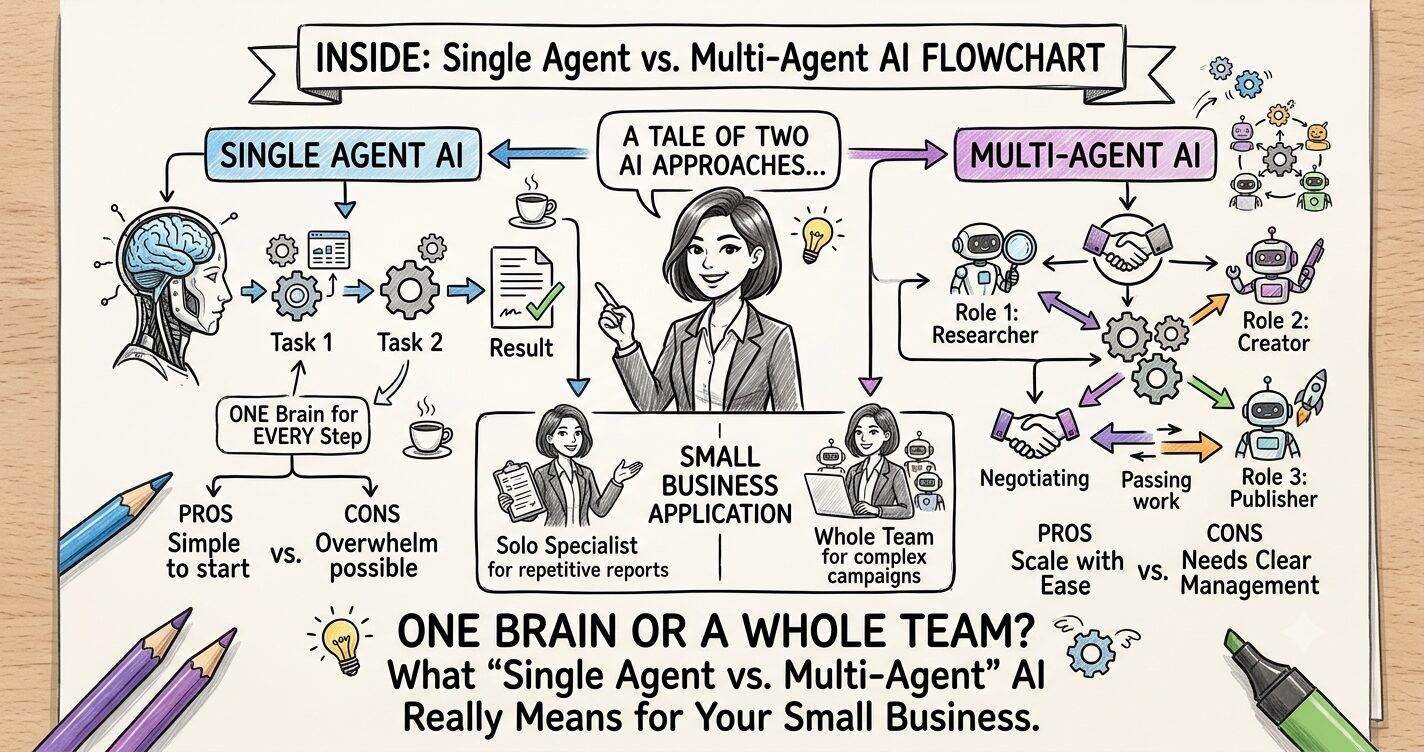
First, Let’s Strip the Jargon Down to Something Human – AI Agents
Forget the technical diagrams for a second. Here’s the simplest way I’ve found to explain it.
A single agent is like hiring one extremely capable, versatile employee. Think of the best generalist you’ve ever worked with — someone who can take a vague instruction (“figure out who our top three competitors are and write me a summary”), think it through, go look things up, decide what to do next, and hand you back a finished result. One person. One train of thought. One conversation, start to finish.
In the technical world, this is exactly what that “Single Agent Architecture” box describes. There’s a reasoning engine — the brain — that takes your request, makes a plan, decides it needs more information, reaches for a tool (say, a web search or your customer database), pulls what it needs, and loops back to keep thinking until the job is done. Then it hands you the finished report. As one industry guide put it plainly, it’s one agent, one control loop, full end-to-end execution.
A multi-agent system is like running a small department. Instead of one generalist, you have several specialists, each good at one thing, plus a manager who divides up the work and makes sure it all comes together. There’s an “orchestrator” — the manager — who takes your request, breaks it into pieces, and hands each piece to the right specialist. One specialist gathers product data. Another digs into pricing and reviews. A writer pulls everything into a draft. And then — this is the part I love — a “verifier” checks the work for mistakes before it reaches you.
In the technical world this is your “Multi Agent Architecture”: a collection of specialized AI agents that coordinate to handle complex workflows, with an orchestrator agent directing multiple worker agents.
That’s the whole concept. One brain that does everything, or a coordinated team of specialists. Everything else is detail.
Now here’s the question that actually matters to you: which one does your business need? And the answer, almost certainly, is going to surprise you.
My Honest Advice: Start With One Brain, Not a Whole Team
I’ll tell you where I land before I justify it, because I don’t want to bury the most important thing I have to say in this entire article.
For the overwhelming majority of small businesses, a single agent is not just the cheaper option — it is the better option. Full stop.
I know that runs against the marketing you’ve been reading. Every vendor wants to sell you the impressive-looking multi-agent “digital workforce” because it sounds like the future and it justifies a bigger price tag. But I’ve watched too many owners get talked into the complicated version and regret it. So let me show you why the simple version wins for most of us, using numbers, not opinions.
The people who study these systems for a living are saying the same thing. One 2026 review of forty-seven real production deployments found that 68% could have achieved the same results with a single well-built agent, at roughly 3x lower cost. Read that again. Two-thirds of businesses that built the complicated multi-agent version didn’t need it — and paid three times more for the privilege.
It gets more pointed. The standard advice from engineers who build these things is blunt: Start single-agent. Add more only when you hit a hard compliance boundary, a genuinely parallelizable workload, or a multi-team ownership problem. Even LangChain, one of the most respected names in the field, tells developers that many agentic tasks are best handled by a single agent with well-designed tools and that single agents are simpler to build, reason about, and debug — so you should start there.
Why does this matter so much for your wallet specifically? Because the costs of going multi-agent are real and they’re not small. The communication between all those specialist agents — the manager handing off to the researcher, the researcher reporting back, the writer asking for clarification — all of that “talking” costs money every single time. One 2026 production benchmark found that token consumption in multi-agent systems ran 4.3x to 4.6x higher than equivalent single-agent implementations due to inter-agent communication alone.
A university study put the range even wider, finding multi-agent systems can consume 4-220x more tokens than single-agent counterparts.
In plain English: every time those AI specialists pass notes to each other, the meter runs. And you’re paying the bill.
The Coordination Tax Nobody Warns You About
Here’s the part that genuinely shocked me when I first dug into the research, and it’s the thing I most want you to remember.
Multi-agent systems don’t just cost more. On the wrong kind of task, they actually perform worse than a single agent. Not slower — worse. Lower quality results.
This feels backwards, doesn’t it? More specialists should mean better work. But think about it from a human angle. Imagine you ask one sharp employee to write a customer follow-up email. They knock it out in two minutes, and it’s great because they remember the whole conversation with that customer.
Now imagine you route that same simple email through a “department.” The manager assigns it. One person drafts a rough version and passes a summary to the next. The next person rewrites based on that summary — but the summary left out the detail that the customer is upset about a late delivery. A third person polishes it. By the time it reaches you, it’s generic, it missed the point, it took five times as long, and you have to redo it anyway.
That’s not a hypothetical. Google researchers found that multi-agent coordination reduced performance by 39-70% on sequential reasoning tasks compared to single-agent approaches. The reason is exactly the email problem above: handoff summaries between agents lost critical context that would have stayed intact inside one continuous model call.
There’s even a speed cost your customers will feel. In a 2026 benchmark on identical customer-support tasks, optimized single-agent architectures answered in 1.8 seconds on average. A three-agent chain doing the same job took 5.2 seconds. And that delay wasn’t harmless — it produced a documented 12% increase in conversation abandonment. People hung up. For a small business, every abandoned conversation is a lost sale you’ll never even know you had.
So the headline I want tattooed on the inside of your eyelids is this: complexity is not a sign of sophistication. It’s a cost. Use it only when the job genuinely requires it.
So When Does a Small Business Actually Need Multiple Agents?
I don’t want to leave you thinking multi-agent is always wrong. It isn’t. There’s a real and growing place for it, even for ambitious small businesses. The skill is knowing how to tell the two situations apart. After watching dozens of these projects play out, here’s the test I now use.
A single agent is the right tool when your task is a chain — one step leading to the next. As one developer guide summarized it neatly, a single agent is right for any task that follows a linear path, fits inside a model’s context window, and does not cross a hard security or compliance boundary. Most of your daily work fits this perfectly: code review, customer support, content drafting, and data extraction are all chains where each step depends on the previous one. Drafting an email. Answering a customer question. Writing a product description. Summarizing a meeting. These are all “one brain” jobs.
Multiple agents start to earn their keep when your task naturally splits into independent pieces that can be worked on at the same time. The clearest example is research. Say you want a deep competitive analysis: who are my rivals, what are they charging, what are customers saying about them, and what’s their social media strategy. Those questions don’t depend on each other. One researcher can chase pricing while another chases reviews, simultaneously, and nobody has to wait.
This is precisely the scenario the experts point to. Research is called the strongest case for multi-agent architecture because of a fundamental structure match: research questions decompose into independent sub-questions that do not modify shared state. The verdict from those who’ve tested it: multi-agent wins decisively for breadth-first exploration across independent information sources.
Here’s a simple rule of thumb I give clients. Ask yourself: “If I handed this whole job to one smart person, would they have to do everything in order, one step at a time? Or could I hand pieces to three different people who’d never need to talk to each other until the very end?”
- If it’s one person, in order → single agent. Keep it simple, keep it cheap, keep it fast.
- If it’s three people working in parallel → multi-agent might be worth it.
And there’s a maturity threshold worth knowing. The guidance I trust says multi-agent architectures become necessary when solutions require more than three to five distinct functions or cross security boundaries. Below that, you’re almost always better off with one well-equipped agent.
What This Looks Like in a Real Small Business — Three Stories – AI agents for small business
Let me make this concrete, because abstraction is the enemy of action. Here are three composite pictures drawn from businesses like the ones I work with.
The Solo Consultant (Single Agent, All Day Long) – AI agents for small business
Priya runs a one-woman brand-strategy consultancy. Her time drains are predictable: drafting proposals, answering prospect emails, summarizing client calls, and turning her messy voice notes into polished follow-ups. Every one of these is a linear, one-brain task.
Priya does not need an orchestrator coordinating a fleet of specialists. She needs one capable AI assistant she can hand a task to and trust. When a prospect emails, the agent reads it, understands the context of their past conversation, drafts a reply in her voice, and flags it for her quick approval. When a call ends, it turns the transcript into action items with owners and due dates in seconds. This matches what the market is actually doing — the AI assistant has become the entry point for adoption and serves as the connective tissue across multiple business functions, functioning as a flexible, low-cost “AI employee”.
Priya’s monthly cost? Often under twenty dollars. Her time saved? She tells me it’s like getting a Friday back every single week.
The Growing E-Commerce Shop (Single Agent, Plus a Couple of Connected Tools) – AI agents for small business
Marcus runs an online store with a few hundred orders a month. His pain is customer service — the same fifteen questions, over and over, plus order tracking and returns. This is still fundamentally a single-agent job, but now the agent needs to connect to his other systems to actually be useful.
This is the lesson that separates AI that helps from AI that just chats. The agents that deliver real value are the ones with end-to-end action capability — that can update records, trigger processes, or communicate across platforms. The differentiator in 2026, as one consultancy put it, is integration depth: agents that connect directly to your store, your payment processor, and your shipping platform deliver far greater value than isolated tools.
Marcus’s setup handles the routine — order status, FAQs, simple returns — automatically, and seamlessly hands the tricky stuff to him. That’s the model the data keeps validating: automation for the routine with seamless handoff for the complex. Businesses doing this report saving 12 or more hours weekly.
The Marketing Agency Owner (Where Multi-Agent Finally Makes Sense) – AI agents for small business
Now meet Dana, who runs a six-person marketing agency. Once a quarter, she produces deep competitive-intelligence reports for clients — exactly the breadth-first research task we talked about. This is where, after starting simple, she’s earned her way into a light multi-agent workflow: one piece gathering product and feature data, another collecting pricing and reviews, a writer assembling the draft, and crucially, a verifier checking it before it goes to a client whose trust is everything.
Notice the progression. Dana didn’t start here. She started with a single agent for her daily work, got comfortable, proved the ROI, and only then graduated to a multi-agent workflow for the one task that genuinely benefits from parallel specialists. That’s the right order. Every time.
The Mistakes I See Owners Make (Please Don’t Make These) – AI agents for small business
I’ve now watched enough of these projects succeed and fail that the failure patterns are painfully predictable. Let me save you the tuition I’ve watched others pay.
Mistake #1: Buying the “everything” agent. The single biggest risk in 2026 is the over-promise of generalist agents that claim to replace multiple roles simultaneously. Vendors love to sell you a magical do-everything system. But without clearly defined task boundaries, these tools produce inconsistent results, miss contextual nuances, and create more work through error correction than they save. I’ve seen an owner spend eight thousand dollars in setup plus over a thousand a month on an “enterprise AI ops” agent that failed on basic edge cases, hallucinated inventory data, and needed 3x more human oversight than promised. It got shut down in two weeks. The lesson the team drew was simple and true: expensive ≠ better.
Mistake #2: Trying to automate ten things at once. This is the killer. The sobering reality is that 70-85% of AI projects still fail, mostly due to unclear goals or trying to do too much at once. The owners who succeed do the opposite. They pick one task — the one that drains the most time for the least joy — and automate just that.
Mistake #3: Confusing complexity with capability. I’ll keep beating this drum because it’s the heart of everything. The fanciest architecture is not the best architecture. The best architecture is the simplest one that solves your actual problem. Recent research is even challenging the whole assumption that more agents are better, finding that a single agent equipped with a skill library can match multi-agent performance at lower cost on a broad set of benchmarks.
Mistake #4: Skipping human oversight where judgment matters. Despite all the progress, fully autonomous customer service without human escalation remains problematic. Customers can still tell, and the complex cases need your judgment. Keep yourself in the loop where it counts.
Your Practical Starting Plan (This Week, Not “Someday”) – AI agents for small business
Enough theory. Here’s exactly what I tell an owner to do when they’re ready to actually begin. You can do all of this yourself, without a consultant and without code.
Step 1 — Find your single biggest time drain. Don’t theorize. For three days, just notice: what task takes the most time and gives you the least satisfaction? For most owners it’s one of these: email management, social media posting, report generation, or answering the same customer questions. The advice that works is to identify the single repetitive task consuming the most of your time.
Step 2 — Start with one general-purpose assistant. You almost certainly don’t need a custom-built system to begin. The most effective starting approach is a structured but simple stack, anchored by one general assistant for research, drafting, and ideation. The good news for your budget: the leading assistants — including ChatGPT, Claude, and Gemini — all offer free tiers, and no-code tools mean you don’t need technical expertise. A realistic small e-commerce setup using AI for customer service, content, and email automation can cost around $70/month total while saving the equivalent of a part-time hire.
Step 3 — Make it a single agent doing one job well. Resist the urge to build a “department.” Give your one assistant a clear, narrow task with defined rules and a clear definition of success. Narrowly scoped agents are the ones that consistently prove practical: specific tasks, clear rules, and human oversight for exceptions.
Step 4 — Measure for thirty days, then decide. This is the discipline that separates winners from the 70% who fail. Track the actual hours saved over a month before you spend another dollar or add another tool. The proven path is to measure, then scale, and the data shows most entrepreneurs run 3-5 agents within six months — but they get there one proven win at a time, not all at once.
Step 5 — Only graduate to multi-agent when a task forces you to. When you eventually hit a job that’s genuinely several independent tasks running in parallel — like Dana’s quarterly research reports — then you consider adding specialist agents and an orchestrator. Not before. The right mindset is the one the most successful owners share: they build AI ecosystems thoughtfully, adding or testing new tools in a thoughtful way that builds upon initial success.
Why This Is the Great Equalizer for People Like Us – AI agents for small business
I want to end on the bigger picture, because it’s genuinely exciting and I don’t want the cautions to drown it out.
For most of business history, the small operator was at a structural disadvantage. The big company could afford a research department, a customer-service team, a marketing staff, a data analyst. You couldn’t. You did all of it yourself, late at night, after the kids were asleep.
That gap is closing fast. The data is striking: 82% of small business employers have invested in AI tools, the average small business now uses a median of five AI tools, and tellingly, 93% of small businesses using AI plan to continue investing in it in the next year. People don’t keep paying for things that don’t work. That continued investment is, as the survey authors note, one of the clearest indicators of ROI.
What a well-chosen single agent gives you is the output of a capable employee at a fraction of the cost — it can qualify a lead, book an appointment, send a follow-up email, and update your CRM, all without you touching a keyboard. And the tools have become dramatically cheaper and easier to use while the no-code AI tools eliminate the need for technical expertise. The gap between the corporate giant and the corner shop has nearly closed.
But — and this is the whole reason I wrote this — closing that gap depends entirely on making smart choices, not impressive ones. The owner who quietly sets up one reliable single agent to handle their email and customer questions will run circles around the one who spent five thousand dollars on a tangled multi-agent “digital workforce” that breaks every other Tuesday.
So here is everything I know, compressed into a single sentence: Start with one capable brain, give it one clear job, measure what it saves you, and only build a team of agents when a real task genuinely demands it.
Do that, and AI stops being something that happens to your business and becomes something you put to work for it. That’s the difference between watching the future arrive and being the person who walked in early, picked the simple thing that worked, and quietly got their evenings back.
You don’t need the complicated diagram. You need one good decision, made this week. Go make it.
This article reflects current research and market data as of mid-2026. AI tools, pricing, and capabilities change quickly — always run your own thirty-day test with your own real customers before committing to any tool or architecture. The specific business examples are composites drawn from common small-business scenarios, not real named individuals.






One Comment