
The Business Behind the Wheel: How Trailer Rentals Power Local Logistics in 2026
Local logistics in 2026 looks very different from a decade ago. Same‑day delivery, fast-moving construction projects, and lean inventory models have made flexibility more important than ownership. In the middle of all this movement, one quiet hero keeps cities supplied and businesses running: the humble trailer. Not just owned by large fleets anymore, trailers are increasingly rented on demand by everyone from small retailers to regional logistics companies.
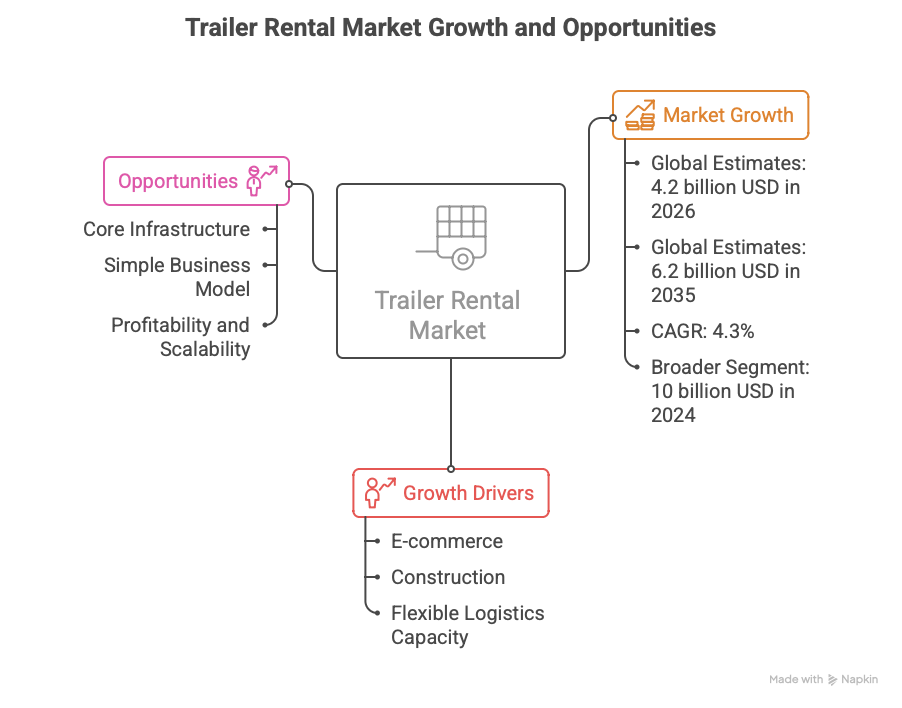
The trailer rental market itself is growing steadily as businesses search for cost‑effective transport solutions. Global estimates suggest the trailer rentals market will reach around 4.2 billion USD in 2026 and grow to over 6.2 billion USD by 2035, at a compound annual growth rate (CAGR) of about 4.3%. Other analyses put the broader trailer rental segment at over 10 billion USD in 2024, with strong growth expected through the 2030s. This growth is driven largely by e‑commerce, construction, and the need for flexible logistics capacity instead of owning everything outright.
For entrepreneurs and existing logistics operators, this shift creates a powerful opportunity. Trailer rentals are no longer just a side service; they are becoming a core infrastructure piece for local logistics. The good news is that the basic business model is simple to understand, and with the right systems, it can be highly profitable and scalable.
1. What Exactly Is a Trailer Rental Business?
A trailer rental business provides trailers—often without drivers—to individuals and companies on a short‑ or long‑term basis. These can include:
- Dry van trailers for general goods
- Flatbed trailers for construction materials and machinery
- Refrigerated (reefer) trailers for temperature‑controlled goods
- Dump or tipper trailers for waste, mining, or construction fill
- Storage trailers, which stay parked and act like mobile warehouses
Large players like Ryder, Premier Trailer Leasing and others offer huge fleets of semi‑trailers, reefers, flatbeds, and storage trailers, often bundled with maintenance, roadside assistance, and tracking technology. At a smaller, local level, the same concept works on a leaner scale: a yard with 5–50 trailers serving a specific city, region, or industrial area.
Unlike full truck rental, a pure trailer rental model may not include a tractor or truck. Clients either:
- Use their own trucks to haul the trailers
- Hire independent truckers
- Or, in a combined model, rent both truck and trailer from the same provider
This separation creates flexibility: a small contractor, a retailer, or even a moving customer can rent only what they need—capacity, not an entire fleet.
2. Why Local Businesses Prefer Renting Over Owning in 2026
In 2026, logistics is less about owning the biggest fleet and more about using the right capacity at the right time. Businesses are shifting from asset‑heavy to asset‑light models, and trailer rentals are a perfect fit for that mindset.
Key reasons businesses rent trailers instead of owning them:
- Lower upfront investment
Buying a trailer requires a large capital outlay, plus registration, financing, insurance, and ongoing maintenance. Renting converts this into a predictable operating cost instead of a long‑term liability. - Scalability with demand
Many industries—e‑commerce, retail, agriculture, construction—face seasonal or project‑based demand. Renting allows them to scale up for peak months and scale down when things are slower, without being stuck with unused trailers. - Reduced maintenance responsibility
Reputable rental firms handle maintenance, inspections, and safety compliance. This saves time and reduces risk for small businesses that may not have technical teams in‑house. - Access to specialized equipment
Not every business can justify buying refrigerated, dump, or heavy‑duty flatbed trailers for occasional use. Rentals give them “on‑demand specialization” without tying up capital. - Improved cash flow and agility
In an uncertain economic environment, many businesses prefer to keep balance sheets light and cash flow flexible. Trailer rentals fit that financial strategy very well.
For local logistics, these advantages translate into faster response times, more delivery capacity during peaks, and less downtime when things change unexpectedly.
3. How Trailer Rentals Plug Into Local Logistics Workflows
Trailer rentals quietly sit at several critical points in local logistics. Here are practical scenarios where they power day‑to‑day operations.
a) Retail and E‑commerce
- Local and regional retailers rent trailers as overflow storage during festive seasons or big sales, parking trailers at distribution centers or store backlots. Companies like Warehouse on Wheels specialize in this “storage on wheels” model.
- E‑commerce sellers use trailers for linehaul movements between city hubs and local delivery centers, especially when volumes spike and they need extra capacity without buying more vehicles.
b) Construction and Infrastructure
- Construction firms rent flatbed and dump trailers to move steel, cement, pipes, machinery, and demolition waste between sites and storage yards.
- Short‑term, project‑based rentals help them match equipment usage to project timelines, rather than owning expensive trailers that sit idle between contracts.
c) Manufacturing and Industrial Logistics
- Manufacturers use trailers as mobile buffers between plants, warehouses, and customer sites.
- Trailer pools—shared groups of trailers used by multiple companies—optimize loading/unloading, cut waiting times, and reduce “empty miles.” Platforms like COOP by Ryder show how trailer pools can improve utilization and reduce idle time.
d) Agriculture and Food Supply
- Farmers and food processors rent refrigerated trailers during harvest or peak shipping periods to protect perishable products.
- Bulk grains, fertilizers, and packaging materials are moved using rented flatbeds and bulk trailers when regular capacity isn’t enough.
e) Moving, Events, and General Transport
- Individuals rent small trailers for personal moves, furniture transport, and DIY projects.
- Event companies use trailers to move staging equipment, sound systems, and booths around a city.
In all these examples, the common pattern is simple: trailer rentals give businesses temporary logistics power without permanent ownership, allowing local supply chains to stay agile.
4. The Core Business Models in Trailer Rentals
If the goal is to build or expand a trailer rental business that supports local logistics in 2026, it helps to understand the main business models.
4.1 Stand‑Alone Trailer Rental Yard
This is the classic model:
- You own or lease a yard strategically located near highways, industrial clusters, ports, or warehousing zones.
- You offer a variety of trailers (dry van, flatbed, reefer, dump, storage) for short‑ and long‑term rentals.
- Customers are typically local logistics firms, manufacturers, retailers, and construction companies.
Revenue comes from daily/weekly/monthly rental fees, long‑term contracts, and penalties for late returns or damage.
4.2 Truck + Trailer Combo Rentals
Here, you offer both the tractor (truck) and the trailer as a package. This is attractive for:
- Smaller businesses without their own trucks
- Companies handling one‑off or seasonal projects
- Businesses testing a new route or market before investing in their own fleet
Many commercial rental providers now combine trucks, tractors, vans, and trailers into flexible packages tailored to business needs.
4.3 Trailer Pooling and Shared Fleets
In trailer pooling, multiple companies share access to a common trailer pool. This model:
- Reduces empty runs and “deadhead” miles
- Allows trailers to be dropped at one location and picked up by another truck (drop‑and‑hook operations)
- Is especially useful in high‑traffic corridors and dense industrial areas
Platforms that focus on trailer pooling and fleet sharing help businesses increase trailer utilization while lowering capital expenditure.
4.4 Storage‑Only Trailer Rentals
Some trailers never leave a site. They act as moving warehouses:
- Parked at factories, warehouses, or retail sites
- Used for overflow stock, seasonal inventory, or staging outbound loads
This model reduces the dependency on building permanent warehouse space and provides flexible, low‑cost storage in tight real estate markets.
5. The Operational Backbone: Fleet, Maintenance, and Uptime
A trailer rental business looks simple from the outside, but operational excellence is what separates a profitable player from an average one.
5.1 Fleet Selection and Mix
Your fleet must match your local market:
- Dry vans for general freight and retail
- Flatbeds for construction, steel, and machinery
- Reefers for food, pharma, and cold chain
- Dump trailers for construction and waste
- Smaller utility trailers for personal moves and micro‑businesses
Market research and early customer conversations will tell you where to start. Industry reports show strong demand from e‑commerce, construction, and manufacturing segments, which often require a mix of dry vans, flatbeds, and reefers.
5.2 Preventive Maintenance and Safety
Top rental brands emphasize regular inspections, safety checks, and compliance because trailers are income‑producing assets only when they are roadworthy. A robust maintenance program should include:
- Scheduled inspections (brakes, lights, tires, couplings, suspension)
- Pre‑ and post‑rental checklists with clear documentation
- Partner workshops or in‑house technicians
- Quick turnaround for repairs to reduce downtime
This not only protects customers and the public but also extends the life of your assets and reduces costly breakdowns.
5.3 Uptime Guarantees and Support
Leading rental providers win business by promising high uptime and strong support—often 24/7 roadside assistance. Even a small rental business can:
- Partner with local service centers for emergency repairs
- Offer simple helpline support for breakdowns
- Maintain a few backup trailers to swap out in case of major issues
Reliable uptime is a strong selling point, especially for logistics companies that work on tight delivery schedules.
6. Technology and Data: The New Fuel for Trailer Rentals
In 2026, trailer rental is not just about metal and wheels; it is also about data.
6.1 Telematics and GPS Tracking
Modern rental fleets are increasingly equipped with telematics devices that provide:
- Real‑time trailer location
- Load status (loaded vs. empty)
- Door open/close events
- Temperature monitoring for reefers
- Utilization metrics (how many hours/days a trailer is actually used)
This data helps:
- Rental companies optimize their fleets and reduce idle trailers
- Customers locate trailers quickly and reduce losses/theft
- Both parties plan routes, capacity, and scheduling more accurately
6.2 Customer Portals and Digital Booking
Larger providers offer online portals where customers can:
- Check availability
- Reserve trailers by type, date, and duration
- View contract details, invoices, and fleet data
- Track trailers in real time
Even at a smaller scale, using simple digital tools—booking forms, WhatsApp Business, basic fleet software—makes operations smoother and more professional.
6.3 Analytics for Better Decisions
Market research shows that the trailer rental segment is becoming more data‑driven, especially as e‑commerce and flexible supply chains grow. A rental operator can use analytics to answer:
- Which trailer types are most popular and most profitable?
- What is the ideal rental duration to maximize revenue per trailer?
- Which customer segments have the lowest default and damage rates?
- When is the best time to sell and replace older trailers?
Using this information, you can refine your fleet mix, pricing, and marketing for higher returns.
7. Revenue Streams and Pricing Strategies
A well‑designed trailer rental business has multiple revenue streams, not just basic rental fees.
7.1 Core Rental Charges
Common structures include:
- Hourly or daily rentals for individuals and small jobs
- Weekly and monthly packages for SMEs and local logistics players
- Multi‑year contracts or lease‑to‑own options for large customers
Longer commitments can be priced lower per day but provide predictable cash flow.
7.2 Value‑Added Services
Additional revenue (and differentiation) can come from:
- Delivery and pickup of trailers from customer sites
- Accessory rentals: tarpaulins, tie‑downs, racks, refrigeration units, GPS units
- Maintenance packages for customer‑owned trailers
- Insurance add‑ons or simplified coverage through your partners
- Branding and wrapping services for customers who want logos on long‑term rentals
7.3 Storage‑Only Rates
Storage trailers, especially parked at customer sites, can be priced differently:
- Lower daily rates than road‑going rentals
- Minimal wear and tear
- High demand in tight real‑estate markets or during seasonal inventory spikes
This segment can generate stable, low‑maintenance income.
8. Step‑by‑Step: How to Build or Expand a Trailer Rental Business in 2026
Whether the goal is to start from scratch or add trailer rentals to an existing logistics operation, the steps are similar and practical.
Step 1: Define Your Target Customer and Niche
Ask:
- Are you serving local movers and individuals, SMEs, construction, manufacturing, retail/e‑commerce, or a mix?
- Is your market price‑sensitive, quality‑sensitive, or convenience‑sensitive?
Study your city or region: industrial zones, ports, large construction corridors, growing e‑commerce hubs, and even agricultural belts all signal demand for different trailer types.
Step 2: Choose Business Model and Fleet Mix
Based on your niche:
- Decide if you’ll start with stand‑alone trailers or truck + trailer combos.
- Pick 1–3 trailer types to start instead of trying to cover every category.
- Plan a phased approach: start small, learn, then expand the fleet and services.
Step 3: Understand Regulations and Compliance
Each country and region has its own rules for:
- Trailer registration, permits, and roadworthiness certificates
- Insurance requirements
- Weight limits and loading rules
- Safety equipment and signage
Consult a transport consultant or legal advisor to ensure your contracts and operations meet local standards.
Step 4: Secure Capital and Suppliers
Your main costs will be:
- Trailers (new or used) or lease payments
- Yard/parking space
- Insurance and basic staff
- Initial marketing and technology setup
You can buy trailers, lease them from manufacturers, or even partner with companies that have idle trailers, turning them into a shared rental pool.
Step 5: Build Simple but Strong Operations
Focus on:
- Clear rental contracts and terms (damage, delays, cargo responsibility)
- Standard check‑in and check‑out procedures
- Basic fleet management and tracking (even spreadsheets at first, then software)
- A simple booking process: phone, website form, or messaging app
Your goal is to make renting a trailer as easy and predictable as booking a hotel room.
Step 6: Design a Marketing and Sales Strategy
Practical channels that work for trailer rentals:
- Partnerships with local movers, 3PLs, transporters, and construction firms
- Listings on B2B platforms and local directories
- Google Maps and local SEO (“trailer on rent near me”)
- Social media posts highlighting successful use cases and customer stories
- Direct outreach to warehouses, factories, and retailers in your area
Highlight your strengths: uptime, flexibility, fair pricing, and quick response.
Step 7: Scale with Data, Not Guesswork
As the business grows:
- Track utilization per trailer, per customer segment
- Drop or sell underperforming asset types
- Invest more in high‑demand, high‑margin segments (e.g., reefers in food hubs, flatbeds in construction corridors)
- Explore advanced technology like telematics and customer portals to handle higher volumes efficiently.
9. Risk Management and Protecting Your Business
Trailer rentals involve real‑world risks, but they can be controlled with systems.
Key risk areas to manage:
- Damage and accidents
- Use detailed inspection checklists, photos, and clear responsibility clauses.
- Keep insurance coverage adequate, and require proof of customer insurance where applicable.
- Theft and misuse
- Install GPS trackers on higher‑value trailers.
- Set geographical limits in contracts and monitor unusual movements.
- Regulatory non‑compliance
- Keep up with local transport laws and regularly review your contracts and processes.
- Maintain inspection and maintenance records to protect against liability claims.
- Customer default and late payments
- Use deposits, credit checks for corporate clients, and staged payment terms.
- Offer discounts for long‑term, reliable customers to build a stable base.
Handled correctly, these systems not only protect you but also build trust with your clients, which directly supports long‑term growth.
10. The Future: Why Trailer Rentals Will Matter Even More
All major trends in logistics point toward greater reliance on flexible, on‑demand assets:
- E‑commerce volumes continue to grow, demanding fast and adaptable local transport.
- Urbanization and infrastructure projects keep construction activity strong, requiring moveable capacity rather than fully owned fleets.
- Companies are under pressure to be financially lean and environmentally responsible, which favors rental and sharing models over heavy asset ownership.
Trailer rentals sit right in the middle of these shifts. They allow businesses to “plug in” capacity wherever and whenever needed—making them a backbone of local logistics in 2026 and beyond.
Final Thoughts: Turning Insight into Action
For entrepreneurs, logistics providers, and even traditional transporters, the trailer rental business is a powerful way to participate in the growth of modern supply chains without building a full trucking empire. With thoughtful niche selection, disciplined operations, and smart use of technology, trailers become more than metal boxes on wheels—they become productive, profitable assets that power local economies.
To apply these ideas in your own business:
- Identify where your local market struggles with capacity, storage, or seasonality.
- Design a simple, focused trailer offering that directly solves those problems.
- Start small, learn from early customers, and then expand deliberately—guided by data, not just intuition.
Done well, “the business behind the wheel” can become a reliable and scalable income engine, supporting not only your own growth but also the logistics networks that keep your city moving.






One Comment