
Procure.ai: Redefining Enterprise Buying Through Human Insight and Intelligent Automation 2026
Every day, enterprise procurement teams face a silent crisis that costs their organizations millions in lost efficiency, missed opportunities, and poor vendor relationships. They’re drowning in spreadsheets, wrestling with disconnected systems, and making critical purchasing decisions based on incomplete information. The vendors are becoming increasingly sophisticated. The supply chain is more volatile than ever. And somewhere in the middle of this chaos, humans are making decisions that feel more like educated guesses than strategic choices.
Here’s what keeps procurement leaders awake at night: they know their processes are broken, but they don’t know how to fix them without sacrificing the human judgment that actually makes the system work. They’ve seen vendors promise “full automation” only to realize that removing humans from the equation removes wisdom, context, and the ability to navigate the gray areas that procurement is full of. Meanwhile, their competitors are quietly moving forward with solutions that combine the best of both worlds—artificial intelligence that augments rather than replaces, and data that informs rather than dictates.
This is where the procurement landscape has fundamentally shifted in 2026. We’re no longer asking whether to automate or keep humans in charge. We’re asking how to create a system where intelligent machines handle the complexity, and experienced procurement professionals focus on what they do best: building relationships, making strategic decisions, and driving business value. Enter Procure.ai—a platform that’s quietly redefining how enterprises approach buying by merging human expertise with intelligent automation in ways that actually work.
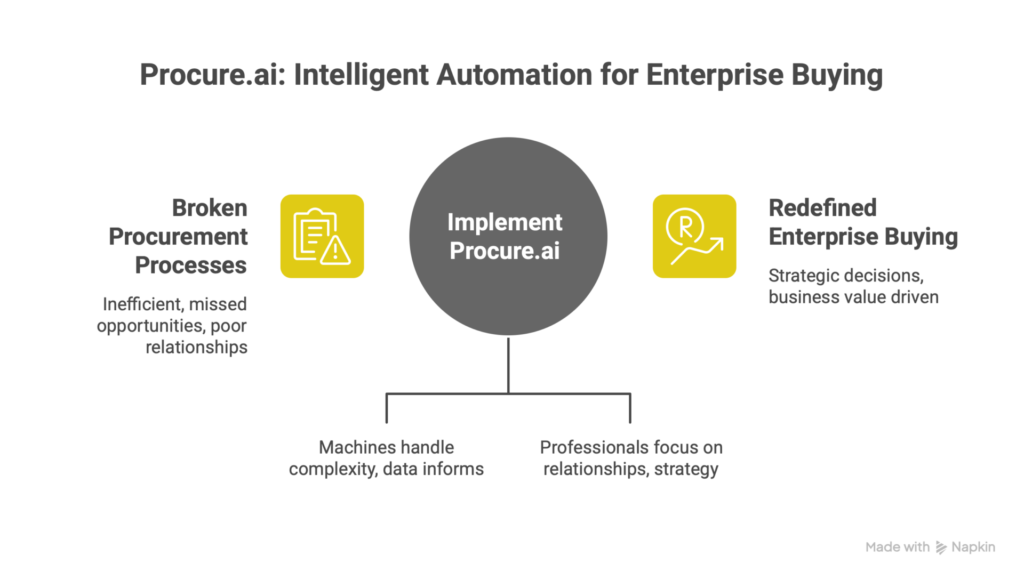
The Broken Procurement Paradox: Why Traditional Solutions Have Failed (Enterprise)
To understand why Procure.ai matters, we first need to understand why procurement has remained stuck in the past despite decades of technology promises.
The traditional approach to enterprise procurement has always been fragmented. You have your ERP system handling transactions, your spend analysis tools buried in another system, vendor management happening through email and spreadsheets, and strategic sourcing discussions happening in meeting rooms where half the team doesn’t have access to real-time data. Each system speaks a different language. None of them communicate seamlessly. And the result? Procurement teams waste an average of 30-40% of their time on administrative work—data entry, reconciliation, chasing approvals—instead of focusing on strategic activities that actually drive competitive advantage.
The first wave of procurement automation promised salvation through complete digitization. Robotic process automation (RPA) tools, for instance, could theoretically handle invoice processing, PO creation, and vendor communication without human intervention. But here’s what happened in practice: companies implemented these tools, achieved initial efficiency gains, and then hit a wall. The systems couldn’t handle exceptions. They couldn’t understand nuance. When something fell outside the narrow parameters they were programmed for, they either made mistakes or handed the problem back to humans with even less context than before.
Then came the artificial intelligence wave. Machine learning algorithms would predict vendor performance, optimize contract terms, identify cost-saving opportunities—all without human bias clouding the picture. But again, reality proved more complex than the pitch. AI trained on historical data inherited the biases of past procurement decisions. It optimized for metrics that looked good on paper but missed the strategic relationships that actually mattered. A system that recommends the cheapest vendor without considering quality, reliability, or long-term partnership potential can be more expensive than the humans it replaced.
The core problem? Both waves of technology attempted to replace human judgment rather than augment it. They treated procurement decision-making as a pure optimization problem—something that could be solved with enough data and computing power. But procurement isn’t just about optimization. It’s about judgment. It’s about understanding your business context, reading subtle signals from vendors, recognizing when a cost saving is actually a false economy, and knowing which relationships will matter five years from now.
By 2026, the enterprises winning at procurement have figured this out. They’re not asking their technology to replace their people. They’re asking it to make their people smarter.
The Connected Procurement Paradigm: Where Procure.ai Enters the Picture (Enterprise)
Procure.ai approaches the problem from first principles: what would an intelligent procurement system look like if we designed it specifically to augment human judgment rather than replace it?
The answer is a platform built on three interconnected pillars: connectivity, intelligence, and human-centricity. Let’s break down what this actually means.
First, connectivity. Traditional procurement systems exist in silos. Your spend data doesn’t talk to your contract management system. Your vendor performance metrics live in a separate tool from your sourcing platform. This fragmentation isn’t just an IT problem—it’s a business problem. It means procurement leaders can’t see the full picture of what their enterprise is buying, from whom, and at what cost. Procure.ai connects these dots by creating a unified data layer that brings information from all procurement touchpoints into a single, coherent view. Now when you’re making a sourcing decision, you can see historical spending patterns, contract terms, vendor performance history, and market benchmarks all in one place. Your team isn’t working with 20% of the information they need—they’re working with 100%.
Second, intelligent automation. This is where Procure.ai differs fundamentally from earlier generations of procurement software. The platform uses machine learning not to make decisions, but to surface insights and automate routine work in ways that are transparent to users. It learns which vendors historically deliver on time, which ones have quality issues, which relationships drive strategic value. It identifies cost-saving opportunities, flags contract terms that deviate from historical norms, predicts supply chain risks before they materialize. But crucially, it presents these insights to procurement professionals as recommendations that inform their judgment, not as decisions to be implemented blindly. The system learns continuously from the outcomes of human decisions, improving its recommendations over time. It’s not “AI makes the call”—it’s “here’s what the data suggests, here’s what worked in similar situations before, now what do you think?”
Third, human-centricity. This might sound obvious, but it’s where most enterprise software falls short. Procure.ai is built with the recognition that procurement professionals are knowledge workers, not button-pushers. They have expertise. They have intuition. They understand their business context. The platform’s interface is designed for them to think and work faster, not to replace their thinking. When they need to make a complex sourcing decision, the system gives them the relevant context upfront. When they’re negotiating contract terms, the system shows them how proposed terms compare to historical data and market standards. When they’re managing vendor relationships, the system helps them stay on top of performance without becoming an additional administrative burden.
This is a fundamentally different philosophy than what you find in traditional procurement software, which often feels like it was designed by people who’ve never actually done procurement work. Procure.ai feels like it was designed by people who understand that procurement isn’t a cost center to be optimized down to zero—it’s a strategic function that creates massive value when done well.
How Procure.ai Creates Connected Procurement Experiences (Enterprise)
So what does this actually look like in practice? Let’s walk through a realistic scenario to understand how a connected, human-centric, intelligently automated system changes the work of procurement.
Imagine you’re a Senior Procurement Manager at a mid-sized technology company, and you need to source a new logistics provider for your growing e-commerce operations. In a traditional procurement environment, this is a multi-week project. You’d manually gather historical shipping data from different systems, compile a list of potential vendors from various sources, create a spreadsheet to score them against criteria you define, and spend hours coordinating with stakeholders across the company to gather input.
With Procure.ai, the process is fundamentally different.
You start by accessing your unified procurement dashboard. The system immediately shows you historical logistics spending across your organization—you realize you’ve been working with seventeen different logistics vendors when optimal vendor consolidation would bring your costs down 12-15%. The system has already identified this pattern and flagged it as a risk. It surfaces the logistics providers you already use who might expand into your new market, along with performance data for each. It identifies providers the system has learned are strong performers in your geographic region, based on data from similar companies in your industry. Within minutes, you have context that would have taken your team days to compile manually.
Now you’re ready to shortlist vendors. Instead of creating a criteria matrix manually, Procure.ai helps you think through what matters most. It suggests evaluation criteria based on what’s driven value in your past logistics relationships, reminds you of terms that worked well before, and highlights any criteria that might contradict each other (like requiring the lowest cost while also demanding premium service). You define your priorities with stakeholder input, and the system creates a systematic evaluation framework—something that once took hours to organize now takes minutes.
The vendor outreach is next. Instead of manually drafting RFQs and managing responses, Procure.ai generates a structured RFQ template based on your specifications and your organization’s standard terms. Vendor responses are captured in a structured format—no more PDFs with different layouts from different vendors. The system begins scoring responses against your criteria in real-time, surfacing any red flags (a vendor quoting terms that significantly deviate from your historical agreements, pricing that looks like an outlier compared to market rates, etc.). When vendors send follow-up questions, the system categorizes them and suggests responses based on how similar questions were handled in past negotiations.
By the time you’re in final negotiations with your top three choices, you have more clarity and better information than you’ve ever had. The system shows you exactly how each vendor’s proposed terms compare to your historical agreements and to what you’re seeing in the market. It surfaces risks you might otherwise miss—a logistics partner proposing terms that give them unilateral rate-increase authority, for instance. It identifies opportunities to negotiate better pricing without requiring you to manually compare fifteen different line items. The negotiation moves faster and more strategically because you’re not spending cognitive energy on data synthesis—you’re focusing on relationship-building and strategic decision-making.
When you finally select your vendor and implement the agreement, the system doesn’t just file it away. It monitors ongoing performance systematically. It tracks delivery times, quality metrics, cost variances, and service level compliance without requiring manual effort. When performance deviates from what was contracted, it alerts you early. When an opportunity emerges to renegotiate terms with a high-performing vendor, the system flags it with the supporting data you’d need to make that conversation productive.
This entire process—which might have taken three months in a traditionally run procurement function—now takes four weeks. More importantly, the quality of decision-making is dramatically higher because the humans involved aren’t drowning in data work. They’re thinking strategically about what matters for the business.
The Business Case: Why Enterprises Are Making This Shift Now
You might be thinking, “This sounds great, but what’s the actual ROI?” Fair question. Let’s look at what enterprises are realizing when they implement platforms like Procure.ai.
Efficiency Gains: The most immediate impact is time savings. Procurement teams using integrated platforms spend roughly 30% less time on administrative work—data entry, reconciliation, report generation, etc. Those are hours that get redirected toward strategic activities. At an organization with a 50-person procurement team, that’s roughly 6,000 hours annually that shift from administrative work to value-creation.
Cost Reduction: Better visibility into spending patterns reveals consolidation opportunities, reduces maverick buying, and improves negotiating position. Early adopters of connected procurement systems are seeing 5-15% total cost of ownership reductions in their procurement operations. For a company spending $500 million annually on procurement, that’s $25-75 million in annual savings. More importantly, these aren’t one-time savings—they’re structural improvements that persist year after year.
Risk Mitigation: When your procurement system has visibility into supplier performance, contract terms, and market conditions, you catch problems earlier. Supply chain disruptions that would have created a crisis in a fragmented system get identified early enough that you have time to respond. Vendor financial distress gets flagged before it becomes a critical problem. Contract renewals don’t slip past their optimal timing windows.
Relationship Quality: This is harder to quantify but equally important. When procurement teams aren’t drowning in administrative work and have better data about what matters to their vendors and their internal stakeholders, vendor relationships improve dramatically. Your organization becomes known as an easier, more professional customer to work with. Strategic vendors give you better pricing and more attentive service because they know you’re organized and professional. Strategic internal stakeholders trust procurement more because the team consistently delivers better outcomes.
Strategic Capability: Ultimately, procurement at technology-enabled organizations becomes a strategic function rather than a transactional one. Your Chief Procurement Officer can speak the language of business strategy because the platform handles the operational complexity. Your procurement team can focus on category strategy, supplier development, risk management, and innovation rather than spending their days in data entry and spreadsheet reconciliation.
This is why major enterprises across industries—from technology to manufacturing to healthcare to finance—are adopting connected procurement platforms in 2026. It’s not because they’ve become enamored with technology for its own sake. It’s because the business case is overwhelming.
The Intelligent Automation Advantage: Why This Matters More Than Ever (Enterprise)
Here’s something important to understand about the state of procurement in 2026: the volume and complexity of buying is increasing dramatically.
Enterprise supply chains are more complex than ever. The number of vendors is growing. Regulatory requirements are multiplying. Geopolitical uncertainty is making supply chain management more critical. Remote work means stakeholders making buying decisions are distributed across time zones and organizational silos. The amount of data that procurement teams need to synthesize to make good decisions has exploded.
A purely manual process can’t scale to handle this complexity. You simply don’t have enough humans to process all the information you need to process at the speed you need to process it.
But equally, full automation doesn’t work because procurement has too many exceptions, too much context-dependency, and too much nuance for a rules-based system to handle.
This is where intelligent automation creates genuine breakthrough value. The system handles the volume—it can process hundreds of RFQs simultaneously, score them against complex criteria matrices, identify compliance issues in contract terms, analyze performance data across thousands of transactions. Humans provide the judgment—understanding what the numbers mean in context, making strategic calls about what matters, recognizing exceptions, building relationships.
The system learns from every decision the organization makes. When procurement decides to pay a premium price for a vendor because of reliability, the system learns that this organization values reliability. When they negotiate harder on a particular contract term, the system learns that term matters strategically. When they override a system recommendation, the system updates its recommendations to better match organizational priorities. Over time, the system becomes less like a rigid rulebook and more like a knowledgeable colleague who understands how your organization thinks.
This is genuinely new capability that wasn’t available five years ago. It required advances in machine learning, access to large datasets of procurement transactions and outcomes, and rethinking about what automation is actually for. Procure.ai represents the maturation of this new approach.
Overcoming Implementation Challenges: What Organizations Need to Know (Enterprise)
That said, transitioning to a connected, intelligent procurement platform isn’t effortless. Organizations that have successfully implemented these systems typically identify a few key challenges upfront and plan for them.
Change Management: Your procurement team has been working in a particular way for years. That workflow is embedded in how they think about their job. Moving to a new system requires genuinely changing how they work. This is a change management challenge, not just a technology challenge. Successful organizations invest heavily in training, involve key users early in implementation, and celebrate quick wins to build momentum.
Data Quality: Intelligent systems are only as good as the data they’re trained on. If your historical vendor performance data is incomplete or your spend data has been categorized inconsistently, the system’s recommendations will reflect those problems. Before implementing, successful organizations invest time in data cleaning and standardization. This is never the most exciting part of a software implementation, but it’s one of the most critical.
Integration Complexity: Your Procure.ai platform needs to connect with your ERP system, your contract management system, your vendor portal, your financial systems, and possibly a dozen other platforms. Making these integrations work smoothly requires technical expertise and patience. Successful organizations plan for integration complexity and don’t underestimate the timeline.
Change in Procurement Culture – Enterprise: The biggest challenge is usually cultural. Procurement teams sometimes initially resist recommendations from an AI system—they’ve built their expertise over years, and taking suggestions from a system feels threatening. The organizations that win past this are clear that the system is augmenting the team’s expertise, not replacing it. They celebrate examples where the system surfaced something the team missed. They show that the system is saving procurement people time, not eliminating jobs.
These challenges are real, but they’re solvable. The organizations that plan for them and invest in managing them get exceptional results.
Looking Ahead: The Future of Enterprise Procurement (Enterprise)
We’re at an inflection point in enterprise procurement. The tools that worked in 2015—the disconnected platforms, the spreadsheet-based workflows, the spreadsheet-fueled decision-making—are becoming increasingly inadequate for the complexity of modern buying.
At the same time, technology has finally matured to the point where we can build procurement systems that actually work the way procurement professionals think. We can create platforms that make data accessible without drowning users in it. We can automate routine work without removing human judgment. We can build systems that get smarter over time and adapt to organizational culture rather than forcing culture to adapt to the system.
Procure.ai represents this maturation. It’s not the culmination of procurement technology—we’ll keep evolving. But it represents a fundamental shift in how intelligent enterprises are approaching the buying function. Connected experiences. Driven by humans. Powered by data.
The enterprises that adopt this approach in 2026 will gain meaningful competitive advantage. Their procurement teams will be more productive. Their costs will be lower. Their supplier relationships will be stronger. Their supply chains will be more resilient. And perhaps most importantly, procurement will become the strategic function it should always have been.
The question for your organization isn’t whether you need better procurement capability. The question is whether you’re going to build it yourself or partner with a platform that’s already solved these problems. For most organizations, the answer is becoming increasingly clear.
Key Takeaways – Enterprise
The future of enterprise procurement isn’t about full automation or pure human decision-making. It’s about the optimal combination of both.
Connected procurement experiences—unified data, intelligent automation, human-centric design—represent a fundamental evolution in how enterprises approach buying. Organizations implementing these approaches are seeing dramatic improvements in efficiency, cost management, risk mitigation, and strategic capability.
If your procurement function is still running on disconnected systems and manual processes, you’re not just inefficient—you’re falling behind competitors who’ve already made this shift. The time to move isn’t next year. It’s now.



One Comment