From Insight to Impact: Using Visier’s AI for Human Truth to Hire, Grow, and Keep Top Talent 2026
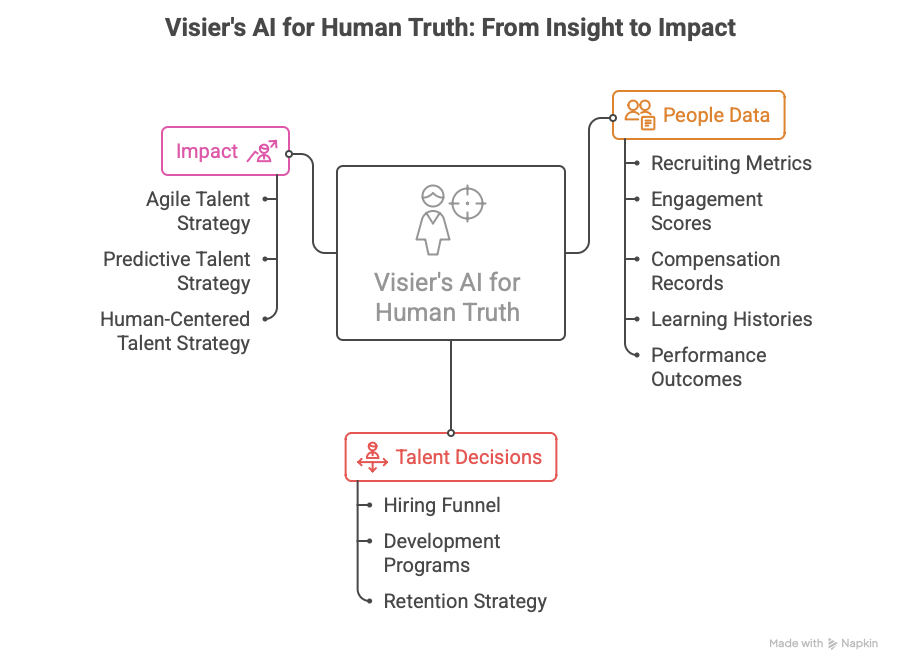
In 2026, every organization is swimming in people data—recruiting metrics, engagement scores, compensation records, learning histories, performance outcomes, and more. Yet many talent decisions still rely on intuition, incomplete spreadsheets, and fragmented systems that never quite line up. The result: leaders sense that something is wrong in their hiring funnel, development programs, or retention strategy, but cannot see clearly enough to act with confidence.
This is where Visier’s AI for Human Truth plays a transformative role. It is not just about dashboards or reports; it is about extracting the human reality behind the numbers and converting that understanding into actions that meaningfully improve how organizations hire, grow, and keep top talent.
This article explores how, in 2026, organizations can move from insight to impact using Visier’s AI for Human Truth, and build a talent strategy that is truly agile, predictive, and human-centered.
What “Human Truth” Really Means in People Analytics
The phrase “human truth” signals something deeper than raw metrics or technical insights. It refers to an understanding of people that is:
- Contextual – grounded in the realities of role, location, manager, workload, and organizational culture.
- Nuanced – recognizing that employees are not just attrition percentages or time-to-fill numbers; they have motivations, constraints, and aspirations.
- Actionable – detailed enough that leaders can translate it into concrete decisions: whom to hire, how to support, where to invest, and when to intervene.
Traditional HR reporting often stops at what is happening: the turnover rate, the time to hire, the cost per hire, the completion rates for training. Visier’s AI for Human Truth is designed to answer the harder questions:
- Why are people leaving, and who is likely to leave next?
- Which candidate, from which source, is most likely to succeed in a specific role and context?
- What development experiences actually move the needle on performance, promotion, or retention?
- Where are hidden pockets of risk—burnout, pay inequity, stalled careers—that have not yet surfaced in traditional metrics?
By unifying data across HRIS, ATS, LMS, performance tools, engagement platforms, and more, Visier creates a coherent, “single source of people truth” that goes beyond individual systems to show how the entire talent ecosystem is behaving.
Why 2026 Demands a New Kind of Talent Intelligence
The need for this level of intelligence is especially pressing in 2026, as organizations face:
- Relentless skills disruption – AI, automation, and new business models constantly reshape the skills required for success, often faster than job architectures can keep up.
- Intense competition for critical roles – High performers in data, tech, sales, and operations remain in short supply, even as remote and hybrid models broaden the talent pool.
- Rising expectations for employee experience – Employees want meaningful work, growth opportunities, fair rewards, and clear career paths—not just a job description and an annual review.
- Scrutiny on equity and ethics – Regulators, boards, and employees expect transparency around pay equity, promotion decisions, and algorithmic fairness.
In this environment, static, annual talent reviews are no longer enough. Talent strategies must be agile—able to adapt quickly to changing business needs and workforce dynamics. Visier’s AI for Human Truth equips organizations with continuous visibility into their talent pipeline, their workforce health, and the real drivers of success and risk.
From Data to Human Truth: How Visier’s AI Works
Visier’s strength lies in combining advanced analytics and AI with domain expertise in people data. At a high level, this involves several key capabilities:
- Data unification and modeling
- Connects disparate HR systems, cleaning and standardizing data across job titles, locations, demographics, and historical records.
- Builds a robust people data model that can be analyzed consistently and at scale.
- Prebuilt people analytics logic
- Offers predefined metrics, benchmarks, and scenario models based on years of talent analytics experience.
- Reduces the need for data science teams to reinvent core HR calculations like turnover, internal mobility, or promotion velocity.
- AI-driven pattern detection
- Identifies complex relationships between variables such as manager behavior, tenure, comp ratios, workload, training, and exit risk.
- Surfaces non-obvious insights that humans alone might miss—such as a specific combination of role, location, and career stage strongly correlating with future resignation.
- Predictive and prescriptive insights
- Forecasts likely outcomes, such as which employee segments are at highest risk of leaving within the next 6–12 months.
- Suggests where to intervene, which factors to address, and how to prioritize resources for maximum impact.
- Explainability and transparency
- Goes beyond “black box” AI by showing which variables are driving predictions and what actions could change outcomes.
- Supports responsible AI use by helping HR and business leaders understand the whybehind model outputs.
With this backbone in place, Visier empowers organizations to operationalize insights across the full talent lifecycle—hiring, growing, and retaining top talent.
Hiring with Human Truth: Building a Stronger, Smarter Talent Funnel
In many companies, the hiring funnel is rich in activity but poor in insight. Recruiters manage countless job postings, applications, interviews, and offers, but key questions often remain unanswered:
- Are the right candidates even entering the funnel?
- Which sourcing channels produce truly successful hires, not just quick fills?
- Where are high-potential candidates dropping out—and why?
- How can hiring remain fast without sacrificing quality or fairness?
Visier’s AI for Human Truth closes these gaps.
1. Designing an intelligent, insight-driven hiring funnel
By linking data from the ATS, HRIS, and performance systems, Visier allows organizations to analyze the entire hiring journey:
- Source-to-success analytics – Evaluates not just time-to-fill but quality of hire by source, role, and recruiter. Organizations can see which job boards, campaigns, or referral programs produce candidates who perform well, stay longer, and move into critical roles.
- Funnel conversion visibility – Highlights where candidates stall or drop out (application, screening, assessment, interview, offer) and how this differs by location, diversity segment, or job family.
- Bottleneck detection – Identifies hiring managers or teams that consistently delay decisions, leading to lost candidates and higher costs.
Human truth in hiring means seeing real candidate journeys, not just isolated stages.
2. Using AI to predict candidate fit and long-term success
Visier’s AI models can help answer a crucial question: Which candidates are most likely to succeed in this job, in this team, at this company?
- Profile of success – By analyzing data from top performers, Visier helps define realistic, evidence-based success profiles that go beyond credentials to include behaviors, experiences, and internal mobility patterns.
- Risk-aware recommendations – Rather than relying solely on intuition or generic scorecards, recruiters and hiring managers can see candidate recommendations grounded in data from similar hires.
- Bias-aware insights – By monitoring patterns in who gets hired, promoted, or exits early, organizations can identify where biases may be creeping into hiring decisions and take corrective action.
The result is a hiring process where AI augments human judgment, helping recruiters and managers focus on the candidates with the highest potential for performance and retention, while still enabling thoughtful, human-led decision making.
3. Aligning hiring to future skills and workforce plans
In 2026, hires must be evaluated not only for today’s role but also for their potential fit in the future skills landscape. Visier supports this by:
- Mapping roles and employees to emerging skill taxonomies.
- Forecasting skills gaps based on strategic workforce plans and attrition patterns.
- Guiding recruiting to prioritize candidates who help close these gaps, not just fill today’s vacancy.
Hiring with human truth means understanding the person, the role, and the trajectory—and using AI to balance all three.
Growing Talent: Turning Insight into Development That Matters
Hiring great talent is only the start. The bigger challenge is ensuring that people grow, stay engaged, and see a meaningful future inside the organization. Development programs often struggle when they are generic, disconnected from real work, or misaligned with promotion and mobility patterns.
Visier’s AI for Human Truth helps organizations design development strategies that are:
- Personalized
- Evidence-based
- Closely aligned with performance and advancement
1. Revealing what truly drives performance and promotion
Instead of guessing which experiences or skills matter most, Visier lets organizations learn directly from their own data:
- Pathways of success – By analyzing the career journeys of high performers and successful leaders, Visier surfaces the roles, projects, skills, and learning experiences that are most commonly associated with advancement.
- Development ROI – Compares participants in specific programs or learning paths with non-participants to quantify impact on performance, promotion velocity, and retention.
- Manager impact – Examines how different managers influence team outcomes, enabling targeted manager development where it matters most.
This turns talent development from a series of “good ideas” into a strategy grounded in reality.
2. Enabling skills-based growth and internal mobility
Visier’s AI supports a shift from job-based to skills-based growth:
- Skills visibility – Aggregates skills data from résumés, learning systems, performance feedback, and job histories to provide a dynamic view of the organization’s skills portfolio.
- Mobility patterns – Identifies which internal moves are most successful in terms of subsequent performance and retention, helping HR design better career paths and rotation programs.
- Targeted development – Pinpoints skill gaps at individual, team, and organizational levels, guiding L&D teams to design learning journeys that genuinely close those gaps.
Employees benefit from clearer career paths, while organizations reduce external hiring costs and tap into underused internal potential.
3. Making development human-centered and inclusive
Human truth in development means recognizing that people have diverse aspirations, life stages, and circumstances:
- Segmented insights – Shows how learning engagement, promotion opportunities, and leadership representation vary across demographics, regions, and job families.
- Equity and access – Highlights where specific groups are underrepresented in high-impact programs or critical roles, supporting more inclusive talent development.
- Experience quality – Connects engagement scores, feedback, and performance data to assess whether development initiatives are improving the lived experience of employees, not just checking boxes.
By combining AI insights with thoughtful talent design, organizations can create development paths that feel fair, achievable, and motivating for employees.
Keeping Top Talent: Proactively Managing Retention and Risk of Exit
Retention has always been important, but in 2026 it is a strategic imperative. The loss of critical talent can disrupt projects, delay innovation, and erode culture. However, many organizations still rely on exit interviews and lagging indicators to understand why people leave—long after the damage is done.
Visier’s AI for Human Truth helps shift this from reactive to predictive and preventive.
1. Understanding the real drivers of attrition
Every organization has its own unique “why” behind turnover, and these reasons can differ significantly across roles, levels, and locations. Visier surfaces these drivers by:
- Correlating exit behavior with factors such as pay positioning, tenure, promotion delays, manager changes, workload, engagement scores, location, and more.
- Showing which factors are most strongly associated with voluntary exits for specific segments—for example, early-career engineers in one region versus mid-career sales professionals in another.
- Distinguishing between healthy turnover (natural movement that opens space for growth) and regretted loss (high performers, critical roles, or hard-to-replace skills).
This gives leaders a much clearer, segment-specific picture of where retention risk is most dangerous.
2. Predicting risk of exit—before it happens
Visier’s predictive models estimate the likelihood of exit for individuals or groups over a defined time horizon:
- Risk scoring – Employees are scored based on patterns that align with past attrition, while respecting privacy and ethical boundaries.
- Risk clustering – Identifies hot spots where exit risk concentrations are emerging—such as a particular manager, team, location, or role.
- Time sensitivity – Gives leaders an early signal that allows for timely action, rather than scrambling after resignations have already been submitted.
Importantly, these predictions are paired with explanations: the factors most associated with elevated risk, which might include missed promotions, pay disparities, extended time in role, low engagement, or sudden changes in workload and schedule.
3. Turning retention insights into practical action
Predictive insights only create value when they lead to meaningful interventions. Visier helps organizations translate risk signals into:
- Targeted retention conversations – Arming managers and HR partners with evidence-based talking points for stay interviews and career discussions.
- Compensation and recognition adjustments – Identifying segments where pay compression, pay inequity, or lack of recognition is pushing valued employees away.
- Career and mobility opportunities – Surfacing internal opportunities that match the skills and aspirations of at-risk employees, reducing the temptation to look elsewhere.
- Manager and culture interventions – Highlighting teams where leadership practices, workload imbalance, or lack of psychological safety are driving exits, enabling focused leadership development or structural changes.
Instead of generic retention campaigns, organizations can apply surgical, data-driven interventions that respect employees as individuals and address root causes, not just symptoms.
Putting It All Together: An Agile, Insight-Led Talent Strategy
When organizations use Visier’s AI for Human Truth across the entire talent lifecycle, they build a continuous feedback loop:
- Hire
- Attract candidates from channels proven to deliver success and retention.
- Use AI insights to balance speed, quality, and fairness in selection.
- Align hiring decisions with future skills and workforce plans.
- Grow
- Understand which experiences, skills, and managers drive real performance and progression.
- Design development journeys that are targeted, equitable, and clearly linked to business outcomes.
- Support internal mobility and skills-based careers.
- Keep
- Detect emerging attrition risks at individual, team, and segment levels.
- Intervene early with career growth, recognition, or structural changes.
- Continuously refine retention strategies based on real-world outcomes.
This integrated approach creates a talent engine where insights from one stage feed the others. For example:
- Patterns in early attrition among new hires can refine hiring criteria and onboarding.
- Successful internal moves can inform both development program design and future recruiting strategies.
- Engagement and performance data can shape workforce plans that inform future headcount, upskilling, and automation strategies.
The result is an agile talent strategy that can adapt to business shifts, market changes, and workforce expectations—grounded not in guesswork, but in human truth.
Responsible AI: Ethics, Trust, and Governance
Any discussion of AI in people decisions must include responsibility and ethics. In 2026, employees, regulators, and boards expect organizations to handle people data—and AI-driven insights—with care.
Using Visier’s AI for Human Truth responsibly involves several practices:
- Transparency – Being clear about how data is collected, which insights are generated, and how they are used in decisions.
- Bias monitoring – Continuously checking for disparate impact across demographic groups in hiring, promotion, and retention decisions, and addressing biased patterns.
- Human oversight – Ensuring that AI informs decisions but does not replace human judgment, particularly in sensitive areas like termination, promotion, and pay.
- Privacy and security – Protecting employee data with robust controls, anonymization where appropriate, and clear governance policies.
- Communication – Engaging employees and managers in dialogue about how people analytics supports fairness, development, and opportunity, rather than surveillance.
When grounded in strong governance, Visier’s AI becomes a trusted partner in talent strategy, rather than a mysterious or threatening black box.
A Practical Roadmap: Moving from Insight to Impact in Your Organization
For organizations looking to leverage Visier’s AI for Human Truth in 2026, a practical roadmap might include:
- Clarify strategic talent questions
- What are the biggest concerns: critical role hiring, leadership pipeline, turnover in key segments, skills gaps, or inclusion and equity?
- Prioritize 2–3 high-impact questions where better insight would directly influence business outcomes.
- Establish a strong data foundation
- Integrate core HR systems (HRIS, ATS, LMS, performance, engagement) into Visier.
- Clean and standardize data, ensuring roles, locations, and demographic fields are consistent and reliable.
- Deploy targeted use cases first
- Start with a focused area such as reducing regretted attrition, improving quality of hire, or accelerating internal mobility.
- Use Visier’s prebuilt models and metrics to gain quick wins and demonstrate value.
- Embed insights into daily workflows
- Train HR business partners, recruiters, and managers to use Visier’s insights in planning sessions, talent reviews, and one-on-one conversations.
- Integrate key metrics into business scorecards and leadership routines.
- Iterate, learn, and scale
- Regularly review which insights led to effective actions and outcomes, and refine models and processes accordingly.
- Expand to additional use cases—workforce planning, DEI, succession management, skills strategy—as maturity grows.
This journey is not just about installing a tool; it is about changing how talent decisions are made—richer data, better questions, and more confident, human-centered choices.
Conclusion: Human Truth as a Strategic Advantage
In 2026, competitive advantage does not come only from technology, capital, or market position. It comes from people—their skills, creativity, adaptability, and commitment. Organizations that understand this are investing heavily in the intelligence required to truly see, support, and unlock their people.
Visier’s AI for Human Truth is a catalyst for that shift. It turns fragmented data into coherent insight, and those insights into concrete actions that:
- Strengthen the hiring funnel and improve quality of hire
- Make growth and development more targeted, equitable, and meaningful
- Reduce regretted attrition by acting on early signals of risk
- Align talent strategy with business strategy in real time
Most importantly, it keeps people at the center. Numbers become narratives about real employees, teams, and leaders. Predictions become opportunities to intervene with empathy and purpose. And talent strategies become agile, adaptive, and anchored in reality.
From insight to impact, human truth is the bridge. In partnership with Visier’s AI, organizations can cross that bridge with clarity and confidence—hiring, growing, and keeping the talent that will define their future.