
Beyond DEI: How Diversio Drives Business Excellence Through Culture-First Strategy 2026
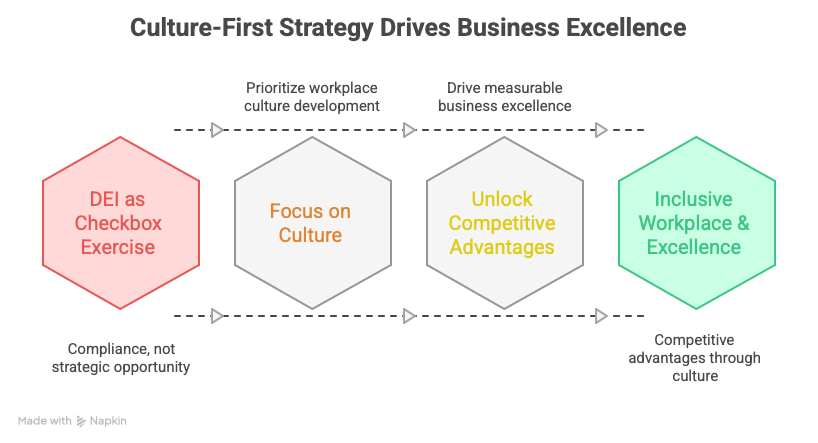
The landscape of workplace transformation has shifted dramatically. For years, organizations have treated Diversity, Equity, and Inclusion (DEI) as a checkbox exercise—a compliance obligation to be managed rather than a strategic opportunity to be seized. But in 2026, a fundamental reimagining is underway. Leading companies are discovering that the path to exceptional business outcomes doesn’t begin with demographic metrics or compliance scorecards. It begins with culture.
This transformation represents one of the most important evolutions in organizational thinking. Companies like those working with Diversio are discovering that culture-first strategies don’t just create more inclusive workplace’s—they unlock competitive advantages that drive measurable business excellence. But how did we get here, and what exactly separates culture-first approaches from traditional DEI efforts? More importantly, what can your organization learn from these innovators?
The DEI Paradox: Why Good Intentions Often Deliver Poor Results (Workplace)
To understand where Diversio’s culture-first approach diverges from conventional wisdom, we must first acknowledge an uncomfortable truth: most DEI initiatives fail to deliver the promised transformation.
Research reveals a startling reality. Harvard Business Review found that 72% of culture initiatives led to no improvements, with employees dismissing them as superficial. McKinsey discovered that executives implementing traditional DEI frameworks without addressing underlying cultural beliefs saw little to no change in inclusion outcomes. The data is unforgiving: the majority of organizations investing millions in diversity training, hiring initiatives, and compliance programs are seeing minimal return on investment.
Why? The answer lies in a critical misunderstanding. Traditional DEI frameworks approach workplace transformation as a collection of individual fixes. Organizations send managers to training workshops with the expectation that systemic issues like bias, exclusion, or disengagement will resolve in a matter of days. This approach is like repeatedly training employees how to leap over a broken staircase while never actually repairing the step itself.
This disconnect extends deeper. Many companies approach DEI as a “corrective measure”—something “bad” that needs fixing, rather than a strategic opportunity. This psychological framing creates an “us versus them” dynamic from the beginning, breeding resistance rather than buy-in. When employees perceive DEI initiatives as punishment or ideological imposition, engagement collapses.
Diversio’s internal experience illuminates this challenge. The organization once launched a well-intentioned culture initiative with solid frameworks, structured systems, and sound logic. It failed spectacularly. The reason? Employee motivation. The initiative addressed the “what” and the “how” but ignored the “why.” Employees didn’t see themselves in the change. They weren’t emotionally invested. The result was predictable: poor engagement, low ownership, and no measurable progress.
This failure became the catalyst for a fundamental insight that has shaped Diversio’s platform and approach to culture transformation across its client base of innovative companies worldwide.
The Culture-First Paradigm: Where DEI Meets Business Strategy (Workplace)
The distinction between traditional DEI and culture-first strategy is not semantic—it’s structural. Culture-first approaches recognize that inclusion, equity, and diversity are not problems to be solved in isolation. They are symptoms and solutions within a larger organizational culture that either enables or inhibits human potential, innovation, and business performance.
Research from the Academy of Management Scholar Quinetta Roberson of Michigan State University indicates that in 2026, organizations are moving beyond traditional DEI frameworks, reimagining how diversity, equity, and inclusion work within organizational systems. The emphasis is shifting from demographic metrics and program utilization to something far more powerful: assessing access and decision quality—who gets heard, who gets sponsored, and who receives stretch assignments that accelerate advancement.
Forward-thinking organizations are tying these human-centric indicators directly to business outcomes such as innovation and market growth. This represents a fundamental reorientation: DEI transitions from a people function to a business strategy.
Diversio’s platform embodies this shift. Rather than tracking headcount diversity alone, Diversio’s analytics examine the quality of inclusion embedded within organizational systems. The platform enables companies to measure whether diverse perspectives actually influence decisions, whether underrepresented employees feel psychologically safe contributing ideas, and whether inclusive cultures translate to tangible business results.
The evidence supporting this approach is compelling. Companies with strong, aligned cultures achieve 2.5x higher revenue growth compared to competitors with weaker cultural integration. Engaged employees in results-focused cultures demonstrate 23% higher profitability and 18% higher productivity. These aren’t marginal improvements—they represent substantial competitive advantages that compound over time.
The Dual-Lens Approach: Structure and Motivation as Multipliers (Workplace)
Diversio’s breakthrough insight, born from its own transformation journey, identified the core equation driving successful culture change: Structure × Motivation = Results.
Like any mathematical multiplier, if either input approaches zero, the entire outcome collapses. This framework explains why so many well-intentioned initiatives fail despite significant investment.
Structure represents the tangible components of organizational design: clear processes, consistent expectations, aligned leadership, and systematic frameworks for ensuring equitable outcomes. Structure is what organizations have traditionally emphasized—the visible infrastructure of DEI work.
Motivation encompasses the emotional and psychological dimensions: genuine buy-in from employees, clarity about why change matters, belief in the organization’s commitment to inclusive outcomes, and personal connection to the transformation journey. This is precisely what traditional approaches have overlooked.
When structure is high but motivation is low, organizations enter a state of comfortable complacency. Employees follow procedures because they must, but they don’t internalize new behaviors or beliefs. Inclusion remains performative rather than authentic. When motivation is high but structure is absent, organizations experience chaotic hustle—short bursts of passionate energy followed by burnout and regression to old patterns. Neither scenario delivers sustainable business outcomes.
Research from McKinsey demonstrates that executives investing time and effort in changing employee mindsets from the start are four times more likely to report successful change programs. Diversio clients implementing the dual-lens approach are observing remarkable improvements:
- +25% higher engagement in culture initiatives that explicitly address the motivational dimension
- 2.5x greater follow-through on team development actions when employees understand and believe in the “why”
- Increased retention in teams where organizational purpose is explicitly tied to inclusive workplace structure
This is the power of alignment. When people care and know how to act, they deliver better outcomes. And better inclusion drives measurable business results.
Beyond Metrics: The Intelligence Behind Culture Analytics (Workplace)
Traditional DEI reporting has long relied on lagging indicators—snapshot views of who works at the organization at a specific point in time. Diversio’s approach represents a paradigm shift toward leading indicators that actually predict and drive inclusion outcomes.
Using advanced people and culture analytics, Diversio helps innovative companies move beyond simple demographic tracking to understand the actual quality of inclusion embedded within their systems. This involves questions that traditional metrics never address:
- Are diverse voices being heard in strategic decision-making, or are they merely present in the room?
- Do employees from underrepresented backgrounds receive equal sponsorship and advocacy from leaders?
- Are psychological safety and belonging distributed equitably across demographic groups?
- Do diverse perspectives actually influence product development, innovation, and market strategy?
Data from multiple sources reveals that organizations utilizing analytics-driven approaches to culture and performance report 5% higher productivity and 6% higher profits than less data-oriented competitors. One mid-sized tech firm that transformed its culture by integrating robust analytics into decision-making processes saw a 20% increase in employee engagement scores within one year, simply because employees felt empowered not just to work, but to influence company strategy through data-driven insights.
This data-driven approach addresses another critical gap in traditional DEI frameworks. Only 35% of chief DEI officers report that their boards actively involve DEI teams in conversations about AI’s impact on the workforce, according to recent Deloitte research. This represents a missed opportunity, but also a signal that DEI’s role is evolving. In 2026, DEI professionals are increasingly being brought into technology and systems decisions, recognizing that algorithms, processes, and AI systems can either reinforce or remedy bias at scale.
Diversio’s platform positions DEI professionals as custodians of inclusion within organizational systems, not merely executors of training programs. This elevation of the function transforms DEI from a cost center to a value driver.
The Business Case: How Culture-First Strategy Delivers Measurable Outcomes (Workplace)
Articulating the business case for culture-first strategy is essential for securing stakeholder buy-in and resource allocation. The evidence is substantial and increasingly specific.
Innovation and Market Expansion: Diverse teams are demonstrably more innovative and better at solving complex problems. McKinsey found that companies in the top quartile for gender diversity on executive teams were 25% more likely to outperform on profitability than those in the bottom quartile. Ethnically diverse companies were 36% more likely to outperform their less diverse peers. This advantage stems from the variety of perspectives that diverse teams bring to problem-solving and market identification.
Companies with diverse product development and leadership teams are better positioned to capture new market segments and anticipate customer needs across demographic groups. Organizations serving global markets increasingly require cultural competency embedded within their workforce—a capability that naturally emerges from authentic inclusion efforts.
Employee Engagement and Retention: The cost of voluntary turnover is substantial—both in direct replacement costs and in lost institutional knowledge. Companies with strong cultures experience significantly lower voluntary turnover. Moreover, when employees feel they belong and can bring their authentic selves to work, engagement soars. Research from Culture Amp found that organizations putting culture first experienced measurable improvements in retention, particularly among high-performers and emerging leaders.
Decision Quality and Organizational Agility – Workplace: When organizations create psychological safety and ensure diverse voices are heard, decision-making improves. Leaders operating within cultures that encourage dissent and diverse perspectives make better-informed choices and anticipate risks that homogeneous teams miss. This agility becomes critical during market disruptions, enabling organizations to respond faster and more effectively than competitors.
Brand Reputation and Talent Attraction – Workplace: In an increasingly values-driven consumer and talent market, organizational culture and commitment to inclusion become competitive advantages. Companies perceived as genuinely committed to inclusion attract higher-quality talent, particularly among emerging workforce demographics that prioritize cultural alignment alongside compensation.
Financial Performance: The cumulative effect of these factors translates to financial outperformance. Companies with strong, inclusive cultures achieve higher profitability, faster growth, and greater market share stability over time. The ROI on culture investment is substantial when measured comprehensively.
The 2026 Landscape: How Innovative Companies Are Reimagining Culture Strategy (Workplace)
As we move through 2026, several strategic shifts are defining how leading companies approach culture transformation:
From Compliance to Competitive Advantage: Organizations are repositioning DEI from a legal and HR obligation to a strategic imperative. Companies like Warby Parker and Casper have integrated their commitment to social impact and inclusive culture into their core business model. Warby Parker’s buy-one-give-one model requires hiring people who genuinely care about social impact. Casper’s culture initiatives directly influence how the company makes product decisions and serves customers. Culture and business strategy have become inseparable.
AI as an Inclusion Tool – Workplace: Rather than fearing AI’s potential to perpetuate bias, innovative companies are leveraging AI and machine learning to monitor DEI outcomes, identify disparities, and automate compliance processes while maintaining human judgment. The question shifts from “Can AI replace human decision-making?” to “How can we use technology to enable humans to perform better and make fairer decisions?”
Accessibility as Core Competency: A billion people globally live with some form of disability, yet only 25% report a sense of belonging in their workplaces compared to 39% of employees without disabilities. Forward-thinking organizations are embedding accessibility into culture strategy not as an accommodation but as a fundamental design principle for systems, processes, and leadership practices.
Systems-Thinking Over Individual Fixes – Workplace: The most sophisticated organizations are moving away from training-centric approaches toward systemic examination and redesign. Rather than investing heavily in bias training, they’re examining promotion systems, sponsorship patterns, compensation structures, and decision-making processes to identify and remedy systemic barriers.
Data Governance and Privacy in Culture Analytics: As organizations collect more detailed people data to drive inclusion insights, ethical questions emerge. Leading companies are establishing governance frameworks ensuring that culture analytics serve employee and organizational interests while protecting privacy and preventing data misuse.
Implementation: How Organizations Can Begin the Transition (Workplace)
For organizations considering a shift toward culture-first strategy, several foundational steps accelerate success:
Conduct an Honest Cultural Assessment: Before launching initiatives, understand current culture across the organization. This assessment should examine both structural elements (promotion systems, hiring processes, compensation equity) and emotional dimensions (psychological safety, sense of belonging, motivation for change). This baseline establishes credibility for subsequent efforts and identifies the most critical leverage points for intervention.
Align Leadership Around Purpose: Culture-first strategy requires visible leadership commitment. Executives must demonstrate that culture transformation is a strategic priority receiving commensurate resources and attention. This alignment translates to specific actions: board members engaging with culture strategy, executives modeling inclusive behaviors, and leadership being evaluated on cultural contributions alongside financial metrics.
Invest in Capability, Not Just Compliance: Rather than one-time training programs, invest in sustained capability building. This might involve coaching for managers, skills development for employees, technology platforms enabling better decisions, or organizational design work examining systemic barriers.
Measure What Matters – Workplace: Establish metrics capturing both cultural health and business outcomes. Track employee engagement and retention, measure inclusion quality through analytics, assess decision quality and innovation pipeline strength, and correlate cultural changes with business performance. This measurement demonstrates ROI while identifying areas needing additional focus.
Create Feedback Loops and Continuous Refinement: Culture transformation is not a destination but an ongoing journey. Establish mechanisms for gathering employee input, assessing what’s working, and evolving approaches. This continuous refinement maintains relevance and demonstrates organizational responsiveness to employee needs.
The Path Forward: Why Culture-First Strategy Matters Now (Workplace)
The convergence of several trends makes culture-first strategy increasingly essential in 2026 and beyond. Demographic shifts in the global workforce are creating competitive advantage for organizations attracting and retaining diverse talent. Regulatory environments are tightening around DEI reporting and accountability. Consumer preferences increasingly reflect values-driven purchasing decisions. Innovation increasingly requires diverse cognitive perspectives and lived experiences.
Most fundamentally, however, the pivot toward culture-first strategy reflects a maturation in organizational understanding. Companies that have achieved significant progress on demographic diversity are discovering that numbers alone don’t guarantee inclusion, innovation, or business impact. Authentic culture transformation—where diverse perspectives actually influence decisions, where belonging is experienced across the organization, and where inclusion drives business results—requires moving beyond DEI as a discrete function to embedding inclusion within organizational DNA.
Workplace – Diversio and similar organizations are leading this transformation by providing tools, frameworks, and insights enabling companies to move from intention to impact. The companies leveraging these capabilities are discovering something powerful: when culture genuinely embodies inclusion, equity, and belonging, the business outcomes follow almost naturally. Innovation accelerates. Talent is attracted and retained. Decisions improve. Markets expand. Financial performance strengthens.
This is not corporate social responsibility dressed up in business language. This is strategic recognition that human potential is the ultimate competitive advantage. When organizations create cultures where every employee can contribute fully, bring authentic selves to work, and influence outcomes, the business results are undeniable.
As we progress through 2026, the question for organizational leaders is no longer whether to invest in culture and inclusion. The question is how quickly they can move beyond traditional approaches to embrace culture-first strategies that drive genuine transformation and measurable business excellence. The companies that answer this question effectively will define competitive advantage for the decade ahead.





One Comment