
Why AI projects Fail – The 10 Failure Modes Every AI Leader Must Know
Introduction: The AI Promise vs. The AI Reality
Artificial intelligence has been heralded as one of the most transformative technologies of our time. From automating complex workflows to predicting customer behaviour with extraordinary accuracy, the promise of AI is undeniable. Gartner estimates that by 2025, AI will be a top-five investment priority for more than 30% of CIOs globally. Yet, despite billions of dollars poured into AI initiatives every year, a staggering number of projects never make it out of the pilot phase.
According to a survey by McKinsey & Company, only about 16% of AI projects are fully deployed at scale. The MIT Sloan Management Review found that over 70% of organisations that have piloted AI have not been able to scale their efforts. The Gartner hype cycle for AI consistently highlights a widening gap between expectation and execution. The question that haunts every chief data officer, every AI team lead, and every board of directors is simple: Why do so many AI projects fail?
The answer, it turns out, is not a single point of failure but a collection of recurring, predictable failure modes — patterns of collapse that transcend industries, company sizes, and geographies. Understanding these failure modes is not just an academic exercise. It is a survival skill for any organisation that has staked its competitive future on AI.
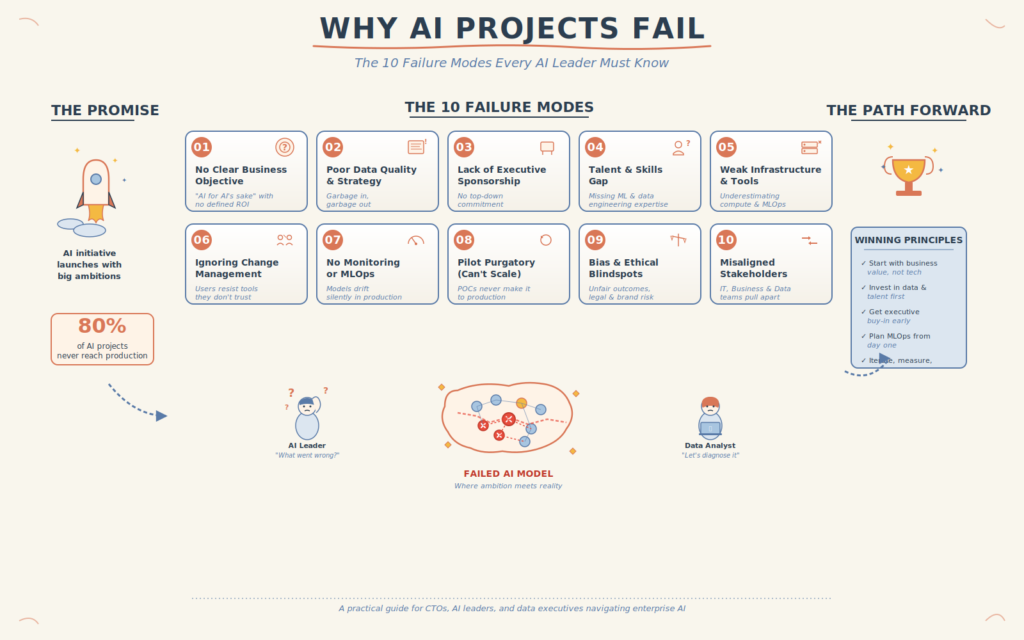
In this blog, we take a deep, uncompromising look at the 10failure modes that have been responsible for the majority of AI project failures worldwide. For each failure mode, we will explore what it is, why it happens, how it manifests in real-world projects, and — crucially — what teams can do to prevent or mitigate it. Whether you are a seasoned data scientist, a product manager, ozˀˀˀˀˀr a C-suite executive, this analysis will give you the clarity and the tools to build AI initiatives that actually succeed.
AI
Failure Mode 01: Hallucination — When AI Makes Up Facts
What Is It?
AI hallucination refers to the phenomenon where a generative AI model — particularly large language models (LLMs) like GPT-4, Claude, or Gemini — produces output that is confidently stated but factually incorrect or entirely fabricated. The model does not “know” it is wrong. It generates plausible-sounding text based on statistical patterns in its training data, and sometimes those patterns lead it astray.
Why Does It Happen?
Hallucination arises from the fundamental architecture of transformer-based language models. These models are trained to predict the next most probable token in a sequence, not to retrieve verified facts. When the model encounters a query that falls outside its training distribution, or when it is asked about highly specific, recent, or obscure information, it may “fill in” gaps with statistically plausible but incorrect content.
“A language model is a remarkably sophisticated autocomplete engine. It is brilliant at generating fluent, coherent text. But fluency is not the same as accuracy.”
Real-World Consequences
In a legal technology firm, an AI-powered contract review tool began citing non-existent case law. In a healthcare application, a chatbot provided incorrect medication dosage information. In a financial services firm, an AI research assistant fabricated analyst reports that were never written. Each of these cases resulted in reputational damage, regulatory scrutiny, and in the healthcare example, potential patient safety risks.
How to Prevent It
- Implement Retrieval-Augmented Generation (RAG) pipelines that ground the model in verified source documents.
- Build fact-checking layers with human oversight, particularly in high-stakes domains.
- Use confidence scoring and uncertainty quantification to flag low-confidence outputs.
- Never deploy LLMs in critical decision-making pipelines without robust validation frameworks.
| KEY STAT | A 2023 Stanford HAI report found that leading LLMs hallucinate on factual queries between 3% and 27% of the time depending on the domain — a significant risk margin for enterprise applications. |
Failure Mode 02: Data Leakage — When Secrets Get Exposed
What Is It?
Data leakage in AI refers to two distinct but equally dangerous phenomena. The first is the accidental exposure of sensitive information through model outputs — for example, an LLM trained on proprietary data inadvertently reproducing customer PII, trade secrets, or confidential strategies. The second is training data leakage in the machine learning sense, where information from the test set “leaks” into the training pipeline, producing an artificially inflated model performance that collapses in production.
Why Does It Happen?
LLMs memorise portions of their training data, particularly when that data contains repeated, highly specific, or unique strings such as email addresses, API keys, phone numbers, or proprietary formulas. If an organisation fine-tunes a model on internal data without proper data sanitisation, that information can be extracted by adversarial prompting. In the ML sense, leakage occurs when preprocessing steps (normalisation, feature selection) are applied to the full dataset before the train-test split, contaminating the evaluation.
Real-World Consequences
In 2023, Samsung engineers accidentally submitted proprietary source code and meeting minutes to ChatGPT, potentially exposing them to OpenAI’s model improvement pipeline. Multiple organisations have discovered that their fine-tuned models could be prompted to reproduce confidential internal documents. From a regulatory perspective, GDPR, HIPAA, and CCPA create significant legal exposure when AI systems handle personal data carelessly.
How to Prevent It
- Sanitise all training data with automated PII detection and removal before any model training begins.
- Implement differential privacy techniques during model training.
- Conduct adversarial red-team testing to probe models for data memorisation.
- Establish strict data governance policies governing what data may be used in AI pipelines.
- Always perform train-test splits before any preprocessing or feature engineering steps.
Failure Mode 03: Bias — When AI Discriminates
What Is It?
AI bias occurs when a model produces outputs that are systematically unfair or discriminatory toward particular groups of people. Bias can manifest along lines of race, gender, age, geography, socioeconomic status, or any other demographic dimension. Unlike random errors, bias is patterned and directional — it consistently disadvantages certain groups while advantaging others.
Why Does It Happen?
AI models learn from historical data, and historical data reflects historical human decisions — which were themselves frequently biased. A hiring algorithm trained on decade-old hiring data will learn that certain demographic profiles (historically male, from elite universities) are “successful” hires, because the historical data skews that way — not because of any objective merit differential. This is known as historical bias. Representation bias occurs when certain groups are underrepresented in training data, causing the model to perform poorly on them. Measurement bias arises from inconsistencies in how data was collected across different groups.
“AI does not create bias from nothing. It amplifies and systematises the biases that already exist in the world — at machine speed and machine scale.”
Real-World Consequences
Amazon famously scrapped an AI recruitment tool in 2018 that had learned to penalise CVs that included the word “women’s” (as in women’s chess club). The COMPAS recidivism prediction tool used in US courts was found to be significantly more likely to incorrectly flag Black defendants as high recidivism risk. Facial recognition systems from multiple major vendors have demonstrated error rates on darker-skinned female faces up to 34 percentage points higher than on lighter-skinned male faces.
How to Prevent It
- Conduct comprehensive bias audits across all demographic dimensions before deployment.
- Use fairness-aware machine learning algorithms and multi-objective optimisation.
- Ensure diverse, representative training datasets with active efforts to address underrepresentation.
- Establish ongoing bias monitoring post-deployment with automated drift detection.
- Build diverse AI development teams — the humans building the AI matter as much as the data.
Failure Mode 04: Model Drift — When Performance Degrades Over Time
What Is It?
Model drift (also called concept drift or data drift) refers to the gradual degradation in a deployed model’s performance over time, as the real-world data it encounters diverges from the training data distribution it was built on. The world changes; the model does not. And over time, the gap widens until the model becomes unreliable or outright harmful.
Why Does It Happen?
A fraud detection model trained in 2022 was excellent at identifying fraud patterns from 2022. But fraudsters adapt. By 2024, their tactics have evolved, and the model is chasing ghosts. A demand forecasting model trained on pre-COVID consumer behaviour was rendered spectacularly useless when lockdowns hit. Customer language evolves, market conditions shift, regulations change, competitor actions alter consumer behaviour — all of these create drift. Without continuous monitoring, the drift goes undetected until it causes a crisis.
Real-World Consequences
A major UK bank deployed a credit risk model that performed with 94% accuracy at launch. Eighteen months later, without any retraining or monitoring, its accuracy had drifted to 71% — a catastrophic drop that resulted in both excessive loan denials (hurting customers) and approvals of risky loans (hurting the bank). A healthcare predictive model that once reliably flagged at-risk patients began generating so many false positives that clinical staff started ignoring its alerts entirely.
How to Prevent It
- Implement continuous model monitoring with automated drift detection pipelines.
- Define clear performance thresholds (KPIs) that trigger model review or retraining.
- Establish regular model refresh cycles based on the rate of change in your domain.
- Use data versioning and model versioning to track changes systematically.
- Build champion-challenger frameworks to continuously test updated models against production models.
Failure Mode 05: Adoption Failure — When Nobody Uses It
What Is It?
A technically excellent AI system that no one uses is a complete failure. Adoption failure is the phenomenon whereby AI tools are built and deployed, but the intended users — whether front-line employees, customers, or operational teams — refuse to use them, work around them, or use them so superficially that no value is generated. In the AI world, a 95% accurate model with 20% adoption delivers less value than an 80% accurate model with 90% adoption.
Why Does It Happen?
Adoption failure stems from several interrelated causes. First, lack of trust: if users do not understand how the AI reaches its conclusions (black-box syndrome), they will not trust it enough to act on its recommendations. Second, poor user experience: if the AI tool is clunky, slow, or does not integrate naturally into existing workflows, users will default to familiar processes. Third, change management failure: AI projects that ignore the human change management dimension — retraining, communication, cultural buy-in — are building on sand. Fourth, threat perception: if employees believe the AI is designed to replace them rather than augment them, resistance is virtually guaranteed.
“The best AI in the world, buried in a terrible user experience, is just an expensive experiment. Adoption is not a technology problem. It is a people problem.”
Real-World Consequences
A global logistics company invested $4 million in an AI-powered route optimisation system. Eighteen months after deployment, field drivers were ignoring its recommendations 60% of the time, preferring their own experience and judgment. The system had been built without any driver input, without explanation of how it worked, and without any demonstration that it understood local road conditions. The investment was largely wasted.
How to Prevent It
- Involve end users in the design process from the very beginning — co-create, do not dictate.
- Invest in explainable AI (XAI) techniques so users understand why the model makes each recommendation.
- Design for seamless workflow integration rather than requiring users to change their processes to accommodate the AI.
- Build a comprehensive change management programme including training, communication, and champions.
- Frame AI as augmentation, not replacement — and mean it.
Failure Mode 06: Lack of Clear ROI — No Tangible Business Benefit
What Is It?
AI projects fail when they cannot demonstrate a clear, measurable return on investment. This failure mode is particularly insidious because it often only becomes apparent after significant resources have already been committed. Projects that were launched on the basis of enthusiasm, competitive fear (“our rivals are doing AI, so we must too”), or vague aspirations of “digital transformation” frequently collapse when finance teams ask for hard numbers.
Why Does It Happen?
ROI failure in AI stems from poor problem definition at the outset. When the business problem being solved is not crisp, specific, and measurable, it is impossible to define what success looks like. Many AI projects are initiated without a clear articulation of: What specific decision will this AI improve? By how much? How will we measure it? What is the cost of the current approach, and what savings does AI deliver? Teams get lost in the technology — excited by what the model can do technically — without anchoring it to business outcomes.
Real-World Consequences
A retail chain deployed an AI-powered personalisation engine at significant expense. Twelve months in, the marketing director could not explain whether it had increased conversion rates, because no baseline had been established and no A/B testing framework had been put in place. The AI was running, but no one could prove it was working. The project was quietly shut down. This is not an unusual story — it is, in fact, the modal outcome for AI projects launched without rigorous ROI frameworks.
How to Prevent It
- Define the business problem first, always. The AI solution comes second.
- Establish clear, measurable KPIs before the first line of model code is written.
- Run controlled experiments (A/B tests or randomised control trials) to isolate AI impact.
- Create executive dashboards that translate model metrics into business outcomes.
- Set realistic timelines for value delivery — AI ROI is often a 12-to-24-month journey, not a quarter.
Failure Mode 07: Overfitting — When AI Is Too Rigid
What Is It?
Overfitting occurs when a machine learning model learns the training data so thoroughly — including its noise and idiosyncrasies — that it performs brilliantly on training data but catastrophically on new, unseen data. The model has effectively memorised the training set rather than learning generalisable patterns. It is rigid, brittle, and useless in the real world.
Why Does It Happen?
Overfitting is typically the result of training a model that is too complex (too many parameters) relative to the amount of training data available. The model has enough capacity to memorise individual training examples rather than learning the underlying signal. It also commonly occurs when teams use the test set to iteratively tune the model — a practice that effectively turns the test set into part of the training process, removing the independent validation that should catch overfitting.
Real-World Consequences
An insurance company trained a fraud detection model on three years of historical claims. In cross-validation on training data, the model achieved 99% precision. In production, over the first 90 days, it performed at 61% precision — barely better than chance for a problem where 55% of flagged cases were actual fraud. The model had learned the specific transaction patterns from those three years, including many that were unique artefacts of that period, rather than learning what fraud fundamentally looks like.
How to Prevent It
- Use regularisation techniques (L1/L2, dropout) to penalise model complexity.
- Apply cross-validation rigorously — k-fold or stratified k-fold — never use the test set during development.
- Follow the principle of parsimony: prefer simpler models that generalise well over complex models that perform well on training data.
- Use early stopping in neural network training to prevent excessive memorisation.
- Curate larger, more diverse training datasets to give the model more generalisable patterns to learn from.
Failure Mode 08: Technical Debt — Unmanageable Complexity
What Is It?
Technical debt in AI systems refers to the accumulated cost of shortcuts, workarounds, and expedient decisions made during development that create long-term maintenance burdens, brittleness, and operational risk. Unlike traditional software, AI systems carry unique forms of technical debt: data debt (poor data quality practices), model debt (undocumented models that cannot be explained or maintained), and pipeline debt (fragile, poorly tested data and feature engineering pipelines).
Why Does It Happen?
AI technical debt accumulates because of pressure to ship quickly. Proof-of-concept code gets promoted to production without proper engineering. Model hyperparameters are hardcoded rather than parameterised. Data pipelines lack unit tests. Models are not version-controlled. Training runs are not documented. Dependencies are not managed. Over time, the system becomes a black box that no one — including its original creators — fully understands. Adding new features becomes risky; debugging failures becomes a forensic exercise.
“ML systems have a special property that makes technical debt particularly dangerous: the system’s behaviour is not determined by the code alone, but by the code, the data, and the model interacting. There are three moving parts to debug, not one.”
Real-World Consequences
A fintech startup built its core credit scoring AI as a rapid MVP. Two years later, the model was deployed in 14 markets, processing 50,000 decisions per day. But the underlying pipeline was built on undocumented notebooks, with no versioning, no automated testing, and no clear data lineage. When a critical bug was introduced in a data preprocessing step, it took the team eleven days to identify the source — days during which the model was making systematically incorrect decisions. The remediation cost exceeded the original development cost.
How to Prevent It
- Treat AI systems with the same software engineering rigour as production software: version control, automated testing, CI/CD pipelines.
- Document models comprehensively: training data, hyperparameters, performance metrics, known limitations.
- Use MLOps platforms (MLflow, Kubeflow, Weights & Biases) to manage the full model lifecycle.
- Conduct regular code and pipeline reviews specifically focused on debt identification.
- Allocate explicit time and resources for debt remediation in every development sprint.
Failure Mode 09: Integration Failures — AI That Cannot Fit Into Existing Systems
What Is It?
Integration failure occurs when an AI system, however technically impressive in isolation, cannot be effectively incorporated into the organisation’s existing technology stack, business processes, or data infrastructure. The model works perfectly in the laboratory but falls apart when connected to the real world. Legacy systems, incompatible data formats, inadequate APIs, and organisational siloes are all common sources of integration failure.
Why Does It Happen?
AI teams are often composed of data scientists and ML engineers who are expert in model building but less experienced in systems architecture and enterprise integration. The AI is built in isolation, on clean, curated data, without deep consideration of how it will connect to the messy, inconsistent, real-time data flows of the production environment. Legacy enterprise systems (ERPs, CRMs, mainframes) were not designed with AI integration in mind and frequently resist it.
Real-World Consequences
A major hospital network invested two years developing an AI system to predict patient readmission risk. The model achieved 87% AUC in development. When the integration team attempted to connect it to the hospital’s legacy EHR system, they discovered that the data the model needed was spread across four different systems, in three different formats, with update latencies of up to 24 hours. The “real-time” risk prediction system ended up running on stale data, dramatically undermining its clinical value.
How to Prevent It
- Conduct thorough technical discovery of existing systems architecture before beginning model development.
- Design for integration from day one: define APIs, data contracts, and latency requirements upfront.
- Include enterprise architects and systems integrators as first-class members of the AI project team.
- Build and test integration pipelines in parallel with model development, not after.
- Invest in a robust data platform (data lakehouse, feature store) that bridges the AI layer and the operational layer.
Failure Mode 10: Lack of Proper Testing — Unverified Results
What Is It?
Insufficient testing is perhaps the most straightforward failure mode and yet one of the most common. AI systems that are not rigorously tested — across diverse data distributions, edge cases, adversarial inputs, and failure scenarios — will inevitably encounter conditions in production that cause them to fail in unexpected and potentially dangerous ways. Unlike traditional software, where testing can achieve near-exhaustive coverage of code paths, AI systems have virtually infinite input spaces that cannot be tested exhaustively, making deliberate, structured test strategy all the more critical.
Why Does It Happen?
Testing is chronically underinvested in AI projects because it is seen as less exciting than model building and less visible than deployment. In organisations under pressure to ship quickly, testing is the first thing cut from the schedule. AI teams also frequently lack the dedicated testing expertise that mature software organisations take for granted. There is no equivalent of QA engineering as a distinct discipline in many AI teams, and the responsibility for testing falls on the same data scientists who built the model — creating obvious blind spots.
Real-World Consequences
An autonomous vehicle system had achieved impressive average-case performance metrics. However, testing across edge cases — unusual weather conditions, atypical road markings, unexpected objects — had been inadequate. Multiple near-miss incidents in early public road testing revealed failure modes that the standard test suite had never encountered. The remediation required six months of additional testing and a full architectural review. In higher-stakes domains — medical diagnosis, financial trading, criminal justice — inadequate testing does not just cost money; it costs lives and freedoms.
How to Prevent It
- Build comprehensive test suites that cover not just average-case performance but edge cases, adversarial inputs, and distribution shifts.
- Establish dedicated AI testing roles or partner with specialised AI testing firms.
- Use shadow deployment (running the new model in parallel with the existing system without acting on its outputs) to validate performance in production conditions before go-live.
- Implement continuous testing pipelines that run automated tests against every model update.
- Conduct structured red-team exercises — deliberately trying to break the model — before any production deployment.
Conclusion: Building AI That Actually Works
The ten failure modes we have explored in this blog are not rare edge cases. They are the primary causes of the majority of AI project failures globally. And yet, for all their diversity — spanning technical, organisational, ethical, and operational dimensions — they share a common root cause: the treatment of AI projects as purely technical endeavours rather than as complex socio-technical systems that require engineering rigour, organisational alignment, ethical scrutiny, and relentless real-world validation.
The organisations that are winning with AI — that are moving from pilot to production at scale, that are generating genuine, measurable business value, and that are building AI systems their users trust and rely on — are not necessarily the ones with the biggest budgets or the most sophisticated models. They are the ones that have learned to treat AI failure modes as known, manageable risks rather than as surprises.
They invest in data quality before model quality. They define business problems before technical solutions. They build for integration from day one. They treat explainability and fairness as non-negotiable. They monitor their models continuously after deployment. They invest in change management with the same seriousness they invest in model training. And they build diverse, multidisciplinary teams that bring together technical, business, ethical, and operational expertise.
“The future of AI belongs not to those who can build the most powerful models, but to those who can deploy the most trustworthy ones.”
As you assess your own AI initiatives — whether you are at the concept stage, mid-pilot, or post-deployment — use these ten failure modes as a diagnostic checklist. Ask honestly: Which of these risks are we most exposed to? Where are our gaps? What needs to change? The answers will be uncomfortable in places. But confronting them now, before they manifest as failures, is the highest-value activity any AI team can undertake.
AI is one of the most powerful tools available to modern organisations. Used well — with rigour, responsibility, and realistic expectations — it can create transformational value. The ten failure modes described in this blog are not reasons to fear AI. They are a map for navigating it successfully. Study the map. Know the terrain. And build AI that the world can actually use.







One Comment