
Why ₹800/Month n8n Beats ₹5,000 WhatsApp SaaS Tools for Indian Businesses
n8n WhatsApp automation India: If you run a business in India today, you have almost certainly been sold a WhatsApp automation subscription. The pitch is seductive: a polished dashboard, a drag-and-drop chatbot builder, a “done-for-you” inbox, and a monthly invoice somewhere between ₹2,500 and ₹15,000. It feels like infrastructure. It feels necessary. And for a great many businesses, it quietly becomes one of the most overpriced line items on the books.
There is a quieter alternative that a growing cohort of technically literate Indian founders, agencies, and operations teams have already migrated to. It is called n8n — pronounced “n-eight-n,” a contraction of nodemation — and when self-hosted on a modest Indian virtual private server, it runs your entire automation stack, WhatsApp included, for roughly the price of two cups of filter coffee a day. Around ₹800 a month. Unlimited executions. Your data never leaving Indian soil.
This article is not a hit piece on WhatsApp SaaS platforms. They are genuinely useful, and for a specific kind of buyer they remain the right choice. But the prevailing assumption — that paying ₹5,000 a month for a managed WhatsApp tool is simply “the cost of doing business” — deserves rigorous interrogation. Once you understand the architecture of what you are actually paying for, the economics become difficult to ignore.
The anatomy of your WhatsApp bill (n8n WhatsApp automation India)
Before we compare anything, you need to understand a foundational truth that most vendors are not eager to spell out plainly: your WhatsApp automation cost has two completely separate layers, and they behave very differently.
The first layer is the Meta conversation fee — the per-message charge that Meta itself levies, billed in Indian Rupees through your provider. As of the rate revision that took effect on 1 January 2026, Meta’s marketing message rate for India rose to roughly ₹0.86 per message, while utility and authentication messages cost approximately ₹0.115 each. Service messages — the ones a customer initiates within a 24-hour window — remain free. This layer is essentially a fixed, regulated input cost. Whether you use a ₹999 tool or a ₹15,000 tool, Meta charges the same underlying rate. You cannot engineer it away.
The second layer is the platform fee — the recurring subscription you pay your Business Solution Provider (BSP) for the inbox, the chatbot builder, the campaign manager, the integrations, and the support wrapped around the WhatsApp API. This is where the pricing diverges wildly. Typical 2026 platform fees in India range from ₹0 to ₹25,000 per month, depending on tier and user count. This second layer is the variable you actually control — and it is precisely the layer that n8n eliminates.
Here is the subtlety that traps so many buyers: two vendors can quote wildly different headline prices, because one may advertise a low platform fee while marking Meta’s pass-through rates up by 30%, and another may charge a higher platform fee while passing Meta rates through at cost. The advertised “₹999/month” is rarely the number that lands on your card statement. Many Indian BSPs quietly add a markup of 12% to 60% on every single message you send, on top of Meta’s official rates. The subscription, in other words, is only the visible part of the iceberg.
Where the ₹5,000 actually goes
Let us be concrete about the SaaS side, because vague comparisons are useless. The established Indian WhatsApp platforms — WATI, Interakt, AiSensy, Gupshup — are mature, capable products, and their pricing reflects a packaged convenience.
WATI’s growth-oriented plans sit in the region of ₹2,499 per month and upward, with a markup frequently layered on top of Meta’s rates. Its pricing has historically been denominated in USD, which means Indian founders watching exchange-rate fluctuations in 2026 often see their bills drift month to month. Interakt, the Jio-Haptik sub-brand favoured by D2C and Shopify sellers, publishes quarterly pricing that runs from ₹3,499 per quarter on Starter up to ₹10,499 per quarter on Advanced, with branched chatbot flows gated behind the higher tiers. AiSensy, the volume-broadcast specialist, starts around ₹1,500 per month on Basic and ₹3,200 per month on Pro.
Stack the real components together — a mid-tier platform subscription, a per-message markup, an add-on for Shopify integration here, an extra ₹2,499 for a second WhatsApp number there, additional agent seats — and the all-in monthly figure for a modestly active business routinely clears ₹5,000. Critically, much of this is what we might call SaaS rent: if you send zero messages in a given month, you still pay the full subscription. You are paying for the privilege of having an active account, not for the value you generated.
For a business with seasonal demand — a wedding-season caterer, a Diwali-peak retailer, a monsoon-quiet travel operator — paying flat rent through the dead months is pure economic leakage.
What ₹800 actually buys you
Now the other side of the ledger. n8n is an open-source, fair-code workflow automation platform — conceptually a self-hosted cousin of Zapier or Make, but architected for technical control rather than point-and-click simplicity. You compose automations visually on a canvas: a trigger node initiates a workflow when an event occurs, action nodes execute tasks, and operator nodes filter, transform, and route data between them. These modular building blocks — n8n calls them nodes — can be combined into arbitrarily sophisticated pipelines.
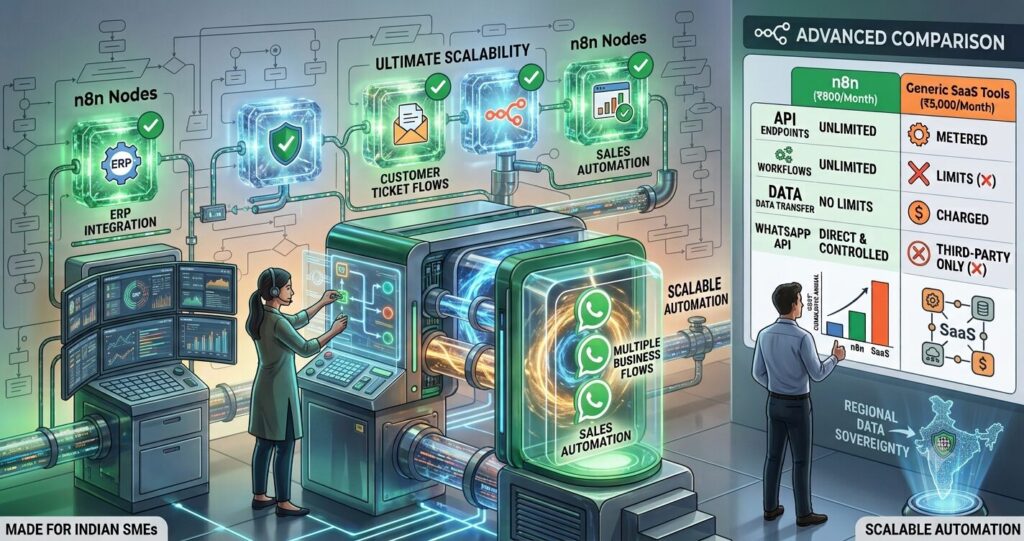
The financial mechanics are fundamentally different from SaaS, and this difference is the entire thesis of this article. n8n’s Community Edition is free, open-source software. When self-hosted, your only recurring cost is the server it runs on — and an Indian comparison at 50,000 tasks per month puts that server cost at roughly ₹800 per month, against approximately ₹6,800 for Make’s equivalent operations plan and around ₹33,000 for Zapier’s professional tier. A basic DigitalOcean droplet in Bengaluru — 2GB of RAM — costs about ₹800 a month, and an experienced developer can have the full stack live in roughly 45 minutes.
The decisive architectural distinction is the execution model. SaaS platforms and even n8n’s own cloud tier meter you. n8n Cloud, for instance, charges per execution: every time a workflow runs from start to finish, it counts as one execution, and once you hit your monthly cap, your workflows simply stop until the next billing cycle. A single workflow triggering every five minutes burns through 8,640 executions per month — enough to exhaust a starter plan’s allowance in nine days from one workflow alone. Self-hosted n8n has no such ceiling. Executions are unlimited regardless of volume — whether your automations fire a thousand times a day or a hundred thousand, the server cost does not change.
This is the conceptual inversion at the heart of the cost argument. SaaS tools price your activity. Self-hosted n8n prices your capacity. As your business scales — more leads, more orders, more conversations — a metered tool punishes your success with a rising bill, while a self-hosted instance absorbs the growth at a flat rate until you genuinely outgrow the hardware.
n8n speaks fluent Indian commerce
A common objection is that an open-source automation engine cannot possibly match a purpose-built Indian WhatsApp tool for local integrations. This is no longer true, and it has not been true for some time.
n8n ships with a built-in WhatsApp Business Cloud node supporting a wide range of features, including sending messages and uploading, downloading, and deleting media. It connects directly to Meta’s official WhatsApp Cloud API — meaning you retain green-tick eligibility, template messaging, interactive buttons and lists, and WhatsApp Flows, the same Meta-native capabilities the big BSPs expose. More importantly for the Indian context, n8n natively supports the local tooling that matters here — Razorpay webhooks, Zoho CRM, Zoho Books, Shiprocket — and any other service through its generic HTTP Request node.
The practical implication is that you can assemble end-to-end Indian business pipelines without a single line of middleware. A typical pattern: connect Shopify or WooCommerce to Razorpay webhooks, auto-update inventory in Zoho Inventory, trigger a WhatsApp order confirmation, and log everything to Google Sheets — every order handled automatically, with zero per-task billing. Lead capture flows from IndiaMART or Facebook Lead Ads into your CRM with geographic routing to the right salesperson. Razorpay settlements reconcile automatically against Zoho Books invoices, flagging discrepancies for your chartered accountant. The hyperautomation principle — chaining whole sequences rather than isolated tasks — is exactly where the compounding time savings live, because each automated step feeds the next.
And because n8n carries native integrations with OpenAI, Anthropic’s Claude, and Google’s Gemini, your WhatsApp bot is not limited to rigid decision trees. You can build a genuinely conversational AI agent: store the last several messages per customer in a database for context, attach a retrieval-augmented generation pipeline that grounds the model in your own product catalogue and FAQs, and let the agent perceive intent, query inventory, calculate a price, and generate a payment link — autonomously. That is the difference between a chatbot that says “Press 1 for support” and an agent that actually closes a sale at two in the morning.
The data-sovereignty argument that changes everything
If the cost case is compelling, the compliance case is, for many Indian businesses, decisive — and it is the dimension SaaS vendors are least equipped to compete on.
India’s Digital Personal Data Protection (DPDP) Act, 2023 is now in active force, and it has materially raised the stakes around where and how customer data is processed. WhatsApp marketing layered on top of this carries specific obligations: opt-in consent is mandatory — the customer must have initiated contact or filled a form agreeing to be messaged — every marketing message must carry an unsubscribe option, and message templates must be approved by Meta before broadcast. Violating these is not merely a compliance risk; if users report your number as spam, WhatsApp can ban it permanently.
Here is where architecture becomes governance. Most SaaS WhatsApp platforms — and certainly the EU-hosted ones — route your conversation data through servers outside India. For a business handling sensitive information — patient records, financial data, legal documents — that cross-border processing introduces real complexity under the DPDP framework. Self-hosting n8n resolves this at the infrastructure level. Running n8n on a virtual private server located in an Indian data centre — the Mumbai or Delhi regions of AWS, DigitalOcean, or Google Cloud — ensures that sensitive financial logs and user chat history never leave the legal jurisdiction, a compliance guarantee that is difficult to obtain from a global multi-tenant SaaS provider.
This is the foundation of what practitioners now call Sovereign AI: self-hosted n8n keeps data within Indian jurisdiction, which is critical for governance-sensitive sectors like healthcare, finance, and manufacturing. For a fintech or NBFC navigating RBI’s payment-data localisation guidelines, this is not a feature — it is a precondition for operating at all. You cannot outsource that control to a dashboard in another continent and hope for the best.
The honest case for the other side
Intellectual integrity demands that we state plainly when n8n is the wrong choice — because for a meaningful segment of businesses, it is.
The single largest hidden cost of self-hosting is not money; it is operational responsibility. Setting up a VPS with Docker, an nginx reverse proxy, SSL certificates, and automated backups takes one to four hours, with ongoing maintenance of one to two hours a month. The software is free; the infrastructure and the expertise to run it are not. When n8n pushes a breaking update, when your SSL certificate expires, when something fails at three in the morning — that is your problem to solve, not a support desk’s. n8n’s own documentation candidly recommends its cloud option for users who are not experienced in managing servers, precisely because self-hosting mistakes can cause downtime, security issues, or data loss.
There are also genuine architectural pitfalls at scale. A naive single-instance deployment creates a single point of failure: if one heavy AI workflow consumes the CPU, incoming WhatsApp webhooks get queued or dropped — and because Meta requires a webhook acknowledgement within three seconds, a blocked process can lead Meta to disable your webhook subscription entirely. Production-grade deployments solve this with n8n’s Queue Mode, which decouples ingestion from execution using Redis as a high-speed buffer, so that during a traffic spike — a Diwali sale, say — the main instance stays responsive while stateless worker nodes scale horizontally to clear the backlog. This is real engineering, and it requires real engineering judgement.
So the honest decision rule is this. If you are a non-technical owner who wants a working WhatsApp chatbot live within 72 hours and never wants to think about a server again, a managed SaaS tool — or n8n’s own cloud tier — is the correct and rational choice. The convenience is worth the premium. A raw VPS is the cheapest option on paper but can become the most expensive once you price in your own time.
But — and this is the pivot — that calculus flips decisively the moment you have access to even modest technical capability, whether an in-house developer, a freelancer, or a managed self-hosting provider that handles the DevOps for a small premium. The middle path is real: managed n8n VPS plans with Indian data residency, 99.99% uptime, daily backups, and no execution limits start around ₹999 per month in India — making the effective total cost of ownership lower than an unmanaged VPS once your time is factored in.
Running the numbers honestly
Let us model a representative Indian SMB to make the comparison tangible rather than rhetorical. Imagine a growing D2C brand running several automations: order confirmations, abandoned-cart recovery, lead follow-up, and an AI support agent — collectively firing in the low tens of thousands of executions per month.
On the SaaS path, this business pays a platform subscription in the ₹3,000–₹5,000 range, plus per-message markup on its Meta conversation fees, plus add-ons for the extra integrations and seats it inevitably accumulates. Call the platform-attributable cost ₹5,000 a month — ₹60,000 a year — before a single rupee of Meta’s own message charges, which it would pay regardless.
On the self-hosted n8n path, the same business pays roughly ₹800 a month for the server (or around ₹1,400–₹1,800 for a managed Indian VPS with backups and support baked in), plus Meta’s conversation fees passed through at cost with zero markup. The platform-attributable cost is therefore ₹9,600 to ₹21,600 a year. Switching from a per-task SaaS model to a flat-rate VPS can save ₹57,000 or more per year, with better performance and full data control.
That delta — somewhere between ₹40,000 and ₹50,000 annually for a single modest business — is not a rounding error. It is a marketing budget. It is a junior hire’s salary contribution. It is the margin that lets a bootstrapped Indian business reinvest in growth rather than rent. And the gap widens as you scale, because the SaaS bill climbs with your activity while the server cost stays flat until you genuinely max out the hardware.
The strategic conclusion
The reflexive instinct to equate “professional WhatsApp automation” with “monthly SaaS subscription” is a habit, not an analysis. When you decompose the actual cost structure, the ₹5,000 monthly tool is revealed to be charging a substantial premium for the platform layer — a layer that an open-source engine running on an ₹800 Indian server replicates and, in important respects, surpasses.
The surpassing is not merely about price. Self-hosted n8n delivers three things the SaaS model structurally cannot match at the same cost: unlimited executions that refuse to punish your growth, genuine data sovereignty that keeps you on the right side of the DPDP Act, and unbounded customisability through code nodes and 400-plus integrations that no proprietary tool will ever fully expose. For data engineering, complex AI agents, and privacy-sensitive environments, n8n wins; for quick marketing automations by non-engineers, the managed tools are faster to deploy. Many sophisticated operations, sensibly, run both — a simple SaaS tool for a non-technical marketer’s broadcasts, and n8n for the heavy, integrated, compliance-critical lifting.
The single most important thing to understand is that you now have a choice you may not have known existed. The ₹5,000 invoice is not a law of nature. For any Indian business with access to even modest technical capacity — and in 2026, that access has never been more affordable — the question is no longer whether self-hosted automation can compete. It is whether you can justify continuing to pay rent on infrastructure you could own outright for the price of a daily coffee.
Audit your last twelve WhatsApp invoices. Separate the Meta conversation fees, which you will always pay, from the platform fees and markups, which you may not need to. The number you find in that second column is the size of the opportunity sitting in plain sight.






One Comment