
From gantthead to ProjectManagement.com: Two Decades of Empowering Project Managers 2026
Introduction: The Foundation of Modern Project Management
The history of project management is rooted in precision, structure, and visual clarity. In 1917, Henry Gantt revolutionized how work was planned and executed by creating the Gantt chart—a visual scheduling tool that transformed industries from construction to aerospace. Over a century later, this fundamental concept remains at the heart of how organizations orchestrate complex work. However, the tools, methodologies, and most importantly, the support systems available to project managers have undergone a remarkable transformation.
The journey from managing projects with hand-drawn Gantt charts to leveraging artificial intelligence-powered platforms represents more than technological advancement. It reflects a fundamental shift in how project managers access knowledge, build networks, and develop professionally. At the center of this evolution stands a remarkable story: the transformation from gantthead to ProjectManagement.com—a two-decade journey of empowering professionals who shoulder the responsibility of delivering critical business outcomes.
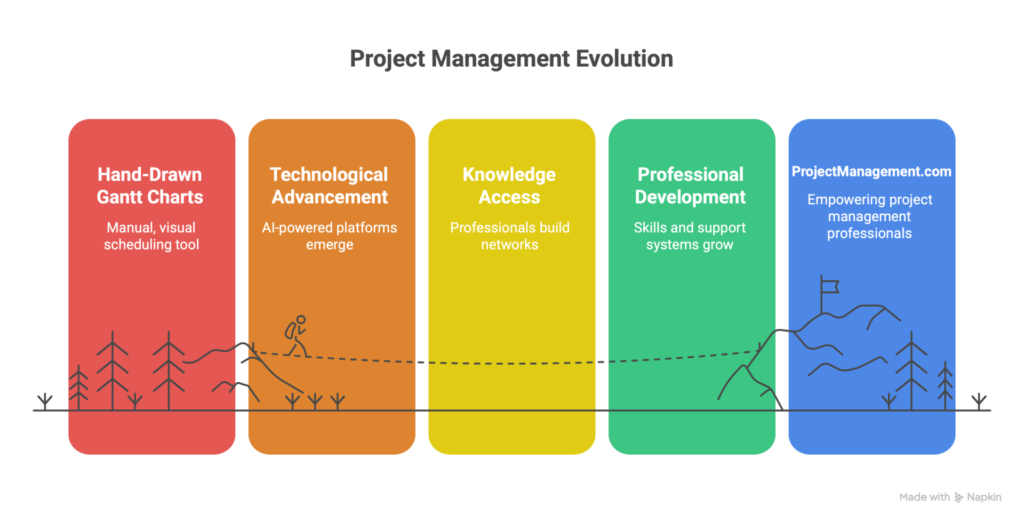
The Birth of gantthead: Filling a Critical Gap (2000)
In March 2000, Dave Garrett founded gantthead.com with a clear vision: create a dedicated online community for project managers to connect, learn, and solve problems together. This wasn’t simply another software tool or consulting firm. Instead, it was an innovation that recognized a fundamental truth—project managers were isolated professionals navigating complex challenges without adequate peer support systems.
At the turn of the millennium, project management was experiencing a fundamental shift. Microsoft Project had already begun digitizing what was once manual scheduling in the 1980s, but the software landscape remained fragmented. More critically, there was a conspicuous absence of a centralized, peer-driven community where project managers could exchange knowledge, ask questions, and learn from colleagues facing similar challenges. The very name “gantthead” was strategic—it acknowledged the Gantt chart as the universal language of project scheduling, signaling that this was a space built specifically for people who spoke that language.
Remarkably, gantthead proved not only viable but genuinely valuable during the dot-com bubble and subsequent crash. While countless internet startups failed, gantthead remained not only operational but profitable—a testament to the fundamental need it addressed. By providing more than 350,000 registered project managers a space to collaborate, gantthead solved what many organizations left unsolved: the isolation of project managers who lacked internal mentors or peer networks.
Understanding the PM Challenge: Why Community Matters
To appreciate what gantthead accomplished, it’s essential to understand the pressures project managers face. The statistics are sobering. According to research from 2024-2025, approximately 50% of all projects struggle with scope creep—the phenomenon where project requirements expand beyond initial plans, stretching budgets and timelines. Add to this the reality that 38% of organizations experience confusion over job roles, and 71% cite funding shortages as their primary challenge. The pressure is relentless: 57% of companies exceed their allocated budgets, and 97% of organizations acknowledge that project management is essential to business success, yet many fail to provide adequate support infrastructure for the professionals executing this critical work.
The psychological burden is equally significant. Nearly 59% of project managers juggle between two and five projects simultaneously, with some managing more than ten. This multitasking madness creates an environment ripe for burnout, where unrealistic deadlines collide with insufficient resources. The modern project manager is expected to navigate scope creep, manage stakeholder expectations that often exceed organizational capacity, maintain team morale despite resource constraints, and deliver results—often without a safety net.
This is precisely where gantthead stepped in. The platform recognized that project managers didn’t need another software vendor selling the next shiny tool. What they needed was something far more fundamental: a community where they could ask, “How do you handle scope creep?” or “What templates have worked for others?” or simply, “Is anyone else struggling with this?” That human connection, combined with practical resources, became the foundation of gantthead’s enduring appeal.
The Digital Transformation Era (2000-2012): Building the Foundation
The first decade of gantthead’s existence coincided with a broader revolution in project management tools and thinking. The early 2000s saw the emergence of Agile methodology, formalized in the Agile Manifesto of 2001. This was transformative—it challenged the waterfall mentality that had dominated project management since its formalization in the 1960s-1970s. Yet many organizations and project managers remained tethered to traditional methods, creating a period of methodological tension and experimentation.
During this period, gantthead evolved from a simple discussion forum into a comprehensive ecosystem of resources. The platform accumulated nearly 10,000 blog posts written by project management peers—not corporate marketing departments, but actual practitioners sharing real-world insights. The site built a library of nearly 2,000 downloadable templates that saved project managers countless hours of reinventing the wheel. Discussion boards and Q&A forums fostered deep conversations about everything from resource allocation to risk management to career development.
What made gantthead particularly valuable during this era was its inclusivity. Project management was professionalizing—the Project Management Institute (PMI), founded in 1969, was establishing standards and credentials like the PMP (Project Management Professional). Yet PMI was primarily an organizational structure, conference organizer, and standards body. gantthead filled the gap between certification and daily practice. You could earn your PMP, but gantthead taught you how to actually manage projects while maintaining your sanity.
The platform’s growth trajectory was particularly notable because it sustained itself through the dot-com crash that bankrupted countless internet ventures. Profitability, not just growth, became gantthead’s hallmark. This wasn’t a venture-backed company betting on eventual scale; it was a lean, focused operation that provided such concrete value to project managers that it became economically self-sustaining.
The Rebranding Moment (2012): Evolution, Not Abandonment
By 2012, gantthead had been operating successfully for over a decade. The project management landscape had evolved considerably. Cloud computing was reshaping how teams collaborated. The lines between traditional waterfall and Agile had blurred into hybrid approaches. Project management had expanded far beyond IT and construction into virtually every industry vertical. More significantly, the role of “project manager” had transformed—from a specialized position in large organizations to a core competency expected across industries.
In October 2012, Dave Garrett and the gantthead team made a strategic decision that reflected this evolution: they rebranded to ProjectManagement.com. This wasn’t a departure from their mission; it was a clarification and expansion of it. The new name eliminated the insider language (“gantthead”) and proclaimed a broader ambition: to be the destination for everything related to project management, regardless of methodology, industry, or experience level.
The rebranding accomplished several things simultaneously. First, it made the site more discoverable for people new to project management who might not know what a Gantt chart was, much less why they’d need a community specifically for “ganttheads.” Second, it signaled that the community had matured beyond its original niche—IT project managers—to encompass the full spectrum of the profession. Third, it positioned the platform for the future, removing any linguistic constraints that might limit growth.
Importantly, the rebranding preserved what made gantthead valuable. The mission remained unchanged: to make project managers more successful. The community foundation, the peer-driven approach, the commitment to practical resources over theoretical frameworks—all of this persisted. What changed was primarily the positioning and the breadth of the welcome extended to new audiences.
Modern Resources and Comprehensive Support (2015-Present)
By the time ProjectManagement.com became fully integrated into the PMI family (2014-2017), the platform had evolved into a comprehensive ecosystem offering an impressive array of resources:
Educational Content and Professional Development: The platform hosts over 2,000 on-demand webinars, most of which qualify for Professional Development Units (PDUs)—the continuing education credits that certified project managers must earn to maintain their credentials. These webinars represent a crucial advantage: rather than hunting for PMI-approved education providers, project managers can access recorded, self-paced learning directly integrated with the community platform.
Knowledge Repository: The nearly 10,000 blog posts written by peers, combined with over 10,000 comprehensive articles authored by subject matter experts, create a searchable knowledge base addressing virtually every phase of project management and every career stage. Whether someone is struggling with their first project charter or implementing organizational portfolio management, the resources address their situation.
Practical Tools and Templates: The nearly 2,000 downloadable templates represent what previous generations of project managers could only dream of—pre-built scope statements, risk registers, status reports, Gantt charts, and thousands of other tools that eliminate the need to start from scratch. These templates, many exclusive to PMI members, represent years of accumulated best practices condensed into usable formats.
Peer Connections and Networking: With over 1 million registered peer connections and expert profiles, ProjectManagement.com functions as a vast network where project managers can find mentors, ask specific questions, and build relationships with professionals facing similar challenges. In an era of remote and hybrid work—where 61% of project professionals work remotely at least part-time—this virtual networking capability has become essential.
The PMI Partnership: Integration and Expansion
The acquisition and integration of ProjectManagement.com (formerly gantthead) into the PMI family represented a significant strategic move for both organizations. PMI brought institutional credibility, global reach, and resources that could amplify the platform’s impact. ProjectManagement.com brought a thriving community, practical resources, and the street credibility that only comes from serving practitioners day after day.
This partnership proved mutually beneficial. PMI, which had traditionally focused on standards-setting, certifications, and conferences, gained a platform for daily engagement with its millions of members. ProjectManagement.com gained access to PMI’s research, its member base, and the institutional resources to accelerate development. By the 2015-2017 period, ProjectManagement.com’s traffic had grown significantly under PMI’s stewardship, with the platform tripling previous traffic records within 15 months of acquisition.
The integration also expanded ProjectManagement.com’s scope. Rather than competing with PMI’s other offerings, it became a complementary platform where project managers could apply what they learned from PMI’s certifications, conferences, and research. The synergy was powerful: someone preparing for their PMP certification might attend PMI-sponsored courses, then turn to ProjectManagement.com’s community for answers to implementation questions they encountered on actual projects.
Project Management in 2025: Why These Communities Still Matter
Two decades after gantthead’s founding, the challenges project managers face have, in some respects, only intensified. Remote and hybrid work have become the standard for 61% of project professionals, requiring new approaches to team coordination, communication, and trust-building. The proliferation of tools—from Jira to Asana to Monday.com—means project managers must not only execute projects but also navigate increasingly complex technology stacks.
Simultaneously, new pressures have emerged. Artificial intelligence is beginning to reshape project management, creating both opportunities and uncertainties. The acceleration of business cycles means that project managers must now operate in environments where requirements shift faster than teams can adapt. The concept of “strategic importance” has become commonplace, meaning that nearly every project is perceived as mission-critical, elevating the psychological weight project managers bear.
Yet the fundamental problem that gantthead solved in 2000 remains unresolved in many organizations: project managers remain isolated professionals lacking adequate peer support, mentorship, and practical guidance. Many organizations still fail to provide project managers with:
- A safe space to discuss challenges without appearing incompetent
- Peer networks where they can learn how others have solved similar problems
- Ongoing professional development that keeps pace with industry evolution
- Practical templates and tools that accelerate their work
- Mentorship from experienced practitioners
This is why ProjectManagement.com remains vital. The platform continues to serve as a bridge—not between management and execution, but between individual isolation and professional community. It acknowledges that project management, despite being taught in business schools and certified by professional organizations, is ultimately a practice—something you learn by doing, by failing, by asking colleagues what they’d do differently, and by iteratively improving.
The Value Proposition: Beyond Tools and Templates
While the practical resources—templates, webinars, articles, and discussion forums—are tangible and valuable, the deeper value of ProjectManagement.com lies in its fundamental philosophy: project managers deserve community, support, and peer learning. This philosophy has proven remarkably durable because it addresses something that no software tool can provide: the sense that you’re not alone in your challenges.
Consider the concrete benefits a project manager might realize:
Accelerated Problem Solving: Rather than spending weeks researching how to handle a specific challenge, a project manager can post a question to ProjectManagement.com’s community and receive responses from experienced practitioners within hours. This isn’t theoretical advice from textbooks; it’s lived experience from people managing real projects.
Professional Development Without Additional Cost: PDUs, critical for maintaining PMP certification, are often expensive to obtain. The 2,000+ webinars available through ProjectManagement.com, many of which award PDU credits, represent a cost-effective way to maintain certification while learning about current issues affecting the profession.
Confidence Through Community: The psychological impact of belonging to a community of 1 million practitioners cannot be overstated. When a project manager realizes that scope creep, resource constraints, and stakeholder management challenges are universal rather than personal failures, it reframes the situation. The problem isn’t incompetence; it’s the inherent complexity of the work. This shift in perspective is often the catalyst for developing more effective coping and management strategies.
Access to Vetted Knowledge: Not all information on the internet is reliable. ProjectManagement.com’s integration with PMI, its requirement that educational resources meet certain standards, and its moderation of discussions ensure that the information shared has credibility. In an age of information overload, this filtering function has tremendous value.
The Road Ahead: Evolution Continues
As project management continues to evolve—with increasing emphasis on leadership development, emotional intelligence, organizational change management, and now AI integration—the role of communities like ProjectManagement.com becomes increasingly critical. The 2026 update to the PMP examination, for instance, reflects growing recognition that technical project management skills alone are insufficient; the profession now demands competency in areas like servant leadership, strategic thinking, and system thinking.
These competencies are best developed not through passive learning, but through active engagement with peers facing similar challenges. ProjectManagement.com, by fostering this engagement, positions itself as an essential component of professional development infrastructure.
Conclusion: Two Decades of Making Project Managers Successful
The journey from gantthead to ProjectManagement.com is more than a corporate rebranding or acquisition story. It’s a testament to the enduring value of peer-driven communities in a complex profession. For over two decades, the platform has operated on a simple principle: project managers, regardless of industry, experience level, or methodology, benefit from community, practical tools, and peer mentorship.
When Dave Garrett founded gantthead in 2000, he recognized an unmet need. Project managers were isolated professionals navigating stress, uncertainty, and complexity without adequate support. The solution wasn’t another software vendor or another consulting firm. It was a community—a space where professionals could ask questions, share experiences, and collectively solve the persistent challenges of their work.
Today, in 2025, that fundamental need remains. If anything, it’s grown more acute. In an era of remote work, rapid change, and increasing organizational complexity, project managers need community more than ever. They need to know that scope creep isn’t a personal failure but a universal challenge. They need templates and tools that save them weeks of work. They need webinars and articles that keep them current with evolving methodologies. Most of all, they need the sense of belonging to a profession—the knowledge that they’re part of a community of 1 million practitioners, all grappling with similar challenges and committed to continuous improvement.
This is what ProjectManagement.com delivers. For two decades, through technological evolution, methodological shifts, and fundamental changes in how work is organized, the platform has remained true to its founding mission: to make project managers more successful. In doing so, it doesn’t just serve individuals; it contributes to organizational success, improves project outcomes, and helps advance the entire profession of project management.
The story of gantthead to ProjectManagement.com reminds us that in an increasingly automated, tool-driven world, the most valuable resource is often the simplest: a community of peers committed to continuous learning and mutual support. That hasn’t changed in 25 years, and it won’t change in the next 25. Project managers will continue to need each other, and platforms that facilitate this connection will continue to provide irreplaceable value.






One Comment