
UiPath and the Dawn of Agentic Automation: Why Native Coding Agent Integration Changes Everything for the Enterprise
How UiPath’s landmark move to embed coding agents natively into its Business Orchestration & Automation Platform is reshaping enterprise digital transformation strategies worldwide.
UiPath
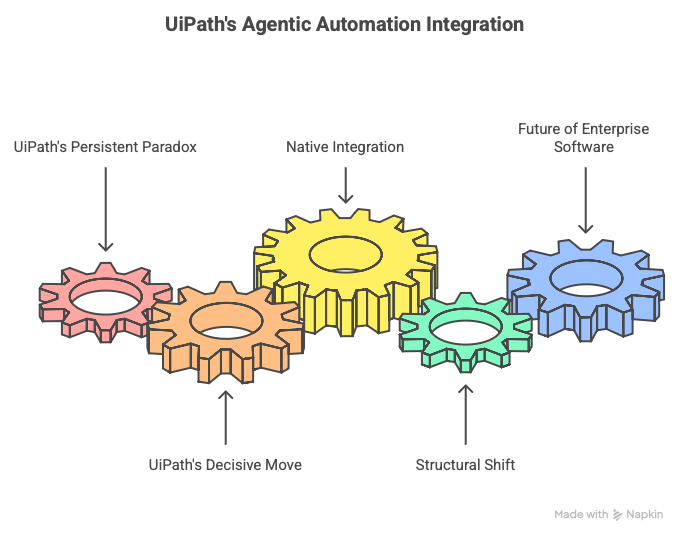
For years, enterprise technology leaders have wrestled with a persistent paradox: their organisations accumulate powerful software platforms, yet realising transformative business value from them remains stubbornly elusive. The gap between automation potential and automation reality has cost companies billions in unrealised productivity gains, stalled digital transformation roadmaps, and frustrated C-suite executives who expected AI to deliver more, faster.
In May 2026, UiPath made a decisive move that may well close that gap for good. The company announced that it has become the world’s first Business Orchestration & Automation Platform to offer native integration for coding agents — intelligent, AI-powered systems capable of writing, testing, debugging, and deploying code autonomously. This is not a superficial product update. It is a structural shift in what enterprise automation platforms can do, how quickly they can adapt, and how deeply they can integrate with the complex, heterogeneous technology environments that define modern organisations.
To appreciate the full significance of this development, we need to examine what it means in practice, why it matters strategically, and what it signals about the future of enterprise software. Whether you are a CIO evaluating automation investments, a developer trying to future-proof your skills, a business analyst seeking faster ROI from technology, or simply a professional curious about where AI is taking the corporate world, this article is written for you.
Setting the Stage: What Is a Business Orchestration & Automation Platform?
Before diving into what UiPath has announced, it is important to understand the category it operates in and why that context matters enormously.
A Business Orchestration & Automation Platform (BOAP) is not simply a tool for automating repetitive tasks. The concept evolved from early Robotic Process Automation (RPA), which digitalised rule-based, manual workflows by mimicking human interactions with software. Over time, leading vendors like UiPath expanded far beyond RPA, incorporating process mining, task mining, document understanding, AI model management, API integration, low-code/no-code development, and orchestration capabilities that coordinate complex, multi-step business processes across departments and systems.
Today, a mature BOAP connects people, bots, AI models, and enterprise applications, enabling organisations to automate not just isolated tasks but end-to-end business processes. Think of it as the central nervous system of a digital enterprise — perceiving operational signals, making decisions, routing work, and triggering actions across the entire organisational ecosystem.
The missing piece, until now, has been the ability to natively accommodate coding agents: AI systems that can autonomously generate and deploy software in real time, responding to business needs without requiring human developers to step in at every turn.
Coding Agents Explained: AI That Builds Itself Into Your Business
The term “coding agent” refers to an AI system that goes significantly beyond the capabilities of conventional AI assistants or code completion tools. While tools like GitHub Copilot offer helpful suggestions to human developers, coding agents operate with a far greater degree of autonomy. They can:
- Understand high-level business requirements expressed in natural language.
- Translate those requirements into functional code, selecting appropriate frameworks and patterns.
- Execute the code in a sandboxed environment to test correctness and performance.
- Identify and remediate bugs, edge cases, and security vulnerabilities without human intervention.
- Deploy the finished integration or automation into a live production environment.
- Monitor outcomes and self-correct based on operational feedback.
In practical terms, a coding agent embedded within an automation platform means that an organisation can describe a business need — say, “we need to automatically reconcile supplier invoices with our ERP system and flag discrepancies above 5%” — and have the system design, build, test, and deploy that integration end-to-end, adapting as the business environment changes.
This is a fundamentally different paradigm from anything the enterprise technology market has offered before. It collapses the traditional cycle of business requirements gathering, development, testing, and deployment — a cycle that typically takes weeks or months — into hours or even minutes.
Why ‘Native’ Integration Is the Critical Differentiator
Technology vendors frequently overuse the word “integration.” It often describes a loosely coupled connection between systems — an API call here, a webhook there — rather than deep, native interoperability. UiPath’s announcement is notable precisely because it emphasises native integration, and that distinction carries significant operational weight.
Non-native or bolted-on integrations between AI agents and orchestration platforms create friction at multiple levels. Data must travel across system boundaries, introducing latency and potential loss of context. Governance and security policies applied in one layer may not automatically extend to the other. Observability and logging become fragmented, making it difficult to audit what an AI agent did, when, and why. Operational teams must maintain multiple interfaces and troubleshoot failures that fall between the cracks of two separate systems.
Native integration, by contrast, means that coding agents operate as first-class citizens within the UiPath platform. They share the same orchestration fabric, governance framework, security model, audit trail, and operational monitoring infrastructure as every other component — whether that is a traditional RPA bot, an AI document processing model, or a human-in-the-loop approval workflow.
For enterprise technology leaders, this is the difference between a feature and a foundation. Native integration transforms coding agents from an interesting experiment into a production-grade capability that can be trusted, audited, governed, and scaled across the organisation.
The Enterprise Transformation Use Cases: Where This Changes Everything
Abstract technological capability only matters when it translates into concrete business value. The native integration of coding agents into UiPath’s platform unlocks a generation of use cases that were previously impractical or impossible at enterprise scale.
1. Dynamic Integration Development
Large enterprises typically operate dozens or hundreds of disparate software systems — ERPs, CRMs, HR platforms, financial systems, supply chain tools, customer portals, and more. The cost and time required to build and maintain integrations between these systems has historically been enormous. With coding agents natively embedded in the orchestration platform, businesses can describe integration requirements and have the agent design, build, and deploy the necessary connectors and data pipelines autonomously, adapting automatically when APIs change or business rules evolve.
2. Self-Healing Automation Pipelines
One of the most persistent pain points in traditional RPA deployments is maintenance overhead. When a software application is updated, screen layouts change, API responses shift, or business logic evolves, automations break and require developer intervention to fix. Coding agents embedded in the orchestration layer can monitor automation health, detect failures, diagnose root causes, and regenerate the affected code — often before human operators are even aware of the issue. This transforms automation from a fragile, maintenance-intensive asset into a resilient, self-sustaining one.
3. Accelerated Compliance and Regulatory Adaptation
Regulated industries — financial services, healthcare, pharmaceuticals, energy — face constant pressure to adapt their business processes in response to new regulatory requirements. Historically, this meant expensive, slow projects to modify existing systems and automations. With coding agents, compliance teams can describe regulatory changes in natural language, and the platform can identify affected workflows, generate necessary code changes, run compliance checks, and deploy updated processes at a pace that was previously unimaginable. For multinational organisations navigating different regulatory frameworks across jurisdictions, this capability is genuinely transformative.
4. Democratising Automation for Non-Technical Teams
One of the most significant barriers to enterprise-wide automation adoption has been the developer bottleneck. Business teams identify automation opportunities but must compete for scarce developer resources to build solutions. With coding agents handling the actual code generation, business analysts, operations managers, and subject matter experts can describe what they need in plain language and receive a working automation in return. This genuinely democratises automation, extending its benefits across the full breadth of the organisation rather than concentrating them in IT-adjacent functions.
5. Intelligent Process Reinvention – UiPath
Mature automation programmes increasingly look beyond task automation to full process reinvention — redesigning entire workflows from the ground up using AI. With coding agents working alongside process mining and AI-powered orchestration, UiPath’s platform can now analyse existing processes, identify inefficiencies, propose redesigned workflows, and build the code to implement them. This closes the loop between process intelligence and process execution in a way no previous platform has achieved.
Strategic Implications for CIOs and Technology Leaders
For senior technology leaders, UiPath’s move reshapes several strategic calculus points.
Platform Consolidation Becomes More Compelling
Organisations that have been managing separate tools for RPA, AI agents, integration platforms, and developer toolchains now have a powerful argument for consolidation. A single platform that natively orchestrates all of these capabilities — with unified governance, security, and observability — dramatically reduces operational complexity and total cost of ownership.
The ROI Calculation on Automation Changes Fundamentally – UiPath
Traditional automation ROI models factor in development costs, maintenance costs, and the opportunity cost of developer time. When coding agents handle the bulk of development and maintenance work autonomously, these cost inputs shrink dramatically. Simultaneously, the speed at which new automation use cases can be identified, built, and deployed accelerates, increasing the value output side of the equation. Organisations that update their automation business cases to reflect these dynamics will find that the ROI bar for new automation investments falls significantly lower — making many previously marginal projects highly attractive.
Governance and Risk Frameworks Must Evolve – UiPath
The introduction of autonomous coding agents into enterprise automation pipelines raises important governance questions. When an AI agent writes and deploys code that modifies business processes, who is accountable for the outcome? What controls prevent an agent from making a change that creates regulatory risk or operational disruption? How are AI-generated code changes reviewed, audited, and rolled back if necessary? Technology leaders must ensure that their governance frameworks keep pace with these new capabilities. Encouragingly, UiPath’s native integration model — with its unified audit trail and orchestration controls — provides a stronger governance foundation than bolted-on alternatives, but organisations will still need to develop new policies, oversight mechanisms, and human-in-the-loop controls appropriate to the risk profile of each use case.
What This Means for Developers and Automation Professionals – UiPath
A common anxiety around agentic AI in software development is that it threatens developers’ livelihoods. This concern, while understandable, misreads the nature of what coding agents actually do and what enterprises actually need.
Coding agents excel at well-defined, bounded tasks where requirements are clear and patterns are established. They are extraordinarily effective at generating integration code, writing automation scripts, producing unit tests, and adapting existing code to changing parameters. What they cannot replace is the human judgment required to understand ambiguous business needs, navigate organisational politics, design systems architecture for long-term scalability, manage stakeholder relationships, and make the value judgements that determine which automation investments deserve priority.
In practice, the most likely near-term impact of coding agents in enterprise settings is a significant expansion of the addressable automation opportunity, requiring more automation professionals — not fewer — to design, govern, and optimise the resulting systems. The profile of skills required will shift, with premium placed on AI orchestration expertise, automation architecture, governance design, and business-technology translation. Professionals who develop these skills will be enormously valuable in the emerging automation economy.
The Competitive Landscape: UiPath’s Market Position and What Rivals Must Do
By becoming the first BOAP to offer native coding agent integration, UiPath has staked out a significant competitive advantage at a critical inflection point in enterprise AI adoption. The “first mover” label in enterprise technology is meaningful when it comes with genuine capability differentiation and an installed base to leverage — and UiPath has both.
Competitors in the automation and AI platform space — including ServiceNow, Microsoft Power Automate, Automation Anywhere, and SAP Build — will undoubtedly accelerate their own agentic automation investments in response. The broader software development platforms, including offerings from Salesforce, IBM, and Oracle, will also need to respond to customer expectations that coding agent capabilities become standard across enterprise software environments.
However, matching a native integration capability is considerably harder than matching a feature addition. UiPath’s advantage lies not just in having coding agents available, but in having them woven into the orchestration, governance, and operational fabric of a battle-tested enterprise platform. Replicating that depth of integration takes years of engineering investment, not months. For organisations evaluating automation platforms, this gap will be a meaningful differentiator in vendor selection discussions through at least 2027.
Global Relevance: Why This Matters for Businesses Everywhere – UiPath
Enterprise automation is inherently a global phenomenon, and UiPath’s advancement has implications that extend well beyond North American or Western European technology markets.
In rapidly growing economies across Asia-Pacific, Latin America, the Middle East, and Africa, digital transformation is accelerating. Enterprises in these markets often face a more acute developer talent shortage relative to the scale and speed of their digitalisation ambitions. Coding agents that can autonomously build integrations and automations dramatically lower the talent barrier to sophisticated automation, making enterprise-grade digital transformation accessible to organisations that could not previously afford the developer headcount required.
For organisations in multilingual environments, coding agents that can process requirements in multiple languages and generate code accordingly add particular value. For businesses operating in jurisdictions with stringent data localisation requirements, native platform integration — rather than reliance on external AI APIs — provides stronger data sovereignty guarantees. And for smaller enterprises in any geography that have automation ambitions but limited IT budgets, the ability to generate automation code without large development teams fundamentally changes the economics of the technology investment.
Responsible AI in Automation: The Ethics and Governance Dimension – UiPath
No discussion of autonomous AI agents in enterprise environments is complete without addressing the ethical and governance dimensions. When AI systems are empowered to write and deploy code that affects business processes — and therefore the employees, customers, and stakeholders those processes touch — the stakes of getting governance right are high.
Several principles should guide responsible deployment of coding agents in enterprise automation contexts. First, human oversight must remain meaningful: while coding agents can operate with high autonomy for lower-risk tasks, changes to critical business processes should require human review and approval before deployment. Second, full auditability is non-negotiable: every action taken by a coding agent — every line of code generated, every deployment made, every change executed — must be logged in an immutable, queryable audit trail. Third, organisations must define clear accountability structures that specify who is responsible when an AI-generated automation produces an incorrect or harmful outcome.
UiPath has historically been one of the stronger voices in the automation industry on responsible AI practices, and the native integration model — with its unified governance fabric — provides a better technical foundation for responsible deployment than fragmented, multi-vendor approaches. Nevertheless, governance is ultimately an organisational capability, not just a technical one. Enterprises that invest in developing strong AI governance practices will be better positioned to realise the benefits of coding agents while managing their risks.
How to Prepare: A Practical Roadmap for Enterprises – UiPath
For organisations looking to position themselves to benefit from this development, here is a practical roadmap:
- Audit your automation portfolio: Identify which existing automations are high-maintenance and most likely to benefit from AI-driven self-healing capabilities. These are strong early candidates for coding agent integration.
- Revisit your automation opportunity pipeline: Many projects may have been de-prioritised due to development resource constraints. With coding agents reducing the developer bottleneck, re-evaluate the business case for those opportunities.
- Invest in automation governance maturity: Before deploying autonomous coding agents at scale, ensure your organisation has robust change management, audit, and oversight processes in place. Strong governance infrastructure is a prerequisite for safe and confident scaling.
- Develop human-AI collaboration skills: Train your automation and development teams to work effectively alongside coding agents — defining requirements clearly, evaluating AI-generated code critically, and designing governance checkpoints appropriately.
- Engage your UiPath account team and ecosystem partners: The specifics of how coding agent capabilities integrate with your existing UiPath deployment, your technology stack, and your regulatory environment will be unique to your organisation. Early engagement will accelerate your readiness.
- Pilot deliberately, scale confidently: Start with bounded, lower-risk automation use cases where the consequences of errors are manageable. Build organisational confidence and technical capability through early pilots before extending coding agent autonomy to mission-critical processes.
Conclusion: The Enterprise Automation Era Has Entered a New Chapter – UiPath
UiPath’s announcement that it has become the first Business Orchestration & Automation Platform with native integration for coding agents is more than a product launch headline. It represents a genuine inflection point in enterprise technology — the moment when AI moved from being a tool that assists automation to being an active participant in creating it.
The implications ripple across every dimension of enterprise technology strategy: how automation is built, how it is maintained, how it is governed, who can access it, and what returns it can generate. For organisations that move quickly to understand and leverage this capability, the competitive advantages — in speed, cost efficiency, operational resilience, and innovation capacity — will be substantial.
For those who wait or dismiss this as incremental, the risk is not just falling behind on a technology feature. It is ceding the ability to operate at the pace that the coming decade of business will demand. Automation has always been about compressing time — doing more, faster, with less manual effort. Native coding agents accelerate that compression to a degree that fundamentally changes what “good” looks like in enterprise operations.
The organisations that thrive in this new era will be those that embrace the possibilities deliberately, govern them responsibly, and build the human capabilities to partner with AI in ways that amplify rather than replace human judgement. The tools are now in place. The question is what we build with them.
About This Article
This article was written to provide in-depth, independent analysis of UiPath’s announcement regarding native coding agent integration within its Business Orchestration & Automation Platform. It is intended for enterprise technology professionals, business leaders, automation practitioners, and curious readers worldwide seeking to understand the strategic significance of this development.
Keywords: UiPath, coding agents, business orchestration, automation platform, enterprise automation, agentic AI, RPA, digital transformation, AI integration, enterprise technology strategy.




One Comment