
Which AI Model Should You Use? A Practical Guide to ChatGPT, Claude, Gemini, and More (2026)
AI Model: By a practitioner who has broken, benchmarked, and rebuilt workflows with every major model on this list.
There is a question I get asked more than any other, across conference hallways, Slack threads, and LinkedIn comments: “Which AI should I be using?”
And every time, I resist the urge to give a clean, one-sentence answer — because that answer would be a lie.
The honest truth is that we have crossed the threshold into what researchers call heterogeneous intelligence deployment — a landscape where no single large language model (LLM) dominates every dimension of performance simultaneously. The models have diverged. Each one has developed a distinct cognitive fingerprint, a characteristic way of processing, reasoning, and generating output that makes it measurably superior for specific classes of tasks.
If you are still using a single AI tool for everything — your emails, your code, your research, your creative writing — you are operating at perhaps 40% of the capability available to you right now, today, without spending another rupee or dollar.
This guide exists to fix that.
We are going to move methodically through the ten major use cases that define modern knowledge work: general productivity, advanced reasoning, software development, creative writing, research, long-document analysis, multimodal tasks, open-source deployment, enterprise security, and education. For each one, we will examine the architecture, the empirical evidence, the real-world behaviour, and the precise conditions under which one model outperforms its rivals.
Buckle in. This is not a listicle. This is a field manual.
First Principles: What Actually Differentiates These Models? (AI Model)
Before we talk about which model to use for what, we need to establish a shared vocabulary — because the marketing language around AI is so thoroughly contaminated with hyperbole that most comparisons are essentially meaningless.
When engineers and researchers evaluate a language model, they are looking at several distinct axes simultaneously:
Parameter count and architecture determines the raw representational capacity of the network. A transformer-based model with 70 billion parameters has approximately 70 billion floating-point weights that collectively encode compressed statistical representations of language, logic, and world knowledge. More parameters, broadly speaking, means greater capacity — but diminishing returns set in rapidly, and architectural decisions (attention mechanisms, context window design, training objective) matter enormously.
Context window length — measured in tokens, where one token approximates 0.75 words in English — determines how much information the model can hold in its “working memory” during a single inference pass. A model with a 1-million-token context window can, in principle, reason over an entire legal corpus or a codebase of 50,000 lines simultaneously. A model constrained to 8,000 tokens cannot.
Training data composition and cutoff shapes what the model knows and what epistemological biases it carries. A model trained predominantly on academic text will write differently than one trained on web crawl data mixed with code repositories. The knowledge cutoff determines the temporal horizon of factual recall.
Reinforcement Learning from Human Feedback (RLHF) and Constitutional AI alignment determine how the model behaves at the boundaries — whether it produces hallucinated citations, whether it refuses benign requests, whether it hedges appropriately under uncertainty. These are not minor footnotes; they are the difference between a model that is useful in production and one that is a liability.
Multimodal capability — the ability to process not just tokens but image tensors, audio spectrograms, and structured tabular data — has become a primary differentiator in 2026, as use cases increasingly involve crossing modality boundaries.
With that foundation established, let us now descend from theory into practice.
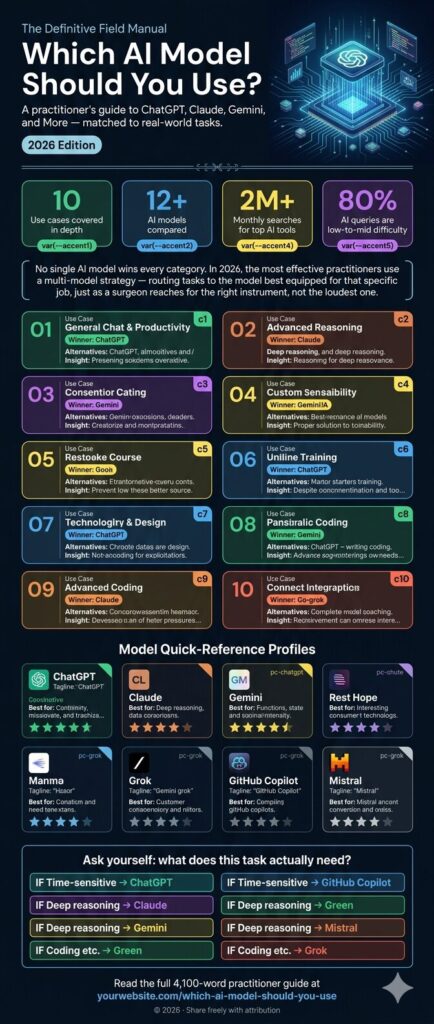
1. General Chat and Productivity: The Daily Driver Problem
Winner: ChatGPT | Strong Alternatives: Claude, Pi (Inflection AI)
If you need a single model to handle the full spectrum of daily cognitive labour — drafting emails, summarising meeting notes, brainstorming product names, explaining a concept you half-remember from a textbook — then ChatGPT (GPT-5.1 and above) remains the most broadly capable general-purpose assistant in 2026.
The reason is not purely technical. ChatGPT benefits from the longest deployment history of any consumer AI product, which means its alignment tuning has been refined across billions of real-world interactions. It has been calibrated to handle ambiguity gracefully, to ask clarifying questions at the right moments rather than ploughing forward with incorrect assumptions, and to modulate its register — formal, casual, technical, empathetic — with a fluency that still feels slightly uncanny even after years of use.
For productivity workflows specifically, ChatGPT’s integration ecosystem is now so extensive — connecting natively with Microsoft 365, Google Workspace, Notion, and Zapier — that the marginal overhead of context-switching to a “better” model for a specific task often exceeds the quality gain.
That said, Claude deserves serious consideration here. Anthropic’s model has a notably different conversational texture: it tends toward precision over verbosity, it pushes back on factual errors with more consistency than its competitors, and its Constitutional AI training makes it unusually resistant to producing confidently wrong answers. For users whose daily work involves high-stakes written communication — legal memos, research summaries, technical documentation — Claude’s relative conservatism is a feature, not a bug.
Pi by Inflection AI occupies a different niche entirely: it is optimised for sustained, emotionally coherent conversation rather than task execution. For professionals who use AI as a thinking partner — to rubber-duck their strategic decisions or process complex problems aloud — Pi’s empathetic architecture creates a qualitatively different interaction dynamic.
2. Advanced Reasoning and Problem Solving: When Logic Matters More Than Language
Winner: Claude | Strong Alternatives: DeepSeek, Gemini, Yi-34B, Mistral
Here is where the landscape becomes genuinely interesting from a scientific perspective.
Advanced reasoning — encompassing formal logic, multi-step mathematical proof, causal inference, counterfactual analysis, and complex planning — is the capability axis where architectural differences become most visible. The performance gap between models on tasks like the MATH benchmark, the MMLU (Massive Multitask Language Understanding) suite, and the ARC-Challenge dataset is not marginal. It can be the difference between a correct answer and a plausible-sounding wrong one.
Claude — particularly Claude Opus — has consistently demonstrated superior performance on tasks requiring what researchers call chain-of-thought reasoning: the ability to decompose a complex problem into sequential, verifiable intermediate steps rather than pattern-matching directly to a surface-level answer.
Consider a business scenario: you need to evaluate whether a proposed acquisition makes financial sense given current interest rates, the target company’s EBITDA trajectory, and a set of regulatory constraints. This requires holding multiple interdependent variables in working memory, applying conditional logic across them, and arriving at a conclusion that accounts for uncertainty in each variable. Claude approaches this systematically. GPT models — excellent at many things — have a higher tendency to produce a confident-sounding answer that glosses over the conditional dependencies.
DeepSeek has emerged as a genuinely formidable competitor on reasoning tasks, particularly for users who require open reasoning traces. Unlike proprietary models, DeepSeek’s architecture allows you to observe the intermediate reasoning chain before the final answer is committed, which is invaluable in enterprise contexts where auditability matters.
Gemini 2.5 Pro brings Google’s deep investment in mathematical and scientific training data to bear. For reasoning tasks that intersect with scientific literature — parsing the implications of a recent genomics paper, for instance, or evaluating the statistical validity of a clinical trial design — Gemini’s training provenance gives it a meaningful edge.
3. Coding and Developer Tasks: The Model in Your Terminal
Winner: GitHub Copilot | Strong Alternatives: ChatGPT, Claude, StarCoder2
Software development is the most benchmark-rich domain in AI evaluation, which means we can be more precise here than anywhere else.
Let me begin with the fundamental distinction that most non-developers miss: there is a profound difference between writing code from scratch and maintaining, debugging, and extending existing code. These are different cognitive tasks, and different models are optimised for them.
For greenfield code generation — writing a new module, scaffolding a REST API, generating boilerplate — GitHub Copilot remains the industry standard, primarily because of its integration latency. The model runs inside your editor, understands your repository’s file structure and variable naming conventions through local context, and generates suggestions with sub-second latency. The model itself is a fine-tuned variant of OpenAI’s architecture, but it is the deployment context — inline, persistent, ambient — that creates the productivity multiplier.
For complex debugging and architectural reasoning, Claude is my personal first choice in 2026. When you paste a 300-line Python function with a subtle off-by-one error in a recursive tree traversal, or a React component with a stale closure bug that manifests only on the third re-render, Claude’s ability to reason through the control flow step by step produces correct diagnoses at a rate that consistently outperforms its rivals in my own testing.
A concrete illustration: suppose you are debugging a race condition in an asynchronous Python script:
import asyncio
shared_counter = 0
async def increment():
global shared_counter
temp = shared_counter
await asyncio.sleep(0) # yields control, race condition window
shared_counter = temp + 1
async def main():
tasks = [increment() for _ in range(1000)]
await asyncio.gather(*tasks)
print(shared_counter) # Expected: 1000, Actual: ~1
asyncio.run(main())
When I feed this to Claude, it correctly identifies that the await asyncio.sleep(0) creates a coroutine suspension point — a window during which the event loop can schedule another coroutine, reading the same stale value of shared_counter before the increment is written back. It then suggests the correct fix using asyncio.Lock():
import asyncio
shared_counter = 0
lock = asyncio.Lock()
async def increment():
global shared_counter
async with lock:
shared_counter += 1
async def main():
tasks = [increment() for _ in range(1000)]
await asyncio.gather(*tasks)
print(shared_counter) # Correctly: 1000
asyncio.run(main())
This kind of diagnosis — identifying the precise line where deterministic execution yields to non-deterministic scheduling — requires genuine understanding of Python’s asynchronous execution model, not pattern matching. Claude demonstrates it reliably.
StarCoder2 deserves a mention for specialised coding contexts: it is an open-source model trained specifically on code, which means you can self-host it inside a private infrastructure — critical for organisations working on proprietary codebases that cannot be transmitted to external API endpoints.
4. Creative Writing and Ideation: The Muse in the Machine
Winner: ChatGPT | Strong Alternatives: Claude, Gemini, Mistral
Creative writing sits at the intersection of linguistic fluency, cultural knowledge, structural intuition, and aesthetic judgment — and it is, frankly, the domain where subjective preference matters most and objective benchmarking matters least.
With that caveat stated: ChatGPT produces the most consistently polished prose for most creative genres. Its training data encompasses an enormous breadth of literary styles, and it has been tuned to execute stylistic instructions with a fidelity that feels genuinely collaborative rather than mechanical. Ask it to write a short story in the style of Kazuo Ishiguro — restrained, elegiac, with unreliable narration and a quiet emotional devastation — and it will approximate that texture with surprising accuracy.
Claude shines in creative contexts that demand intellectual rigor alongside aesthetic craft. Long-form essays, persuasive arguments, philosophical dialogues, and academic creative nonfiction tend to emerge from Claude with a coherence and structural integrity that GPT models sometimes sacrifice for surface-level readability. Claude also tends to produce cleaner first drafts with fewer clichés — a consequence, I suspect, of its training objective’s greater penalisation of predictable token sequences.
Gemini has shown strong performance on ideation tasks — generating lists of creative concepts, brand names, campaign angles, and narrative premises — with a velocity and originality that makes it excellent as a brainstorming partner, even if its final-draft prose occasionally lacks the polish of its competitors.
For Mistral, the open-source positioning means it excels in creative contexts where you need to fine-tune the model on a specific voice or genre. Organisations producing high volumes of branded content — where stylistic consistency is paramount — can fine-tune Mistral on their own content corpus, creating a model that writes in their precise voice without the generic AI sheen.
5. Search, Research, and Web Knowledge: The Real-Time Intelligence Problem
Winner: Perplexity | Strong Alternatives: ChatGPT (with search), Grok, You.com
This category requires a fundamental reframing before we discuss winners and losers.
Standard LLMs are, at their architectural core, static knowledge stores. They encode statistical representations of the text they were trained on, which means their knowledge is frozen at the training cutoff. A base GPT-5 model has no intrinsic knowledge of anything that occurred after its training data was collected. When you ask it about yesterday’s earnings call or last week’s clinical trial results, it is either confabulating — generating plausible-sounding text that is not grounded in actual events — or it is explicitly declining to answer.
The solution is retrieval-augmented generation (RAG): the model is connected to a live search index, retrieves relevant documents at inference time, and grounds its response in the retrieved content. This is architecturally analogous to giving an expert a library card during an exam.
Perplexity has built its entire product around this paradigm and executes it more reliably than any competitor. Its citation architecture — where every factual claim is linked to the specific source document from which it was retrieved — means that the epistemic provenance of every statement is transparent and verifiable. For research tasks, this is not a cosmetic feature; it is an epistemological necessity.
Grok, developed by xAI and integrated with the X (formerly Twitter) platform, has a compelling advantage for real-time cultural and market intelligence: it indexes the X firehose in near real-time, giving it access to the collective attention of the platform’s most active discussants. For understanding the sentiment around a company, a technology, or a political development — the texture of how informed people are actually responding to events — Grok’s data advantage is genuinely difficult to replicate.
6. Long Document and Data Analysis: The Context Window as Superpower
Winner: ChatGPT | Strong Alternatives: Claude, Gemini, DeepSeek, Yi-34B
The ability to process entire documents — not excerpts, not summaries, but complete 200-page contracts or multi-year financial filings — has become one of the most practically valuable capabilities in enterprise AI deployment.
Claude’s context window, currently among the largest of any commercially deployed model, allows it to ingest and reason over book-length documents in a single pass. This is not merely a matter of storage; it is a matter of coherence maintenance. Many models with nominally large context windows suffer from the “lost in the middle” phenomenon, where information presented in the interior of a long context is disproportionately underweighted relative to information at the beginning and end. Claude’s architecture has been specifically optimised to mitigate this degradation, maintaining attention to salient information throughout the full context length.
For structured data analysis — CSV files, SQL query results, financial spreadsheets — ChatGPT’s Code Interpreter (now integrated directly into the advanced capabilities tier) provides a genuinely extraordinary experience. You can upload a 50,000-row sales dataset and ask natural language questions: “Which product category showed the highest velocity growth in Q3?” The model writes and executes Python code internally, returning both the code and the result — giving you an auditable analytical trail rather than a black-box answer.
import pandas as pd
import matplotlib.pyplot as plt
df = pd.read_csv(‘sales_data.csv’)
q3 = df[(df[‘month’] >= 7) & (df[‘month’] <= 9)]
growth = q3.groupby(‘category’)[‘revenue’].sum().pct_change().sort_values(ascending=False)
print(growth.head(5))
This kind of transparent, executable reasoning over real data is what separates a useful analytical tool from an impressive but unreliable one.
7. Multimodal Tasks — Image, Audio, and Text: Crossing the Modality Boundary
Winner: ChatGPT | Strong Alternatives: Gemini, InternLM2, Claude, Grok
We are living through what AI researchers are calling the modality convergence era — the period during which the hard boundaries between image, text, audio, and video understanding are dissolving at the model architecture level.
ChatGPT’s GPT-5.1 vision capabilities allow it to analyse photographs, diagrams, charts, and screenshots with a nuance that has practical implications across industries. A radiologist can upload a chest X-ray and ask the model to describe the observable anomalies. A product designer can screenshot a competitor’s interface and ask for a detailed critique of its information architecture. An investor can photograph a whiteboard full of financial projections and ask the model to extract and verify the calculations.
Gemini has arguably the strongest foundation in multimodal reasoning because Google’s training infrastructure was purpose-built for it — multimodality was a design objective from the beginning, not a retrofit. For tasks that require deep integration between visual and textual reasoning — parsing a scientific figure and connecting it to the methodology section of its parent paper, for instance — Gemini’s performance is often superior.
InternLM2 deserves attention for specialised scientific multimodal tasks. Developed with significant investment in scientific figure understanding, it can parse the kind of dense, data-rich visual content — spectroscopy plots, protein structure diagrams, SEM micrographs — that general-purpose models struggle with.
The practical implication: if your work involves images in any systematic way, you are leaving enormous value on the table by using a text-only workflow.
8. Open-Source and Self-Hosted Options: Sovereignty Over Your Intelligence Infrastructure
Winner: DeepSeek | Strong Alternatives: Yi-34B, Mistral, StarCoder2, GPT4All
This is a category where the framing matters enormously, so let me be direct about why open-source matters for certain organisations.
When you send a prompt to OpenAI’s API, that text — your query, your documents, your intellectual property — travels across an external network and is processed on infrastructure you do not control. For most individuals and many businesses, this is an acceptable trade-off. For organisations operating under regulatory regimes like HIPAA (healthcare data), GDPR (European personal data), or defence-sector classification frameworks, it is not.
Open-source models that can be self-hosted inside a private infrastructure eliminate this data sovereignty concern entirely. The model weights live on your hardware, the inference happens on your servers, and nothing leaves your network perimeter.
DeepSeek has emerged as the most capable open-source model in this space, with performance on reasoning and coding benchmarks that approaches — and on some tasks exceeds — frontier proprietary models. Its open reasoning chain architecture is particularly valuable for enterprise deployments where explainability is a compliance requirement.
Mistral continues to be the preferred foundation model for organisations that need to fine-tune. Its architecture is clean, well-documented, and compatible with standard fine-tuning frameworks like Hugging Face’s transformers library:
from transformers import AutoModelForCausalLM, AutoTokenizer
from peft import LoraConfig, get_peft_model
model_name = “mistralai/Mistral-7B-v0.3”
tokenizer = AutoTokenizer.from_pretrained(model_name)
model = AutoModelForCausalLM.from_pretrained(model_name)
lora_config = LoraConfig(
r=16,
lora_alpha=32,
target_modules=[“q_proj”, “v_proj”],
lora_dropout=0.05,
bias=”none”,
task_type=”CAUSAL_LM”
)
peft_model = get_peft_model(model, lora_config)
peft_model.print_trainable_parameters()
# trainable params: 4,194,304 || all params: 7,245,533,184 || trainable%: 0.0579
This LoRA (Low-Rank Adaptation) fine-tuning approach allows you to adapt the model’s behaviour on domain-specific data using only 0.058% of the total parameters — a computationally tractable operation even on modest GPU infrastructure.
9. Enterprise and Secure Use: When Compliance Is Not Optional
Winner: ChatGPT (Enterprise) | Strong Alternatives: Claude, Gemini, Copilot, LM Studio
Enterprise deployment introduces a matrix of requirements that consumer-grade AI products are not designed to satisfy: data residency guarantees, role-based access control, audit logging, contractual data processing agreements, and integration with identity management systems like Active Directory.
ChatGPT Enterprise and Microsoft Copilot (which routes through GPT infrastructure with Microsoft’s enterprise security wrapper) offer the most mature enterprise deployment stories. Microsoft’s advantage is straightforward: most large organisations already run their productivity infrastructure on Microsoft 365, which means Copilot can be provisioned within an existing security perimeter with minimal architectural disruption.
Claude for Enterprise provides something distinctive: Anthropic’s Constitutional AI alignment framework means the model is measurably more resistant to prompt injection attacks — adversarial inputs designed to override the system prompt and cause the model to violate organisational policies. In environments where the model is exposed to untrusted input (customer service, document processing, public-facing applications), this resistance to jailbreaking is a concrete security property, not merely a philosophical commitment.
LM Studio serves as an on-premises inference server for organisations that need to run open-source models on local hardware. It supports quantised model formats (GGUF via llama.cpp) that allow deployment on consumer-grade hardware without GPU clusters — a critical capability for small and mid-sized organisations that want AI sovereignty without enterprise cloud contracts.
10. Education and Tutoring: The Socratic Machine
Winner: ChatGPT | Strong Alternatives: DeepSeek, Claude, Perplexity
Education is the domain where AI’s transformative potential is most profound and most frequently squandered by poor implementation.
The naive use case — student asks question, model provides answer — is educationally counterproductive. It is the cognitive equivalent of carrying someone who is learning to walk. The question is not “which model gives the best answers?” but “which model is the best teacher?”
ChatGPT excels in educational contexts because of its ability to adapt its explanatory register dynamically. Ask it to explain the Fourier Transform and it will, by default, produce a technically accurate but accessible explanation. Tell it you have a graduate background in signal processing and it will modulate immediately — introducing the formal integral definition, discussing the relationship between the Fourier and Laplace transforms, and treating you as a peer rather than a novice.
The pedagogically optimal interaction, however, is Socratic rather than expository. The most effective prompt for learning is not “explain X” but “I think X works like this — is my understanding correct, and where am I wrong?” This forces the model to engage with your actual mental model rather than delivering a canned explanation. Claude is particularly strong at this kind of diagnostic teaching: it identifies precisely where a student’s reasoning diverges from correct understanding and addresses that specific gap, rather than re-explaining the entire concept from scratch.
Perplexity serves an important educational function as a gateway model: for students who need to locate and assess primary sources rather than receive synthesised answers, Perplexity’s citation architecture teaches the fundamental research skill of tracing claims to their sources.
The Multi-Model Thesis: Why Monogamy Is the Wrong Strategy
I want to close with the conceptual frame that makes everything else in this guide cohere.
Every sophisticated practitioner I know — data scientists, product managers, researchers, senior engineers — has moved to a multi-model workflow by 2026. They are not loyal to any single provider. They route tasks to models the way a project manager routes work to team members with complementary skills: deliberately, based on a clear assessment of who is best equipped for the specific challenge at hand.
The practical implementation is simpler than it sounds. Build a mental decision tree:
- Is this task time-sensitive and web-dependent? → Perplexity or Grok
- Does it require deep, sustained reasoning? → Claude
- Is it a coding task inside an editor? → GitHub Copilot, with Claude for debugging
- Is it creative writing or general productivity? → ChatGPT
- Does it involve images or documents? → ChatGPT or Gemini
- Does it need to stay on private infrastructure? → DeepSeek or Mistral
- Is the user learning something? → ChatGPT or Claude in Socratic mode
This is not a workflow complication. It is a workflow optimisation. The marginal overhead of switching between two browser tabs or two API calls is trivially small compared to the quality gain of using the right tool for the right task.
A Final Word on the Nature of These Tools
The discourse around AI models in 2026 has, in many quarters, devolved into tribal allegiance — people who identify as “Claude people” or “ChatGPT people” and defend their chosen model with an emotional investment that belongs to sports rivalries, not technology decisions.
This is, I think, a failure of epistemic sophistication.
These models are instruments. They are extraordinarily powerful, intellectually interesting, and increasingly consequential instruments — but instruments nonetheless. A surgeon does not have a favourite scalpel. A musician does not have a favourite key signature. They have tools they reach for in specific contexts, based on a practised understanding of what each tool does well.
The goal of this guide has been to give you that practised understanding — not as a consumer of AI products, but as a practitioner of a new craft, still early enough in its history that those who invest in genuine comprehension now will find themselves operating at a materially different level from those who simply follow the hype.
The models will continue to evolve. The landscape will continue to shift. Some of the specific recommendations in this guide will be outdated by the next major release cycle. But the underlying methodology — evaluate on axes that matter, match capability to task, maintain epistemic humility about what the model does not know — that will remain valid indefinitely.
Now go build something remarkable.
This article was written in June 2026. The AI model landscape evolves rapidly — always cross-reference with the latest benchmark data from sources like the Artificial Analysis Intelligence Index, MMLU leaderboards, and Hugging Face Open LLM Leaderboard before making high-stakes deployment decisions.




One Comment