
Machine Learning Algorithms Every Data Scientist Must Know — And How They Can Transform Small Business Growth
Introduction: Machine Learning Is No Longer a Big Tech Monopoly
There was a time when machine learning felt like science fiction — something reserved for NASA engineers, Silicon Valley unicorns, and billion-dollar research labs. That time is gone.
Today, machine learning is powering the recommendation engine on your favourite shopping app, catching fraudulent transactions on your bank account, and predicting what you will search for before you finish typing. And increasingly, it is becoming one of the most powerful — and accessible — tools available to small businesses that are willing to embrace it.
But here is the challenge most small business owners face: they hear the term “machine learning” and immediately feel overwhelmed. The algorithms have intimidating names. The mathematics sounds impenetrable. And the whole subject seems to belong to a world operating at a scale far beyond a local retail store, a growing consultancy, or a bootstrapped e-commerce brand.
This article is here to change that perception completely.
The truth is, every machine learning algorithm — from the most foundational to the most sophisticated — was built to solve a real problem. And many of those problems are exactly the kind that small businesses face every single day: predicting customer behaviour, detecting unusual transactions, finding hidden patterns in sales data, and making smarter decisions faster.
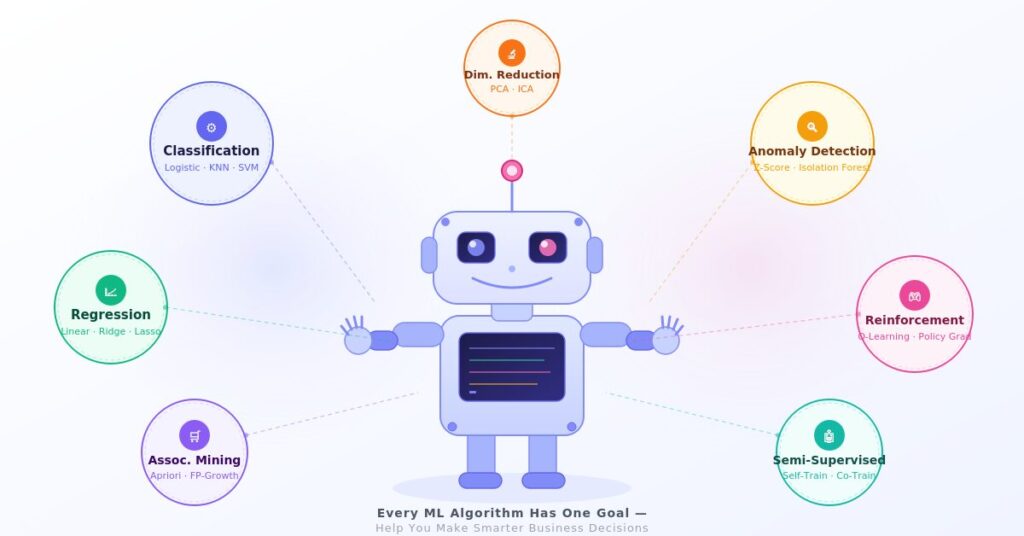
In this article, we walk through every major category of machine learning algorithm that every data scientist must know — Classification, Regression, Dimensionality Reduction, Association Rule Mining, Anomaly Detection, Semi-Supervised Learning, Reinforcement Learning, and more. For each one, we explain what it does in plain language, how it works, and — most critically — how small businesses can use it to grow, compete, and thrive.
What Is Machine Learning, Really?
Before diving into the algorithms, let us build a common foundation.
Machine learning is a branch of artificial intelligence that enables computers to learn from data without being explicitly programmed for every possible scenario. Instead of writing a rulebook, you feed the system examples — and it learns the patterns itself.
Think of it this way: instead of telling a computer “if the customer has bought running shoes, show them running socks,” a machine learning model looks at thousands of purchase histories and figures that rule out on its own — and discovers hundreds of other patterns you never thought to look for.
There are three broad learning approaches:
Supervised Learning — The model learns from labelled data where you know the answer. Classification and Regression fall here.
Unsupervised Learning — The model finds patterns in unlabelled data. Dimensionality Reduction, Association Rule Mining, and Anomaly Detection live here.
Semi-Supervised and Reinforcement Learning — Hybrid or feedback-driven approaches enabling learning with minimal labelled data or through trial and error.
Part One: Classification — Teaching Machines to Sort and Predict
What Is Classification?
Classification is one of the most widely used forms of machine learning. Its job is conceptually simple: given a set of inputs, predict which category something belongs to.
Is this email spam or not? Will this customer churn or stay? Is this transaction fraudulent? These are all classification problems.
1. Logistic Regression — The Foundation of Predictive Decision Making
Despite its name, Logistic Regression is a classification algorithm. It calculates the probability that something belongs to a particular category — expressed as a value between 0 and 1. It uses a sigmoid function to map inputs to a probability score. If the score exceeds a threshold, the model classifies it as one category; below, the other.
How small businesses can use it:
- Customer churn prediction: Score every customer with a probability of leaving in the next 30 days. Proactively reach out to high-risk customers with retention offers before they cancel.
- Lead scoring: Assign probability scores to sales leads so your team focuses on those most likely to convert — saving time and improving conversion rates dramatically.
- Credit risk assessment: Small lenders and fintech startups can evaluate the likelihood of loan default before approving credit.
Logistic Regression is fast, interpretable, and an excellent starting point for any small business building its first predictive model.
2. Naive Bayes — The Speed Champion of Text Classification
Naive Bayes is a probabilistic classifier based on Bayes’ Theorem. It assumes all input features are independent of each other — a simplification that is mathematically “naive” but surprisingly effective, especially for text-based problems.
It calculates the probability of each class given the input data and picks the highest. Despite its simplifying assumptions, it performs remarkably well on real-world data.
How small businesses can use it:
- Email spam filtering: Build your own spam detection layer for your business email system.
- Customer sentiment analysis: Automatically classify incoming reviews, support tickets, or social media mentions as positive, negative, or neutral — without reading every single one manually.
- Document categorisation: Automatically sort contracts, invoices, and applications into categories for faster processing.
Naive Bayes is lightweight, fast to train, and performs well even with limited data — a strong choice for small businesses with modest datasets.
3. K-Nearest Neighbors (KNN) — Decision Making by Similarity
KNN is beautifully intuitive: to classify something new, find the K most similar existing examples in your data, and let the majority vote decide the class. The algorithm calculates distance from all existing points, identifies the K nearest neighbours, and assigns the most common class among them.
How small businesses can use it:
- Product recommendation: Recommend products based on what similar customers bought. No complex infrastructure — just a well-organised purchase history.
- Customer segmentation: Group customers by similarity in purchasing behaviour, demographics, or engagement level for personalised marketing.
- Personalised pricing: Identify similar customers to understand the price points that work for comparable profiles.
KNN requires no model training time, is easy to update as new data arrives, and is particularly powerful for recommendation systems at modest scale.
4. Support Vector Machine (SVM) — The Precision Classifier
SVM finds the optimal boundary — called a hyperplane — that separates classes with the maximum margin. It identifies the data points closest to the boundary (support vectors) and maximises the gap between them, making the boundary as robust and generalizable as possible.
How small businesses can use it:
- Image classification: A food business can classify product images for quality control. A retailer can tag product photos for an online catalogue automatically.
- Fraud detection: Separate legitimate transaction patterns from suspicious ones with high precision.
- Customer behaviour classification: Segment website visitors into high, medium, and low intent categories to deliver tailored content in real time.
SVM shines when the dataset is not enormous but the problem requires high precision — a common scenario for small businesses with focused, clean datasets.
5. Decision Tree — The Algorithm You Can Draw on a Whiteboard
Decision Trees mirror the way humans naturally make decisions — by asking a series of yes/no questions until arriving at a conclusion. Each internal node represents a question, each branch an answer, and each leaf node an outcome.
How small businesses can use it:
- Customer credit scoring: Build a transparent, auditable model to decide whether to extend credit terms to a business customer.
- Product fault diagnosis: Automate customer support by guiding users through diagnostic questions — reducing support ticket volume significantly.
- Marketing channel selection: Based on customer profile features, recommend the best marketing channel or offer type automatically.
The biggest advantage for small businesses is transparency — you can show a Decision Tree to a non-technical stakeholder and they immediately understand how the model makes decisions.
6. Random Forest — The Wisdom of the Crowd, Applied to Data
Random Forest builds multiple decision trees and combines their predictions through voting. It creates hundreds of trees, each trained on a random subset of data and features. The final prediction is the class receiving the most votes across all trees.
How small businesses can use it:
- Sales forecasting: Predict next month’s revenue with high accuracy by combining multiple models trained on different views of historical sales data.
- Employee attrition prediction: Identify which employees are at risk of leaving before it becomes a costly talent loss.
- Customer lifetime value prediction: Accurately predict how much a customer will spend over their entire relationship with your business — enabling smarter acquisition spending.
Random Forest consistently ranks among the top-performing algorithms in real-world applications. It handles messy data well, resists overfitting, and requires minimal tuning — ideal for small business data science projects.
Part Two: Regression — Predicting Numbers That Drive Business Decisions
What Is Regression?
Where classification predicts a category, regression predicts a number. How much will we sell next quarter? What price should we set? How long will this customer stay? Regression answers these questions with mathematical rigour.
7. Linear Regression — The Timeless Workhorse of Prediction
Linear Regression models the relationship between input variables and a numerical output by fitting a line through the data. It is the most foundational predictive algorithm in statistics and data science.
How small businesses can use it:
- Revenue forecasting: Predict next month’s revenue based on historical trends, seasonality, and marketing spend.
- Pricing optimisation: Understand the precise relationship between price changes and sales volume to set optimal prices.
- Resource planning: Predict staffing requirements based on anticipated customer volume, helping you schedule efficiently and avoid both overstaffing and understaffing.
Linear Regression is fast, explainable, and requires minimal data to deliver meaningful results — making it the perfect first regression tool for small businesses.
8. Ridge Regression — Preventing Overconfident Models
Ridge Regression adds a penalty for overly large model coefficients, preventing the model from becoming too complex and losing its ability to generalise to new data — a problem called overfitting.
How small businesses can use it:
- Demand forecasting with many variables: When predicting demand using dozens of input features (seasonality, promotions, weather, day of week), Ridge prevents the model from placing too much weight on any single variable.
- Multi-factor customer scoring: Build robust customer scoring models that hold up well when applied to new, unseen customer segments.
9. Lasso Regression — The Automatic Feature Selector
Lasso goes one step further than Ridge — it not only penalises large coefficients but shrinks some all the way to zero, effectively removing irrelevant features from the model entirely and performing automatic feature selection.
How small businesses can use it:
- Identifying key sales drivers: When you have 50 potential variables that might explain your sales performance, Lasso will automatically identify the handful that truly matter — giving you focused, actionable insights.
- Simplifying marketing attribution: In a world of multiple marketing touchpoints, Lasso identifies which channels genuinely drive conversions versus which ones are noise.
Part Three: Dimensionality Reduction — Finding Signal in the Noise
What Is Dimensionality Reduction?
Modern business data is high-dimensional — a single customer record might have hundreds of attributes. Dimensionality Reduction compresses this data into fewer dimensions while preserving the most important patterns and relationships.
10. Principal Component Analysis (PCA) — Compressing Data Without Losing Meaning
PCA transforms high-dimensional data into a smaller set of uncorrelated variables called principal components, each capturing the maximum possible variance from the original data.
How small businesses can use it:
- Customer profiling: Compress dozens of customer behaviour variables into 3–5 meaningful dimensions that capture what makes customers different — enabling sharper segmentation.
- Visualising complex data: Reduce multi-dimensional data to two or three dimensions for visual exploration, making patterns visible that algorithms can then exploit.
- Faster model training: Use PCA as a preprocessing step to reduce features before training more complex models, significantly speeding up computation.
11. Independent Component Analysis (ICA) — Separating Mixed Signals (Machine Learning)
ICA separates a multivariate signal into independent non-Gaussian components — particularly powerful when the goal is to find truly independent underlying sources within mixed data.
How small businesses can use it:
- Separating marketing signal from noise: Isolate the true effect of each marketing channel from background noise and seasonal trends.
- Financial signal separation: Separate genuine business performance trends from external market noise in financial time series data, giving cleaner insight into what your own business is doing versus what the market is doing to you.
Part Four: Association Rule Mining — Discovering What Goes Together
What Is Association Rule Mining?
Association Rule Mining uncovers hidden relationships between variables in large datasets — discovering which things tend to occur together. It is most famously used in market basket analysis.
12. Apriori Algorithm — The Classic Market Basket Discovery Tool (Machine Learning)
Apriori identifies frequent item sets in transaction data and generates rules about their co-occurrence. It is the foundational algorithm of association rule mining.
How small businesses can use it:
- Product bundling: Discover that customers who buy coffee beans also frequently buy filters and grinders — then create bundled offers that increase average basket size.
- Store layout optimisation: Place frequently co-purchased items near each other in a physical retail store to increase impulse purchases.
- Website cross-selling: Automate “frequently bought together” recommendations based on your own customer transaction patterns.
- Menu design: Restaurants and cafes can discover which menu items are most frequently ordered together and design combo meals accordingly.
13. FP-Growth — Faster Association Mining at Scale (Machine Learning)
FP-Growth is a more efficient version of Apriori that avoids generating candidate item sets, making it significantly faster on larger datasets.
How small businesses can use it:
- All the same applications as Apriori, at greater speed and scale — making it practical for businesses with thousands of daily transactions.
- Real-time recommendation engines: FP-Growth’s speed makes it suitable for powering live recommendation widgets on e-commerce websites without perceptible lag.
For any small business with transaction data — retail, hospitality, e-commerce, subscriptions — Association Rule Mining is one of the highest ROI applications of machine learning available.
Part Five: Anomaly Detection — The Early Warning System for Your Business
What Is Anomaly Detection?
Anomaly Detection identifies data points that deviate significantly from expected patterns. In business, anomalies can signal fraud, equipment failure, a sudden shift in customer behaviour, or a data quality issue that needs investigation.
14. Z-Score (Statistical Method) — Simple, Fast, and Surprisingly Effective (Machine Learning)
The Z-Score measures how many standard deviations a data point is from the mean. Points beyond a defined threshold are flagged as anomalies. It is one of the simplest and most immediately deployable anomaly detection tools available.
How small businesses can use it:
- Expense monitoring: Automatically flag unusually large expenses in your accounting system for review before they become problems.
- Sales anomaly alerts: Get notified immediately when a product’s daily sales drop or spike far outside its normal range.
- Website traffic monitoring: Detect unusual traffic spikes that might indicate a viral mention, a bot attack, or a campaign going live without proper notification.
15. Isolation Forest — Advanced Anomaly Detection for Complex Data (Machine Learning)
Isolation Forest detects anomalies by randomly partitioning data and measuring how quickly individual points can be isolated. Anomalies — being unusual — are isolated much faster than normal points, making them easy to identify.
How small businesses can use it:
- Fraud detection: Identify unusual transaction patterns in payment data that may indicate credit card fraud or internal theft — often before a human would notice.
- Customer behaviour anomalies: Flag accounts that suddenly behave very differently from their established pattern — a potential sign of account takeover or a sudden shift in needs worth a personal outreach.
- Supply chain monitoring: Detect unusual patterns in supplier delivery times or inventory levels that may indicate a disruption before it impacts your operations.
Anomaly detection is like having a tireless watchman monitoring every corner of your business data at all times — something no human team could achieve at scale.
Part Six: Semi-Supervised Learning — Getting More From Less
What Is Semi-Supervised Learning?
Labelled data — data where you know the answer — is expensive and time-consuming to create. Semi-Supervised Learning bridges the gap by using a small amount of labelled data alongside a large amount of unlabelled data to build effective models. This is enormously relevant for small businesses, where creating large labelled datasets is often impractical.
16. Self-Training — Teaching a Model to Label Its Own Data (Machine Learning)
Self-Training starts with a small labelled dataset, trains a model, uses that model to label unlabelled data with high-confidence predictions, adds those newly labelled points to the training set, and repeats the cycle.
How small businesses can use it:
- Customer sentiment classification: Label a few hundred reviews manually, then let the model label thousands more — giving you a rich sentiment dataset without the manual effort.
- Product categorisation: Manually categorise a small portion of your product catalogue, then use Self-Training to categorise the rest automatically.
- Lead qualification: Manually qualify a sample of leads, then train a model to qualify new leads automatically based on the patterns it learned.
17. Co-Training — Learning From Multiple Perspectives (Machine Learning)
Co-Training uses two or more models, each trained on different subsets of features, and lets them teach each other by labelling unlabelled examples the other model can then learn from.
How small businesses can use it:
- Combining web and transaction data: One model learns from website behaviour; another from purchase history. They share insights to build a more complete customer picture than either could alone.
- Multi-source customer intelligence: Train one model on demographic data and another on behavioural data — letting both contribute to a richer, more accurate customer understanding.
Semi-Supervised Learning is one of the most practically valuable areas for small businesses precisely because it reduces the single biggest barrier to AI adoption: the need for large volumes of labelled training data.
Part Seven: Reinforcement Learning — Teaching Machines to Optimise Through Experience
What Is Reinforcement Learning?
Reinforcement Learning (RL) is fundamentally different from the other approaches covered here. There is no labelled dataset. Instead, an agent learns by taking actions in an environment, receiving rewards for good actions and penalties for bad ones, and gradually discovering the optimal strategy through trial and error — much like training through experience.
18. Model-Free Reinforcement Learning — Learning Without a Map (Machine Learning)
Model-Free RL learns directly from interaction with the environment without building an internal model of how it works. It is highly adaptable and performs well in complex, unpredictable environments.
How small businesses can use it:
- Dynamic pricing: An RL agent can continuously adjust prices in response to demand, competitor pricing, and inventory levels — learning over time the pricing strategy that maximises revenue.
- Ad bidding optimisation: Automatically optimise bids in real-time ad auctions by learning which bid amounts, audiences, and times of day generate the best return on ad spend.
- Personalised email timing: Learn the optimal send time for emails to each individual customer by observing open rates — continuously improving deliverability and engagement.
19. Policy Gradient Methods — Optimising Strategy Directly (Machine Learning)
Policy Gradient Methods optimise the agent’s decision-making policy directly by adjusting it in the direction that increases cumulative rewards — well suited for continuous action spaces.
How small businesses can use it:
- Supply chain optimisation: Continuously refine ordering and restocking policies based on real-world inventory performance and demand patterns.
- Customer journey optimisation: Optimise the sequence of touchpoints in a customer’s journey — which content to show, when to send follow-ups, when to offer a discount — to maximise conversion.
20. Q-Learning — The Gateway to Practical Reinforcement Learning (Machine Learning)
Q-Learning is one of the most accessible and widely used RL algorithms. It learns a Q-value for each state-action pair — a score representing how good it is to take a particular action in a particular situation — and continuously updates these values based on experience.
How small businesses can use it:
- Chatbot optimisation: Train a customer service chatbot to learn which responses lead to successful resolutions versus frustrated customers — continuously improving its conversation strategy.
- Inventory management: Learn the optimal reorder policy for each product — minimising stockouts and overstock simultaneously without manual rule-setting.
- Personalised loyalty rewards: Determine which reward offers are most effective for retaining different customer segments — learning from actual redemption and retention data over time.
Reinforcement Learning represents the frontier of machine learning for business applications. While more complex to implement, the long-term potential for small businesses — particularly in dynamic pricing, personalisation, and operations optimisation — is extraordinary.
Part Eight: A Practical Machine Learning Roadmap for Small Businesses
Understanding these algorithms is valuable. But knowing where to start is even more important. Here is a practical roadmap:
Stage 1 — Foundations Begin with Logistic Regression for churn prediction or lead scoring, and Linear Regression for sales forecasting. Add Decision Trees for explainable models you can present to your team and stakeholders with confidence.
Stage 2 — Discovery Introduce Association Rule Mining using Apriori to discover what your customers buy together. Add Z-Score anomaly detection to your financial monitoring. These two additions can generate significant revenue uplift and cost savings with relatively modest implementation effort.
Stage 3 — Intelligence Graduate to Random Forest for more accurate forecasting and customer scoring. Implement KNN-based recommendation systems. Use PCA to streamline and improve your more complex models.
Stage 4 — Automation Explore Semi-Supervised Learning to build models without massive labelled datasets. Begin experimenting with Q-Learning for dynamic pricing or inventory management. At this stage, machine learning is no longer a project — it is a core operational capability of your business.
Why Now Is the Best Time for Small Businesses to Embrace Machine Learning
The barriers that once made machine learning the exclusive domain of large enterprises have largely dissolved.
Cloud platforms like Google Cloud, AWS, and Azure offer machine learning infrastructure at a fraction of what it cost five years ago. Python libraries like scikit-learn, XGBoost, and TensorFlow have made implementing these algorithms accessible to anyone with basic programming knowledge. Small businesses today generate more data than ever — from POS systems, e-commerce platforms, CRM tools, social media, and website analytics. And the global community of data scientists and ML engineers has grown enormously, making expert help accessible and affordable.
The small businesses that start building machine learning capabilities today — even modestly — will have a significant competitive advantage over those that wait.
Conclusion: The Algorithm That Matters Most Is the One You Start With
Machine learning is not magic. It is a collection of mathematical tools, each designed to solve a specific type of problem. And when those problems are the ones your business faces every day — predicting customer behaviour, detecting unusual events, finding patterns in your data, optimising your pricing — the return on investment can be transformative.
You do not need to master every algorithm on this list before you begin. You need to pick one problem that matters to your business, find the algorithm that fits it best, and start.
The data scientists who thrive — and the small businesses that grow — are not the ones who know the most algorithms. They are the ones who act on the ones they know.
Start small. Think big. And let the data lead the way.






One Comment